Guides
Case study: reporting a fictional food recall and outbreak alert
Fictional food recall case showing how a news desk verifies product codes, outbreak evidence, consumer action, case counts, uncertainty, and updates.
What to take away
- The scenario below is fictional and teaches workflow, not current safety advice.
- Product scope and consumer action lead the first report.
- Epidemiology, traceback, and testing are labeled as separate evidence streams.
- A recall does not make every illness part of the outbreak.
- Each update changes the prominent facts, not just the final paragraph.
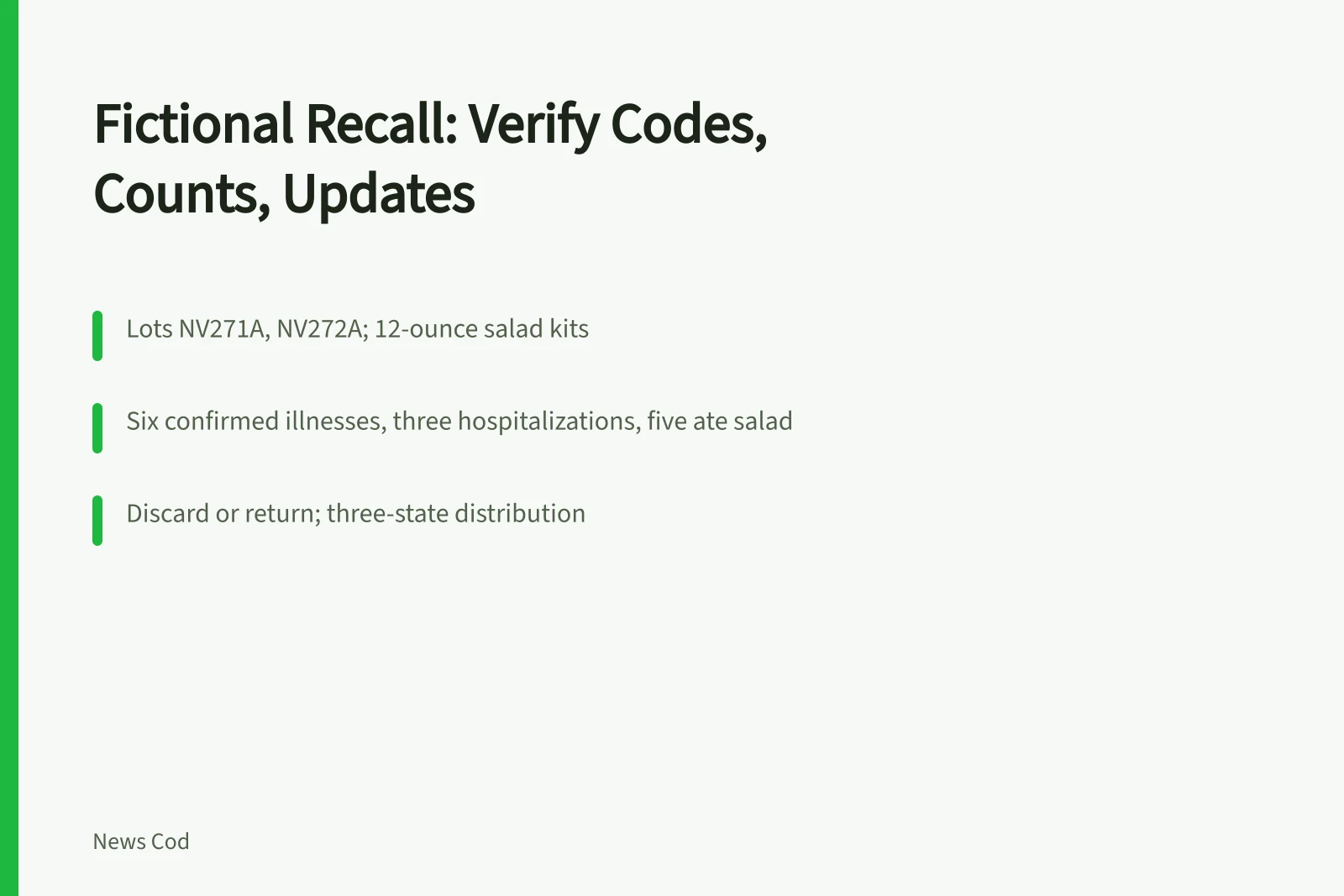
At 9:10 a.m., a fictional state health department posts an investigation notice about six laboratory-confirmed illnesses. At 9:35, fictional producer North Valley Kitchens announces a recall of two 12-ounce salad kits with named lot codes. No real company, product, case, or notice is described here.
9:15 a.m.: open an evidence ledger
The desk copies the state notice, records the page time, and creates four columns: confirmed, reported, inferred, and unknown. Confirmed facts include six cases meeting the notice's definition, three hospitalizations, illness-onset dates, and interviews that found five people ate packaged salad. Unknowns include the ingredient, contamination point, full distribution area, and whether additional illnesses will meet the case definition.
Evidence ledger columns
Confirmed
- Cases
- Six cases
- Hospitalizations
- Three
- Onset dates
- Recorded
- Distribution
- Contamination
Reported
- Cases
- Five ate salad
- Hospitalizations
- Onset dates
- Distribution
- Contamination
Inferred
- Cases
- Salad link
- Hospitalizations
- Onset dates
- Distribution
- Contamination
Unknown
- Cases
- Ingredient
- Hospitalizations
- Onset dates
- Distribution
- Full area
- Contamination
- Point unknown
The reporter does not write "salad caused six illnesses." A common exposure reported by patients supports a hypothesis, not a completed source finding. The evidence-verb discipline follows the health alerts and medical news guide.
CDC describes a multistate foodborne investigation as a seven-step process with several steps possibly underway at once. The CDC investigation sequence distinguishes detecting a possible outbreak, defining and finding cases, and generating and testing hypotheses.
It covers confirming the source, controlling the outbreak, and deciding when it is over. Epidemiologic, traceback, and food or environmental testing are three evidence types used to confirm a source.
9:40 a.m.: reconcile the product notice
The producer's fictional announcement lists:
| Field | Fictional detail |
|---|
Product notice fields
- ProductNorth Valley Garden Crunch salad kit
- Package12 ounces
- LotsNV271A and NV272A
- Use-byFebruary 4 and 5, 2027
- Distributionstores in three named states
- Actiondo not eat; discard or return
The desk checks every character twice. It does not shorten the headline to "North Valley salads recalled"; other products may be unaffected.
It asks the company and regulator whether the action is voluntary, whether a recall class has been assigned, and whether retailers have received notices. Reading the notice fields in order follows how to read a public health notice.
10:05 a.m.: publish the first brief
The opening names the two lots, three-state distribution, and discard-or-return instruction. The second paragraph states that officials are investigating whether the recalled kits are connected to six illnesses. The story says the connection is under investigation and gives illness-onset dates.
First brief checklist
- Name two lots
- State three-state distribution
- Give discard-or-return instruction
- Say connection under investigation
- Include illness-onset dates
- Withhold causation claim
- Avoid saying all six ate product
The desk withholds a claim that the kits caused the illnesses. It also avoids saying all six patients ate the product because the fictional notice says five reported packaged salad and investigators are still collecting brand information. Before the post goes out, the health alert reporting checklist is marked line by line.
12:20 p.m.: add the regulator's record
The fictional regulator posts the company notice but has not yet assigned a recall class. The update says that plainly. Posting a notice is not described as endorsement or independent confirmation of every company statement.
FDA's consumer explanation of product recalls says a recall can involve correction or removal. It explains where consumers find public warnings and classified entries.
When a company announces a recall, market withdrawal, or safety alert, FDA typically posts the announcement as a public service. FDA does not endorse the product or company. That distinction guides the wording of this fictional update.
Day 2: the evidence changes
Investigators report that traceback records point to one processor and that an outbreak strain was found in an unopened kit. The desk can now describe a stronger link, while attributing the finding and naming the exact product tested. It still does not claim that every illness with similar symptoms belongs to the outbreak.
Evidence changes on Day 2
- Day 2Traceback points to one processor
- Day 2Outbreak strain found in unopened kit
- Day 2Case count rises to nine
- Day 2Three older reports meet case definition
The case count rises to nine because three older reports now meet the case definition. The story explains that the increase does not necessarily mean three people became ill that day. Reporting and classification can lag symptom onset.
Day 4: the scope narrows
Testing found one ingredient supplied during a limited production window; officials say other lots are not included. The desk rewrites the headline and action box to keep exact affected codes and adds a dated note on the narrower scope.
It does not say all other salad products are proven safe. A parallel desk drill for a utility advisory is the drinking water advisory case.
What the desk preserved
- Exact product identifiers and public action
- Separate dates for illness onset, notice, recall, and article updates
- A case definition boundary
- Distinct epidemiologic, traceback, and laboratory findings
- Attribution for company and government claims
- A visible list of unresolved questions
Common questions
Is North Valley Kitchens a real company?
No. The company, products, lots, cases, and timeline are fictional teaching details.
Why not call the product the cause in the first report?
The initial facts support an investigation and precaution, but the fictional source confirmation has not occurred yet.
Does a higher case count mean transmission increased that day?
Not necessarily. Older illnesses may be reported, tested, reviewed, and added later.
When can the article say the source is confirmed?
When the responsible investigators state that conclusion and describe supporting evidence. Attribute the finding and retain any limits.