Guides
Breaking news and crisis verification guide
Breaking news and crisis verification guide helps newsrooms triage claims by consequence and keep event, visual, people, numbers and cause tracks apart.
What to take away
- Open one incident ledger before publishing, with an evidence cutoff and a named owner for the next update.
- Triage claims by consequenceprotective instructions first, cause and blame last.
- Map each fact to the agency that owns it, and record whether that agency is speaking firsthand.
- Read alerts as structured productsoffice, product type, event code, area, times, action.
- Keep five verification tracks running in parallel and reconcile conflicting figures by scope, not by preference.
Breaking news is not one claim moving quickly. It is a bundle of claims changing at different speeds. The hazard area may be clear while the cause stays unknown.
Officials often know how many people reached a hospital before they know how many were hurt. A photo can be genuine and still unrelated.
Keep those questions apart and each one gets easier to answer.
Open an incident ledger
Create one shared record before the first publish. Every desk writes into the same rows.
Incident Ledger Fields
- Incident nameneutral working label
- Locationaddress, jurisdiction, coordinates
- Start timereported or confirmed
- Lead authorityagency responsible
- Protective actionexact wording
- Evidence cutoffdate, time, zone
- Next updateowner and check time
Field / Entry
- Incident name
- Neutral working label
- Location
- Address, jurisdiction, coordinates if safe
- Start time
- Reported or confirmed, with time zone
- Lead authority
- Agency responsible for this phase
- Protective action
- Exact wording and affected area
- Evidence cutoff
- Date, time, time zone
- Open questions
- Cause, toll, extent, identity, duration
- Next update
- Owner and expected check time
Every claim row carries source, time, status, confidence and publisher. Never overwrite an old figure. Close it with a superseding row so the reporting history stays visible to anyone reading back.
The evidence cutoff is the field people skip. It is the moment your reporting stops and the page starts. Without it, a reader cannot tell whether a number is two minutes or two hours old.
Triage by consequence
Handle claims in this order:
Triage Claims by Consequence
- Instructions affecting immediate safety
- Location and boundaries of hazard
- Status of named people and facilities
- Verified scale and effects
- Cause, responsibility and forecast
- Color, reaction and broader meaning
- Instructions that affect immediate safety.
- Location and boundaries of the hazard.
- Status of named people and facilities.
- Verified scale and effects.
- Cause, responsibility and forecast.
- Color, reaction and broader meaning.
Protective information can go out from a single authorized source when delay causes more harm than caution. Label it as an official instruction, quote it exactly, and print the issue time. Cause, blame, identity and casualty totals earn their place later, after more checking.
Identify the authority for each fact
No single official source owns every question. Police control a crime scene. Fire officials describe suppression. Emergency management issues evacuation instructions. A hospital speaks about its own patients. A utility reports its own outages. A medical examiner or coroner confirms deaths.
Record whether a source is speaking firsthand, coordinating other agencies, or repeating what it heard. A mayor's post is authoritative for what the mayor ordered and indirect for patient counts at private hospitals.
Ask who would have to be wrong for the statement to be false. That answer usually names the authority you still need to call.
Read alerts as structured products
Capture the issuing office and jurisdiction. Capture the product type. Capture the hazard and severity. Capture the affected polygon or named area. Capture the effective, onset and expiration times. Capture the recommended action. Capture any update or cancellation identifier. Capture your retrieval time.
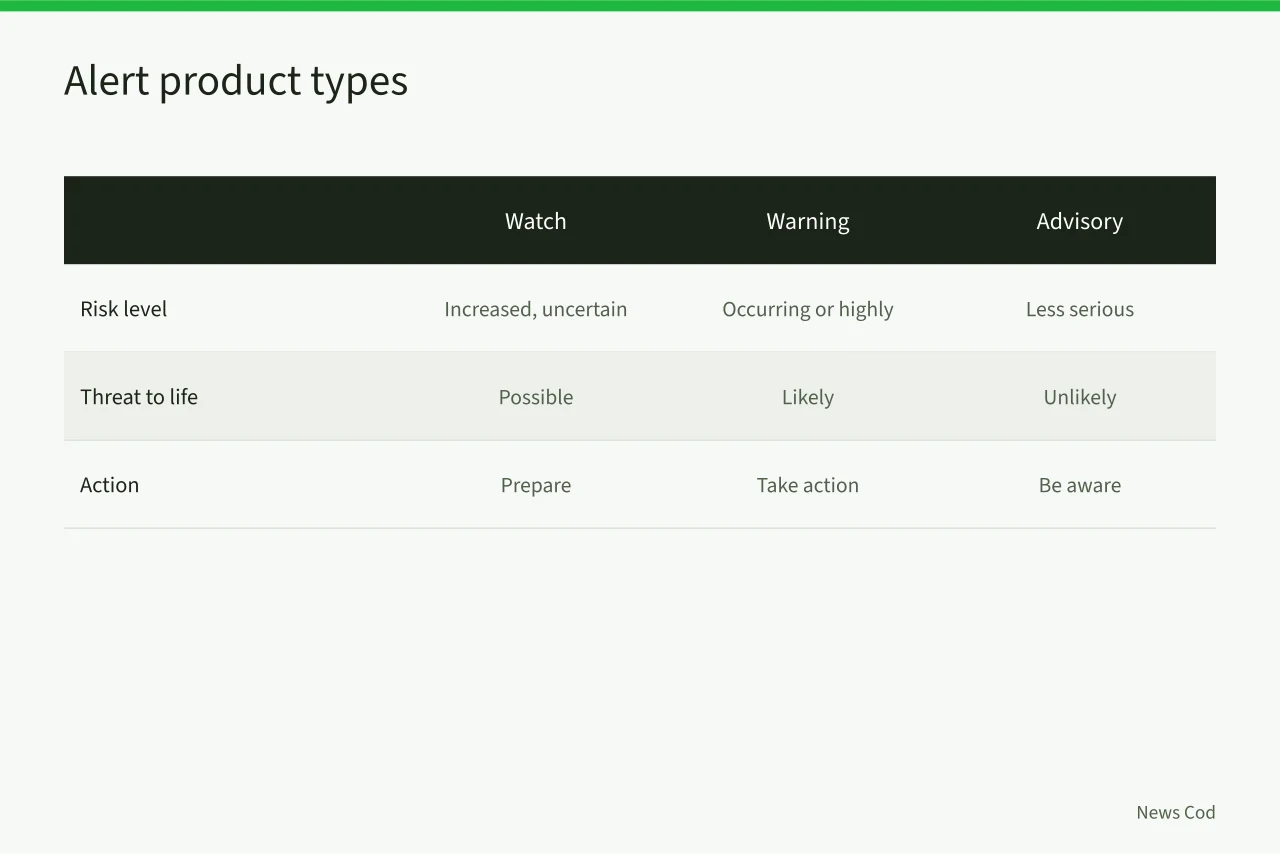
Distinguish a watch, a warning, an advisory, an evacuation order and a voluntary evacuation from a declared emergency. A boil-water notice and a shelter notice are different products with different actions.
The National Weather Service's watch, warning and advisory definitions separate a watch, which flags significantly increased but uncertain risk, from a warning, which flags an occurring or highly probable threat to life or property.
Hazard names are a controlled vocabulary. The event codes broadcast over NOAA Weather Radio give each product a three-letter identifier: a flash flood watch is FFA, its warning is FFW. An older receiver may display a newer code as unknown while still playing the audio. Reading the code settles the product type faster than any paraphrase.
Always use the issuing office's current product. Local thresholds and hazard terminology vary by office.
Build parallel verification tracks
Event track
Confirm that something happened, where, and when. Use dispatch information, official incident records, on-scene reporting, sensor data and independent witnesses. Separate a report of an event from official confirmation of it.
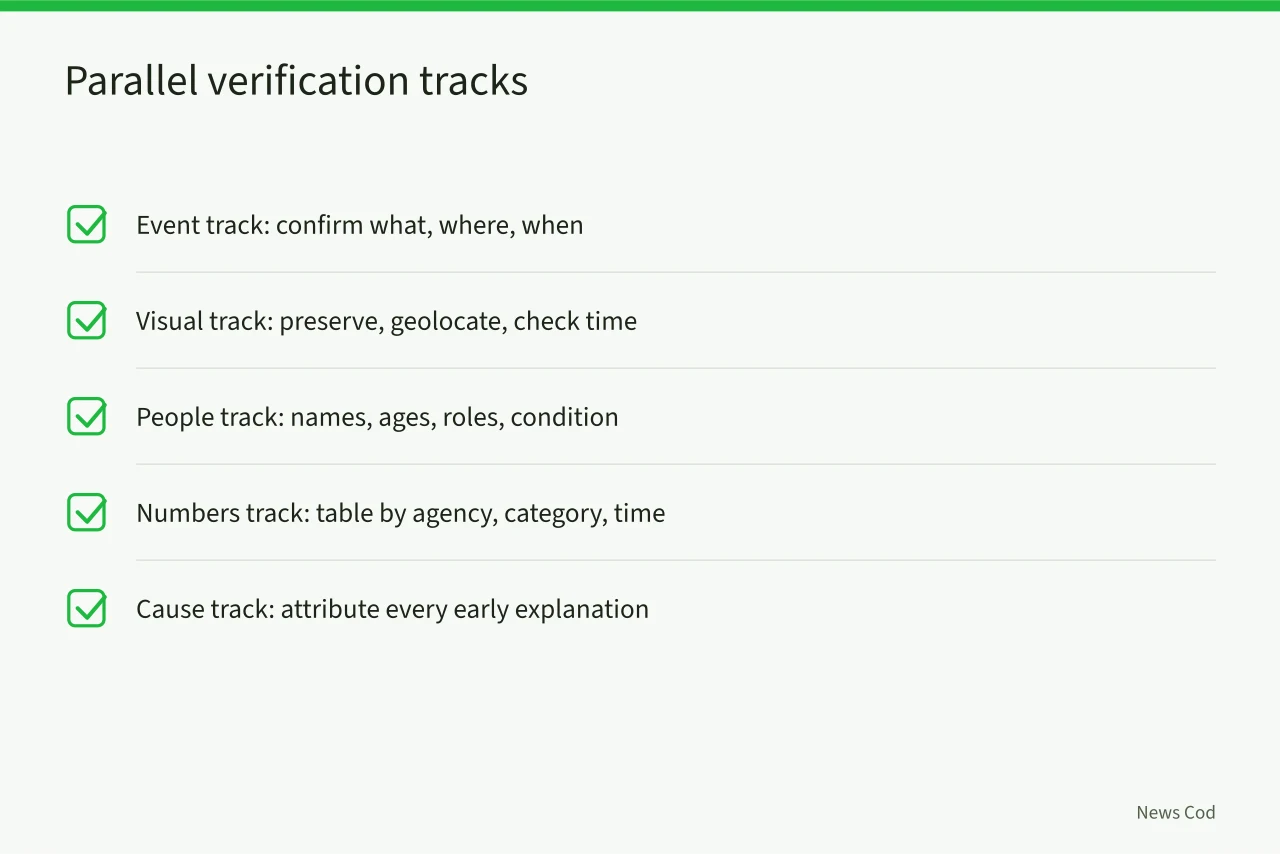
Visual track
Preserve user media. Trace the earliest upload. Geolocate the scene. Check daylight and weather against the claimed time. Contact the creator. Compare against other views of the same place. Never ask a witness in danger to gather more footage.
People track
Verify names, ages, roles, condition and family notification as separate facts. A passenger list, school roster or workplace directory shows possible involvement. It does not show injury or death.
Numbers track
Build a table by agency, category, geography, definition and time. Do not add figures from overlapping jurisdictions. Keep these categories in separate columns:
- confirmed dead
- reported missing
- rescued
- transported
- admitted
- treated
- released
A person can appear in several columns at once. That is not double counting until someone adds the columns together.
Cause track
Attribute every early explanation. An investigator saying "we are examining electrical equipment" is not a finding that electrical failure caused the event. Keep suspected origin, mechanism, responsibility and legal fault in four separate fields.
Reconcile instead of choosing quietly
When sources conflict, compare their scopes before their numbers. A city count may exclude an unincorporated area. A hospital total may include transfers another facility also counted. A sensor network may revise a measurement as more data arrive.
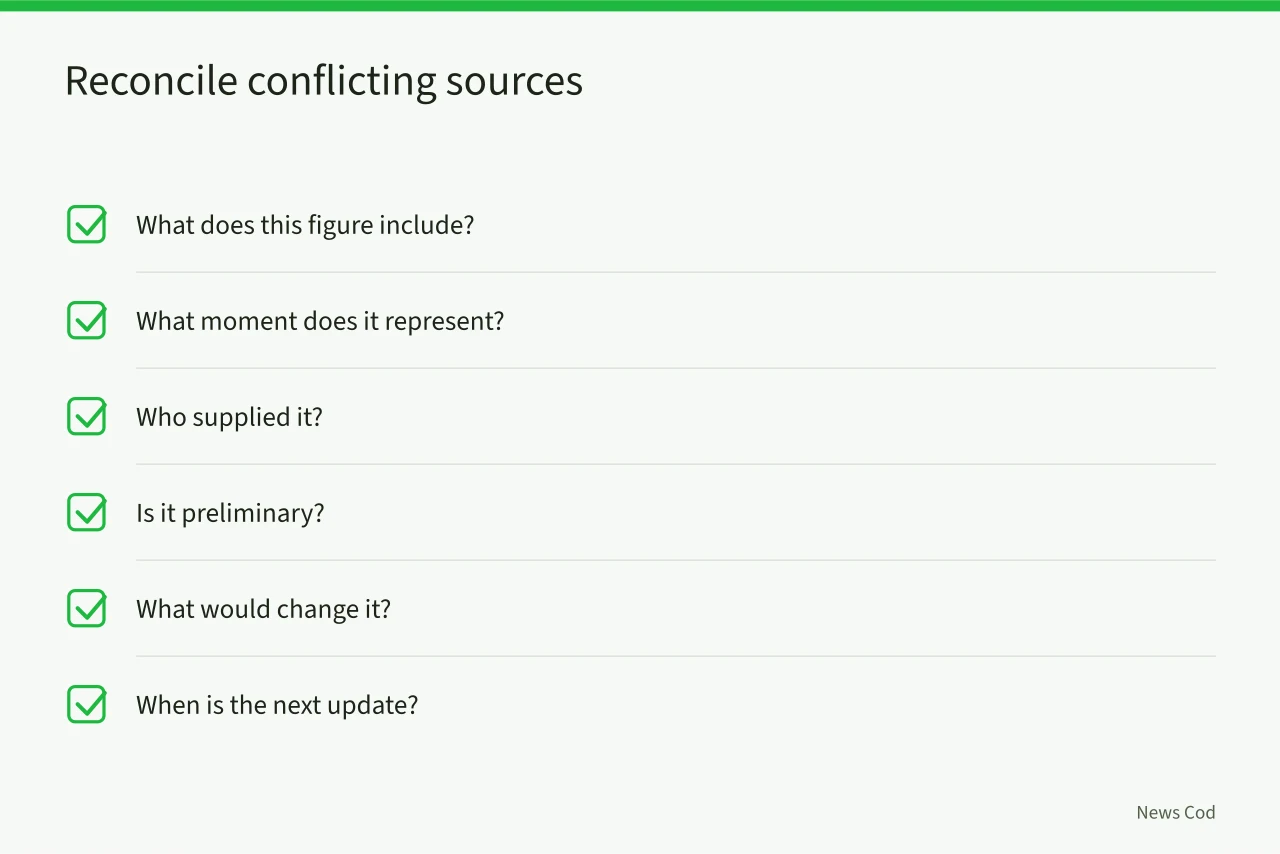
Ask each source the same questions:
- What does this figure include?
- What moment does it represent?
- Who supplied it?
- Is it preliminary?
- What would change it?
- When is the next scheduled update?
Publish the reason for a difference when you know it. When you do not, say the figures cannot yet be reconciled. That sentence is more useful than a false average.
Use an update template
Start each live update with the newest confirmed change, then carry the context a reader needs to follow it:
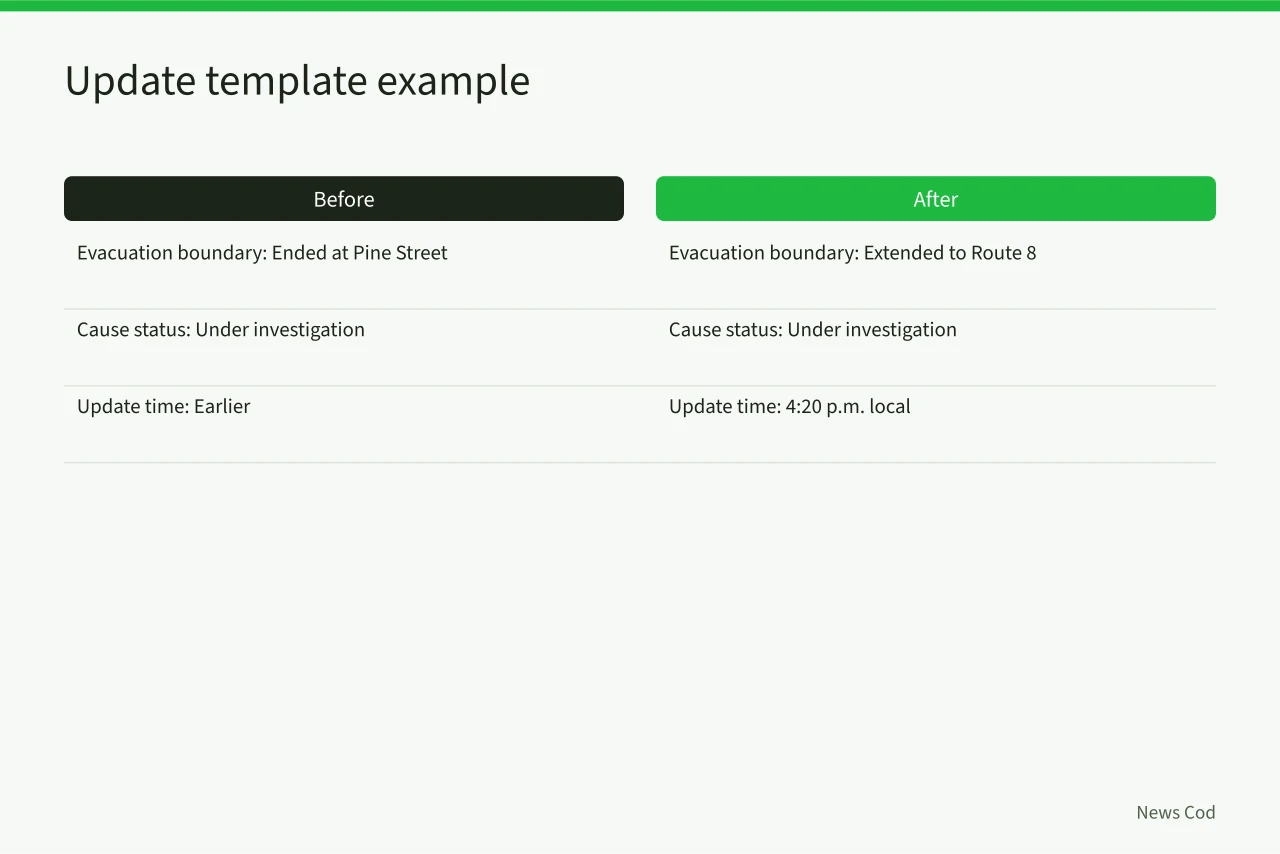
Updated 4:20 p.m. local time: The county expanded the evacuation area to include River Road between Pine Street and Route 8. The earlier boundary ended at Pine Street. The cause remains under investigation.
Avoid silent rewrites. A reader who saw an earlier push alert needs to know what changed, not just meet a new number with no explanation.
Know when to hold
Hold a claim when publishing it could misidentify a victim, expose a safe location, interfere with an active response, prompt an unsafe action, or turn an allegation into blame. Record the reason and the time you will revisit it. "Not published yet" is a decision with a review date, not a failure.
Common questions
Can one official source be enough during an emergency?
Yes, for that authority's own immediate protective instruction when delay creates risk. Attribute it, print the issue time, and keep verifying the scope and any update. One source is enough for the instruction, not for the toll.
Why do official numbers change?
Agencies receive new reports, remove duplicates, refine measurements, change definitions and reconcile overlapping jurisdictions. Report the time and scope attached to every figure. A number without a timestamp is not a number yet.
Should live blogs delete old information?
Correct dangerous errors prominently, but keep a visible change history. Superseded instructions should never look current. Readers who acted on the earlier version need to see exactly what replaced it.
When may cause be reported?
Report what investigators say they are examining, with attribution to the agency. Treat cause as established only when the responsible process reaches that finding. Until then, origin, mechanism and fault stay separate questions.