Maintenance
How to Verify a Police Scanner Claim in a US City: Records and Feeds
How to corroborate police scanner traffic in a US city using dispatch logs, jail rosters, court dockets and official statements before reporting.
What to take away
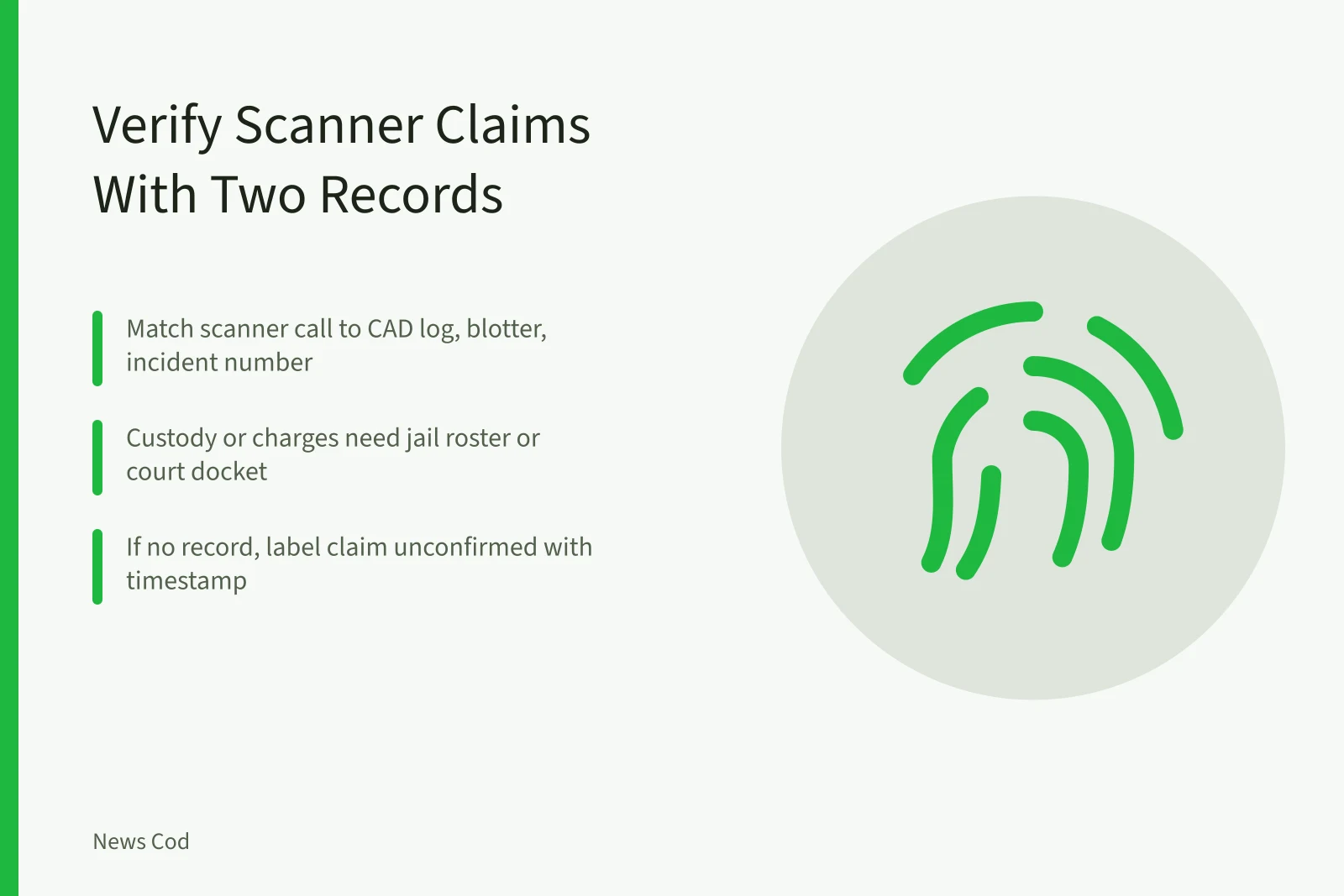
- A police scanner call is a lead, not a fact. Before you publish, match it to at least two independent records.
- The fastest checks are the dispatch log, the daily blotter, and the department's own statement.
- Custody and charging claims need a court docket or a jail roster. Radio traffic alone will not carry them.
- If no record exists yet, publish the claim with a timestamp and say plainly that it is unconfirmed.
- Keep the audio file, the log entry, and the case number together so the chain can be replayed.
What Scanner Audio Actually Proves
Scanner audio proves that somebody said something on a radio channel. It does not prove the thing happened.
Dispatchers work from callers, alarms, and incomplete descriptions. Units are sent to addresses that turn out to be wrong, and calls are recoded before officers arrive.
Most US states allow anyone to listen to scanner traffic. A handful restrict scanners in vehicles or around certain frequencies, so check your state law before relying on a recording.
Departments also change what they broadcast. Many have moved to encrypted channels or to digital systems that a consumer scanner cannot decode. That alone limits what a feed can confirm.
Dispatch Logs and Computer Aided Dispatch Records
The first record to request is the dispatch log, often called a CAD log or a call for service report.
It carries a time stamp, an incident number, a location, a call type, and the units assigned. That structure is what makes it checkable.
Many cities post a daily activity log or media bulletin online. Others require a written request under the state public records law. Active investigations are a common exemption, and it is a broad one.
Departments differ by city, and the three record sets worth pulling for a Chicago call are set out in check a Chicago scanner claim against city records.
Matching Radio Traffic to a Blotter Entry
Use this sequence for any overnight call you heard on a feed.
- Write down the time, channel, unit number, and the words as spoken.
- Pull the department's blotter or daily log for the same window.
- Compare the location and the offense code, not just the street name.
- Request the incident report or CAD entry by case number.
- Ask the public information officer whether the call produced an arrest, a citation, or nothing at all.
The fifth step is the one reporters skip. A call can close with no report at all.
Example: The Shots Fired Call That Was Not a Shooting
A feed carries a shots fired call at an address. The daily log shows a check on the well being of a person at the same address twelve minutes later, with no offense code.
That pattern usually means a noise complaint or a medical call, not gunfire. A detective later confirms nobody was hit.
Wait for the report before you write the word shooting. The correction case in complaint reported as a ruling shows how badly a newsroom can mangle a document when it skips this step.
Court, Custody and Charging Records
An arrest claim needs a booking record. A charging claim needs a docket.
County jails publish rosters, and state court clerks publish dockets. Both are usually searchable by name and date.
Federal charges sit in a different system. The PACER FAQ explains how to pull and verify a federal docket. The structure of the federal courts determines whether a case belongs there at all.
Which Record Settles Which Claim
| Claim heard on air | Record that settles it | Where to ask |
|---|---|---|
| Arrest made | Booking log or jail roster | County sheriff |
| Charges filed | Court docket | Clerk of the court |
| Federal filing | PACER docket | Federal court portal |
| Recall issued | Agency recall database | CPSC, FDA, NHTSA |
Recall and Product Warnings on the Air
Scanner traffic is not the only feed that carries unverified claims. Product warnings spread the same way, usually through a screenshot of a press release.
Before repeating a recall warning, verify a recall claim against the agency database, not the press release. The CPSC runs a searchable recall database that lists the company, the product, and the remedy.
Video, Celebrity and Viral Clips
When a scanner call feeds a viral clip, the clip needs its own verification. You need the original upload, the upload time, and the outlet that first aired it.
When a scanner call turns into a celebrity story, the same discipline applies, as shown in verifying Los Angeles celebrity claims. The name on the radio is often not the name in the story.
When the Answer Is That Nobody Knows Yet
If no log has been posted and no official will confirm, the honest line is that the claim is unverified as of the time of publication.
That sentence is publishable. It is also the one readers remember when the record finally appears.
Add the time you checked, name the agency you asked, and set a reminder to update. A claim that is unconfirmed at 6 a.m. may be confirmed by noon.