Guides
How to Verify a Product Recall Claim Before You Report It
Verify product recall claim before you report it by checking CPSC, FDA and NHTSA records, not the press release. Questions and red flags for editors.
What to take away
- A recall is official only when the agency record exists. Search the CPSC recall database or the manufacturer's listing on the relevant agency page before you write a word.
- A corporate press release is a claim, not a record. Ask the company for the agency identification number and the date the agency posted it.
- Recalls get expanded, downgraded, or closed. An old notice reposted without a date is the most common hoax shape.
- The three federal paths are CPSC for consumer goods, FDA for food, drugs and devices, and NHTSA for vehicles and car seats.
- If the company cannot name the agency, the product, and the remedy, you do not have a story yet.
Scopes that are actually different jobs
Consumer product recalls, food and drug recalls, and vehicle recalls run on separate tracks with separate databases and separate press offices. A single "recall alert" email that covers all three is usually a marketing list, not a regulator.
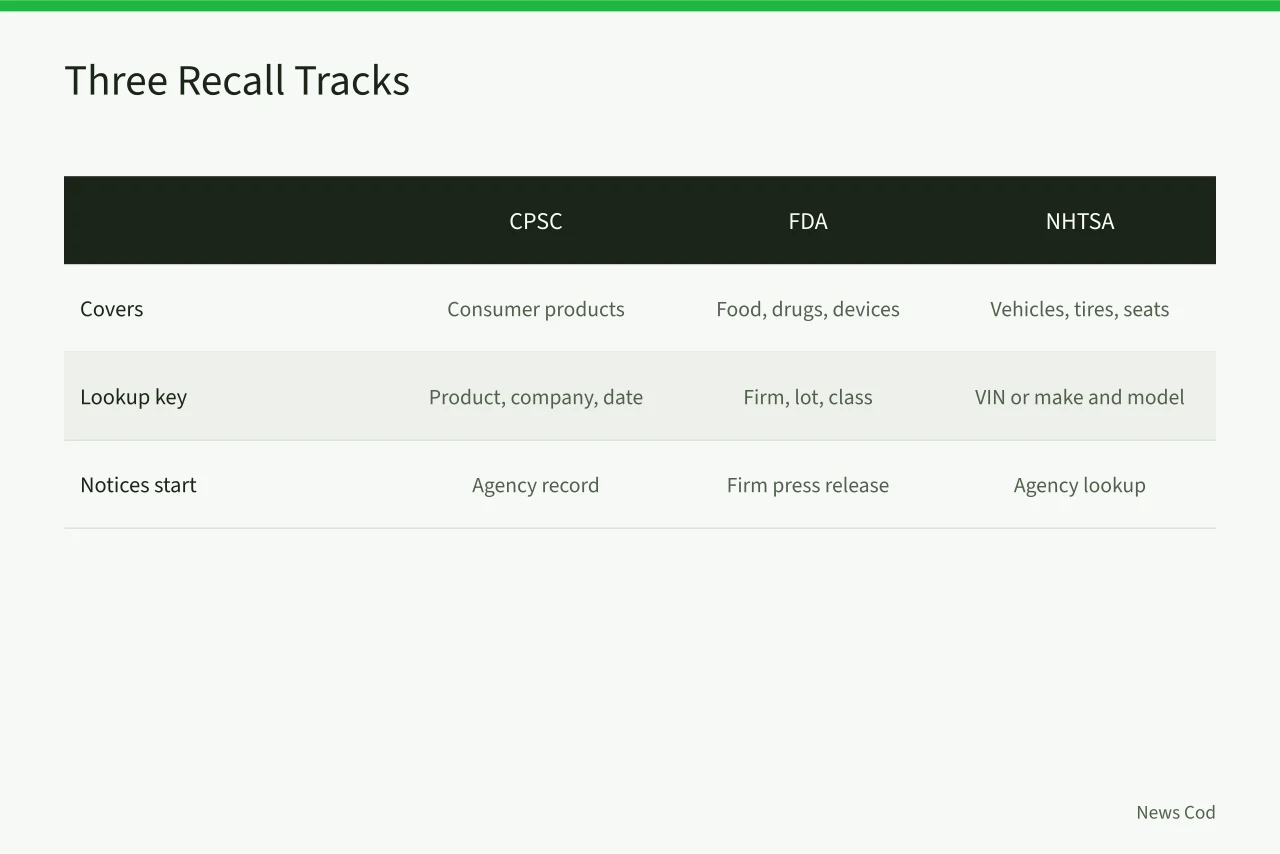
CPSC handles thousands of consumer product actions a year, from cribs to space heaters. FDA handles food, drugs, biologics and medical devices, and its notices often run through a firm's own press release first. NHTSA handles vehicles, tires and child seats, and its lookup is keyed to a VIN. Mixing them is the fastest way to publish a claim that cannot be sourced.
Questions to ask before you publish
Write these down and put them to the company, the agency press office, or both.
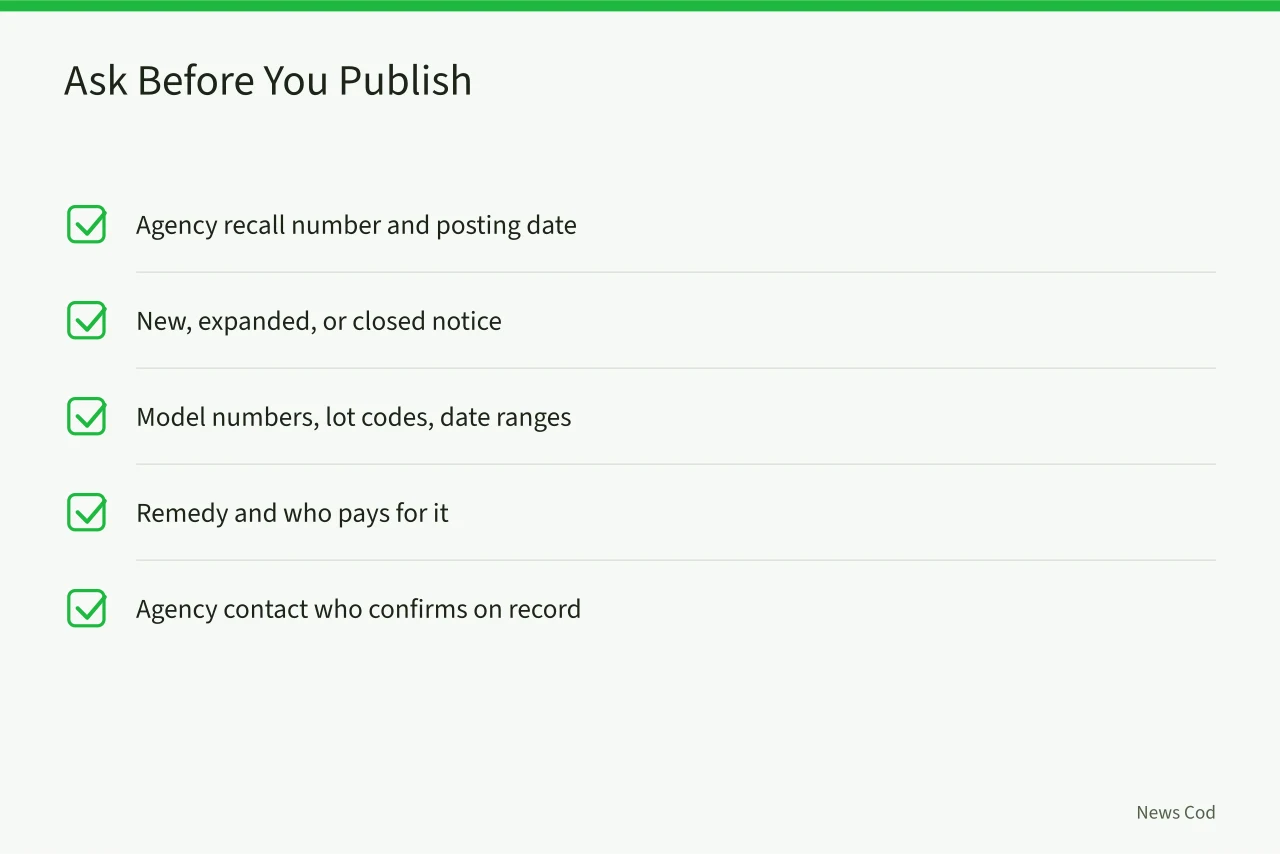
- "What is the agency recall number, and on what date did the agency post it?"
- "Is this a new recall, an expansion of an earlier one, or a reissue of a notice that is already closed?"
- "Which model numbers, lot codes, or date ranges are covered, and which are not?"
- "What is the remedy, and who pays for it?"
- "Who at the agency can confirm this on the record?"
If the answer to the first question is a link to the company's own newsroom, you are reading marketing. That is useful for a quote, not for a fact.
Evidence to request
The agency record is the primary document. Ask for the recall number, the posting date, the hazard description, and the remedy as the agency states them. Then match the company's language against it line by line.
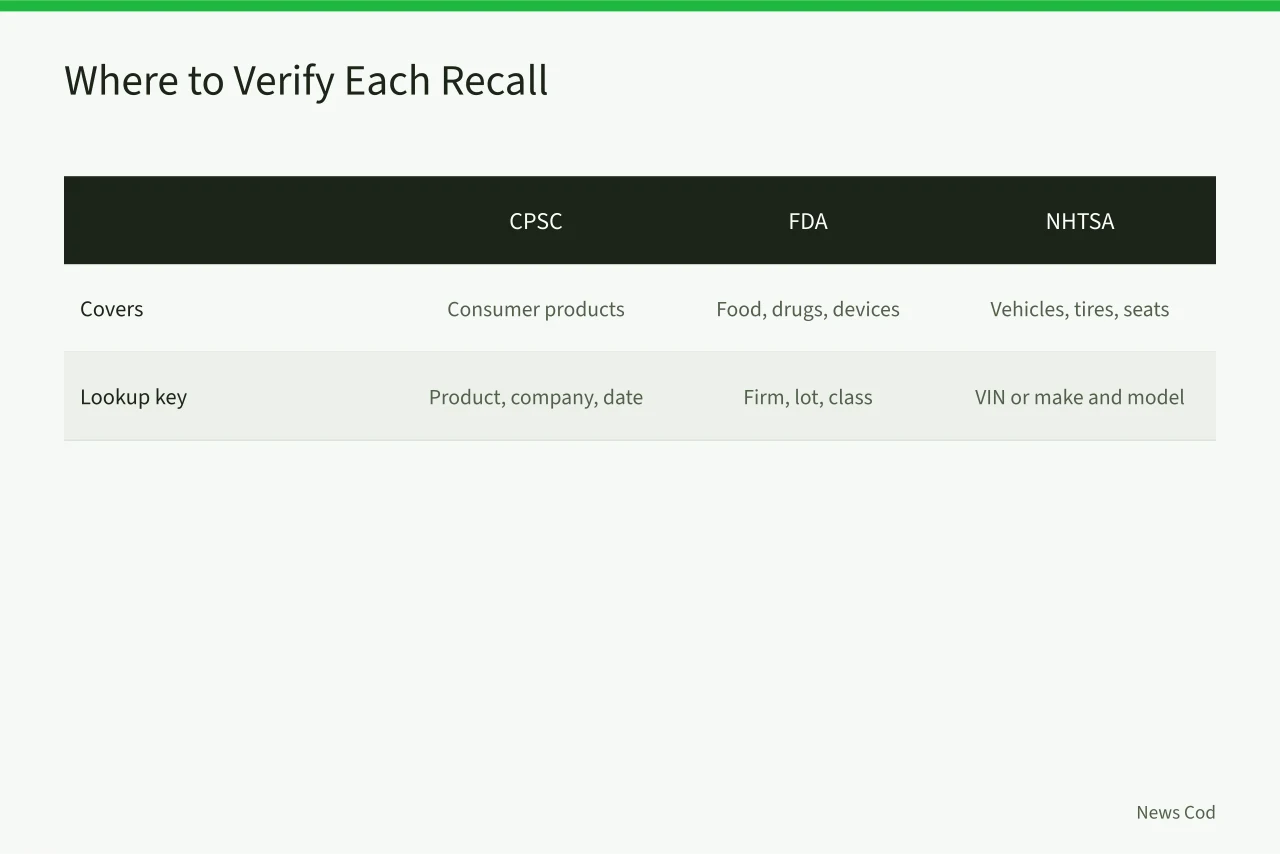
For vehicles, run the VIN through the official NHTSA recall lookup and keep a screenshot of the result. For consumer goods, the CPSC entry usually lists the units affected and the distribution window. For food and drugs, the FDA notice will name the firm and the lot. Where a notice cites a fire safety standard, the NFPA codes and standards list can tell you which edition applies.
| Agency | Covers | Lookup key |
|---|---|---|
| CPSC | Consumer products | Product, company, date |
| FDA | Food, drugs, devices | Firm, lot, class |
| NHTSA | Vehicles, tires, seats | VIN or make and model |
| State commerce offices | Some intrastate goods | State filing number |
Answers that should end the conversation
Some replies tell you to stop. Treat each of these as a disqualifying answer, not a delay.
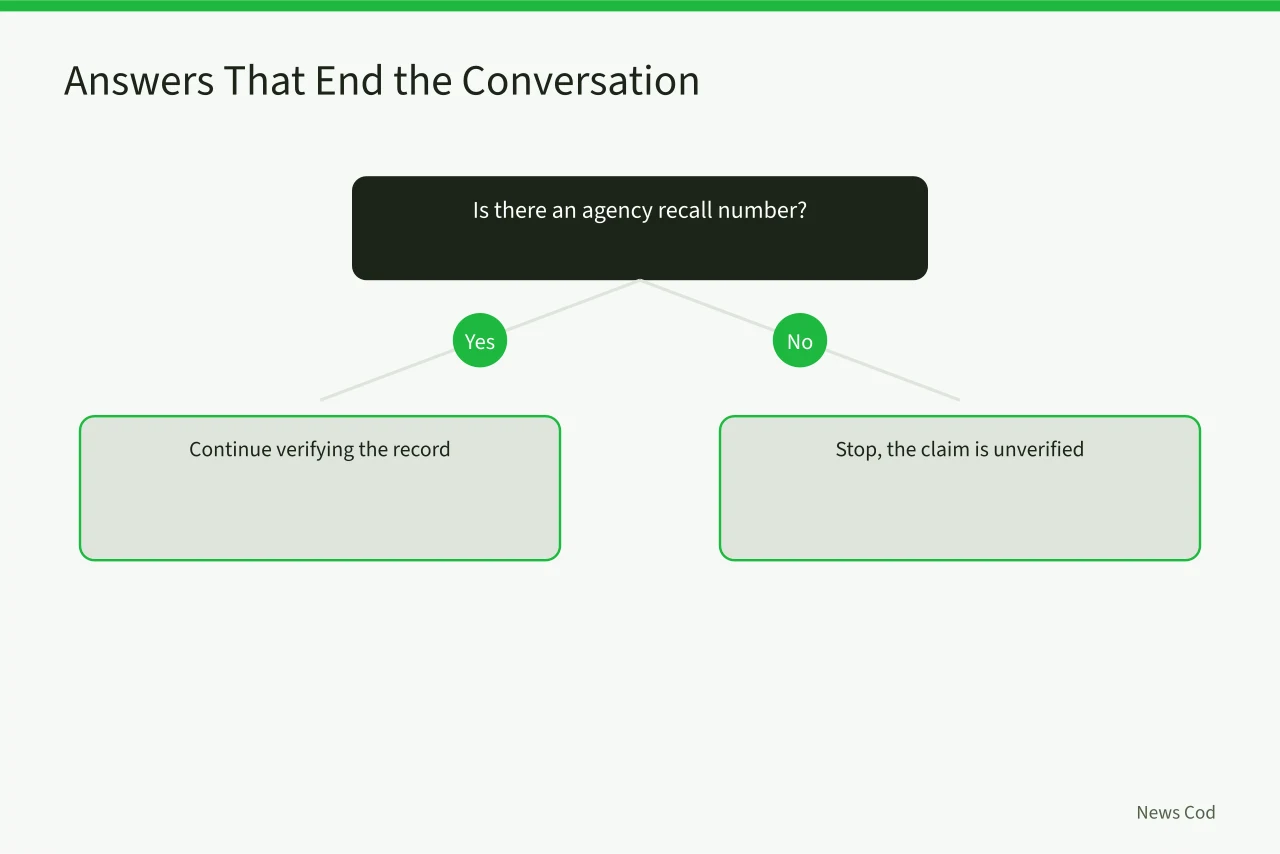
- "We are working with the agency and will have a number soon." No number, no record.
- "The recall is voluntary, so there is nothing public." Voluntary recalls are still posted.
- "Our legal team prefers we not name the agency." A named agency is the whole point.
A fourth answer to watch for is a date that keeps moving. If the posting date changes each time you ask, the notice may be a draft or a rumor. A fifth is a remedy with no mechanism: "customers will be made whole" is not a refund, a repair, or a replacement.
A press release can be accurate and still be unusable. If the agency record does not exist, the claim is unverified, and saying so is the honest report.
What the agreement must say
When you commission or accept a freelance piece built on a recall claim, the contract or the assignment note should state four things. It should name the agency record the writer relied on, with the recall number. It should require the posting date as printed by the agency. It should require the writer to say whether the notice is new, expanded, or closed. And it should give the desk the right to hold the piece until the record appears.
That last clause matters more than it sounds. Recalls are sometimes announced by a firm hours or days before the agency posts them. Holding the piece costs a news cycle. Publishing early costs a correction, and in the case of a deceptive notice, it can cost more than that.
Example: the outdated notice
A retailer emails a "recall alert" about a space heater, with a photo and a model number. The CPSC entry exists, but it was posted two years ago and the remedy window has closed. The retailer is using the old notice to move clearance stock.
The verification path is short. Search the model number on the CPSC site. Read the posting date. Read the remedy. Then ask the retailer, in writing, whether the notice is current. If the answer is vague, the story is about the retailer, not the heater.
For the broader habit of checking a primary record before you repeat a claim, the government records and public documents verification guide walks through the same sequence for non-product records. When the claim touches health data, the CDC and FDA dataset comparison explains why agency datasets and press releases often disagree.
Common questions
Can I report a recall from a company press release alone? No. Use the release for a quote and the agency record for the facts. If the record does not exist yet, say the agency has not posted it.
What if the company says the recall is confidential? Recall postings are public by design. A confidentiality claim is a reason to check the agency directly, not to soften the story.
How do I handle a recall that has been expanded? Report the current scope and note the earlier posting date. Readers who saw the first notice need to know what changed.
Does a state commerce department matter here? Sometimes. States can require their own filings for goods sold only within the state, and those filings are public records you can request.