Guides
EPA Water Quality Reports: A Verification Checklist for Local Claims
Verify an EPA water quality report before repeating a local claim. Use ECHO, state portals, and Clean Water Act standards to confirm what the data shows.
What to take away
- EPA water quality reports are Consumer Confidence Reports (CCRs) delivered by community water systems each year.
- A verified local claim needs a named contaminant, a numeric result, and a comparison to an EPA or state standard.
- ECHO adds enforcement history; state environmental agency portals add local action letters and monitoring waivers.
- If the report is missing or the claim has no source, the honest answer is that nobody has confirmed it yet.
A water quality report is not a press release. It is a compliance document with a defined set of fields, dates, and footnotes. Before you repeat a local claim about lead, nitrates, or bacteria, open the primary records.
Who has jurisdiction
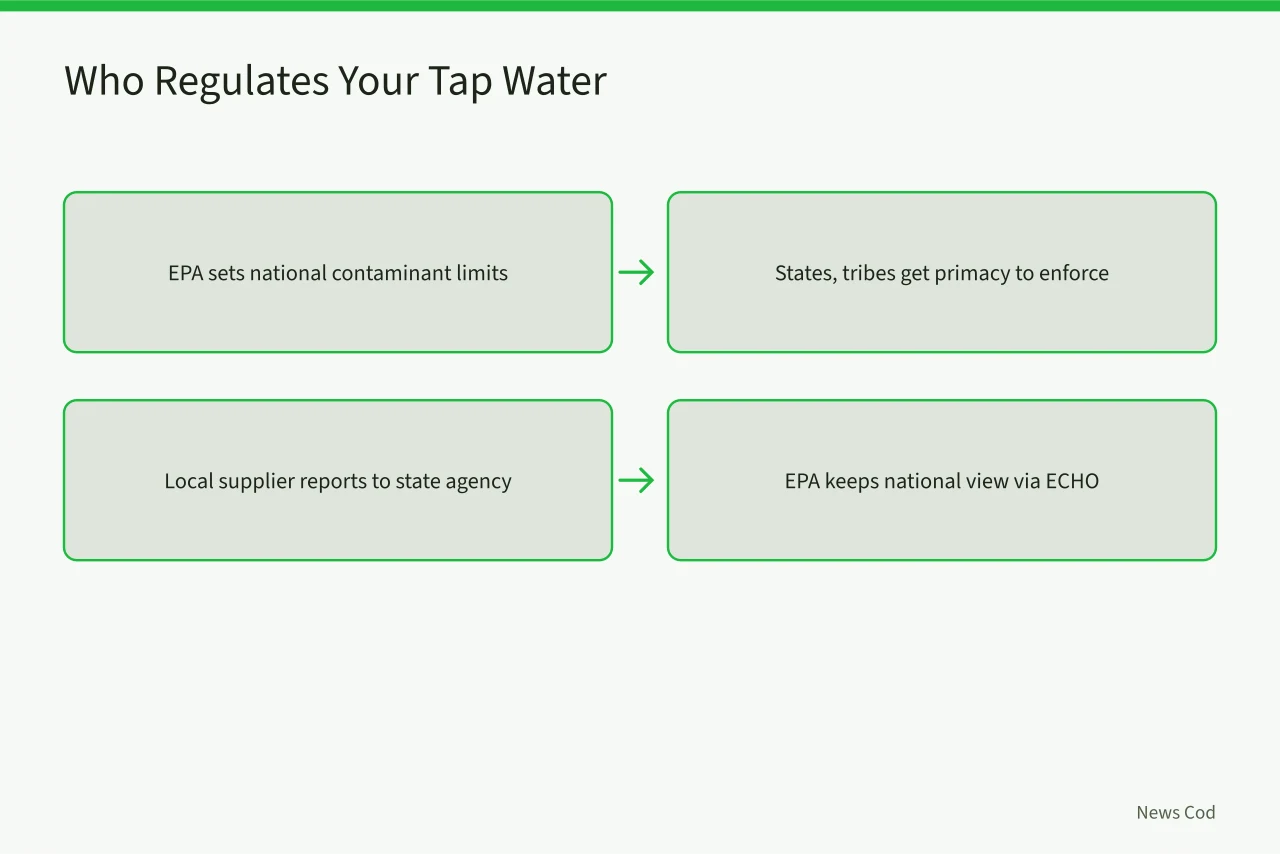
The Safe Drinking Water Act gives the U.S. Environmental Protection Agency authority to set national contaminant levels. The Clean Water Act regulates discharges into surface water. The Safe Drinking Water Act covers what comes out of your tap. States, territories, and tribes can receive primacy to enforce those standards within their borders. A local water supplier reports to the state primacy agency, not directly to EPA. EPA keeps a national view through the Enforcement and Compliance History Online database, known as ECHO. The status of a state order matters: consent orders, unilateral orders, and notices of violation all read differently, as explained in public document types and statuses. The EPA drinking water regulations list current contaminant limits under the Safe Drinking Water Act. If a claim cites a standard, find that standard in the federal table first.
What must be disclosed
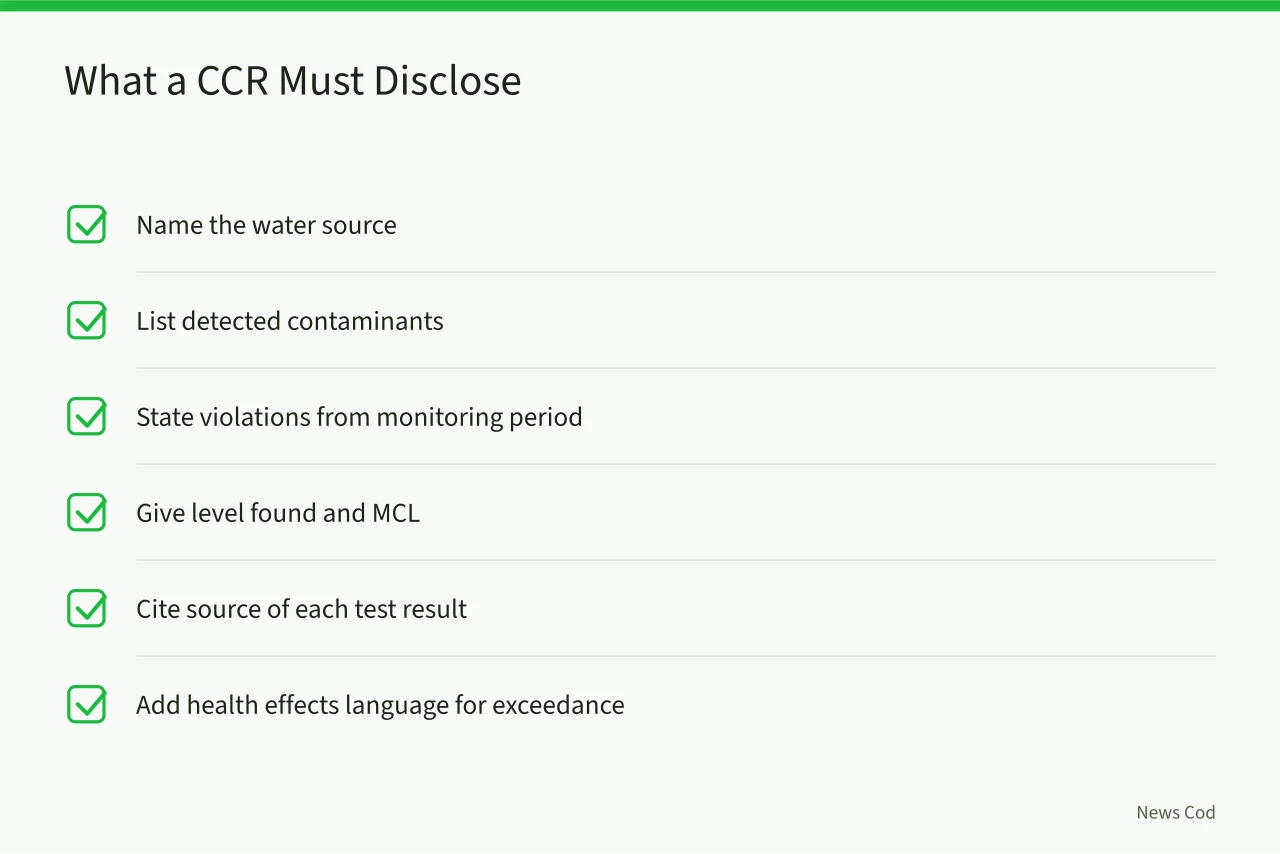
A Consumer Confidence Report must name the water source, list detected contaminants, and state any violations from the monitoring period. The CCR information page explains what belongs in these reports. A compliant disclosure includes the level found, the maximum contaminant level, and the source of each test result. It also must include health effects language for any exceedance. A one-sentence social post that says water is safe or water is toxic is not a disclosure. Ask for the exact report date and page number.
Records to keep
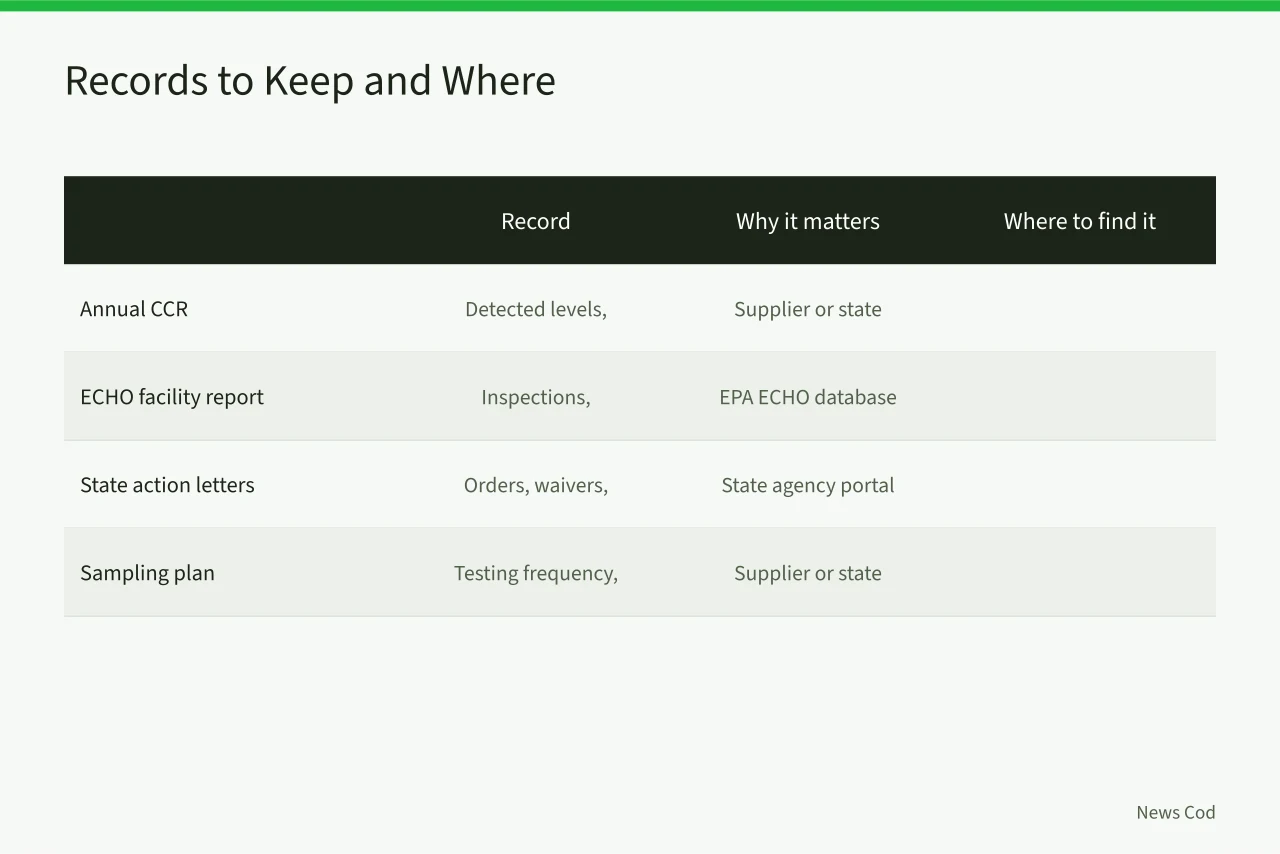
| Record | Why it matters | Where to find it |
|---|---|---|
| Annual CCR | Shows detected levels and violations | Your water supplier or state primacy agency |
| ECHO facility report | Lists inspections and enforcement actions | EPA ECHO database |
| State action letters | Shows local orders, waivers, or variances | State environmental agency portal |
| Sampling plan | Confirms testing frequency and locations | Water supplier or state files |
Keep the full PDF, not just a screenshot. If a claim hinges on one line, ask for the page number. If the record is missing, find and request public records before you repeat the claim.
Verification checklist for a local claim
- Ask the person making the claim for the exact contaminant and the reported number.
- Find the current CCR for the water system named in the claim.
- Open ECHO and search the system by name or permit ID.
- Check the state environmental agency portal for any enforcement order filed after the CCR date.
- Compare the reported number to the EPA standard in the drinking water regulations.
- The claim names a specific water system, not a whole town.
- The numeric level appears in the CCR or ECHO, not just in a social post.
- The date of the report matches the claim's timeline.
- Any violation is confirmed in ECHO or a state order.
What happens if you do not verify
A false claim about lead in water can trigger panic, school closures, and expensive retesting. There is no federal fine for a resident who shares bad water data. A newsroom or official who amplifies a false report may need to issue a correction. If the false report names a private utility, a defamation claim can follow under US defamation law. EPA water enforcement data show how often systems face formal action beyond a CCR.
Where the rules differ by place
EPA standards set a floor. States can be stricter. California sets public health goals lower than federal limits for some contaminants. Texas and New York run different state portal designs and response timelines. The rules for disclosing violations also vary by primacy agreement. A local claim about a water system in one state may not transfer to another. For comparing request rules across states, see state public records compared.
Example: A neighborhood lead claim
A post says the water on Maple Street has twice the legal lead level. Start with the CCR. Look for lead in the detected contaminants table. The federal action level for lead is 15 parts per billion in more than 10 percent of sampled taps. If the CCR shows a 90th percentile of 12, the claim is false. If ECHO shows a lead action level exceedance, the claim becomes official. If no CCR exists for a private well, the honest answer is that a private well falls outside the Safe Drinking Water Act. That gap matters.
Common questions
What is the difference between a CCR and an ECHO report? A CCR is the annual water quality report sent by the supplier. ECHO is the EPA database of inspections, violations, and enforcement actions across facilities.
Can a local government override an EPA drinking water standard? A state can set a stricter standard, but not a weaker one. A city cannot lower a federal maximum contaminant level.
Do private wells get CCRs? No. Private wells are not regulated under the Safe Drinking Water Act. The owner must test the water and compare results to EPA guidance.
What if the claim quotes a number but no CCR exists? Treat the claim as unverified. Ask for the source record, then follow the checklist before sharing.