Guides
Is That Screenshot of a PACER Court Filing Real? A Verification Guide
Verify PACER court filing screenshots by matching the case number to the live docket, checking the filing date and judge, and confirming with the court.
What to take away
- A screenshot proves nothing on its own. The case number, filing date, and judge must match a live entry in PACER or a state docket.
- A real docket entry can still carry a forged PDF. Authentication means pulling the document from the court, not from the post.
- Federal and state systems differ. A filing that looks federal may sit in a county court, and the reverse happens too.
- The failure that stays hidden for months is a mislabeled exhibit: the docket entry is genuine, the attachment is not the one filed.
- When the docket is sealed, the honest answer is that nobody outside the case can confirm it yet.
The failure that stays hidden for months
A viral post shows a screenshot of a federal complaint. The case number is real. The docket entry exists. The caption names the right parties. Everything checks out for weeks, so nobody looks further.
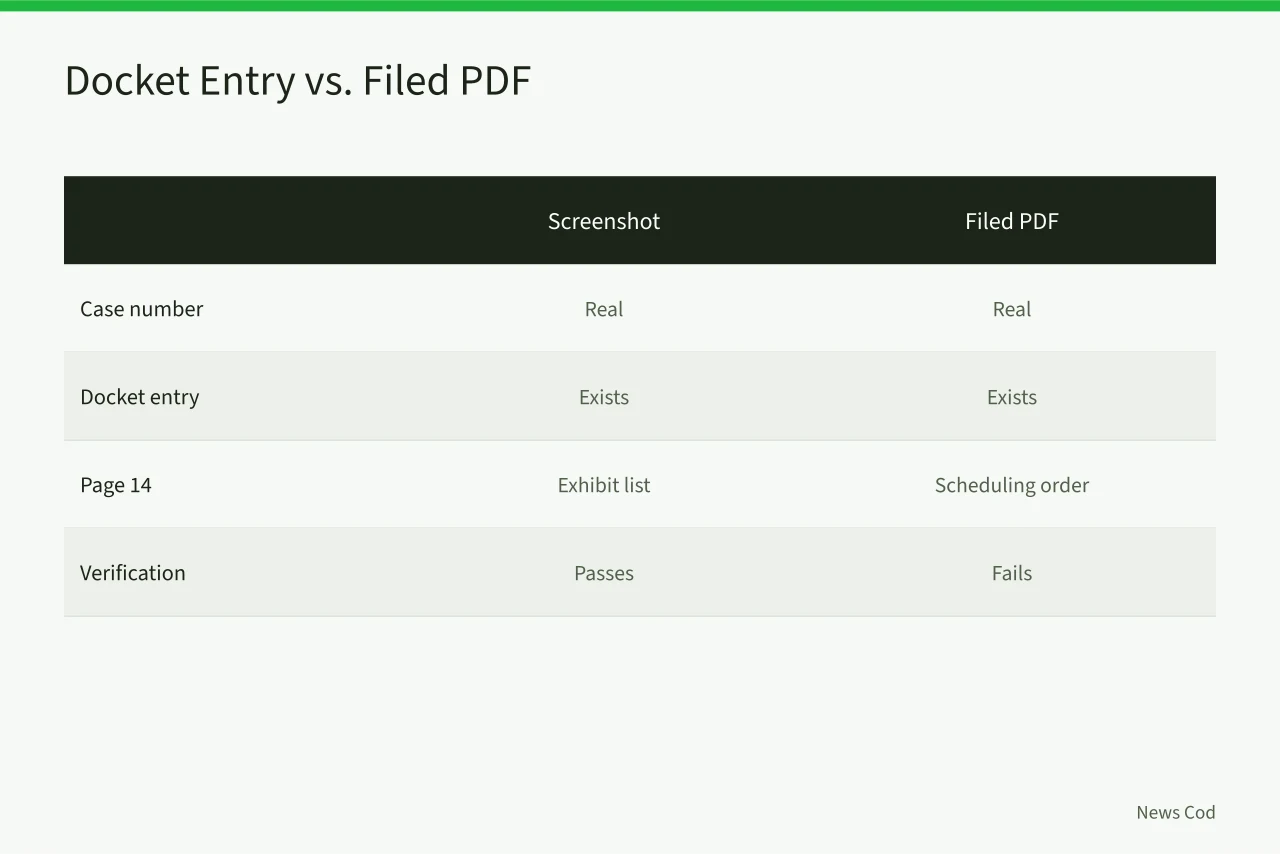
Then a reporter pulls the actual PDF from PACER and finds the exhibit list does not match. The screenshot showed page 14 of a 40 page attachment. The filed version of page 14 is a scheduling order. Someone lifted a genuine docket header, pasted it onto a different document, and posted the result.
This stays invisible because the easy checks pass. Case number, court, and filing date all verify. The forged part sits inside the attachment, where most readers never go. Prevention is one step: download the document from the court and compare the page, not just the entry.
A docket entry is a label. The PDF behind it is the evidence. Verify the second one.
The ones that look fine at first
Situation. A screenshot shows a criminal indictment with a district court header and a judge's name. It spreads for a week.
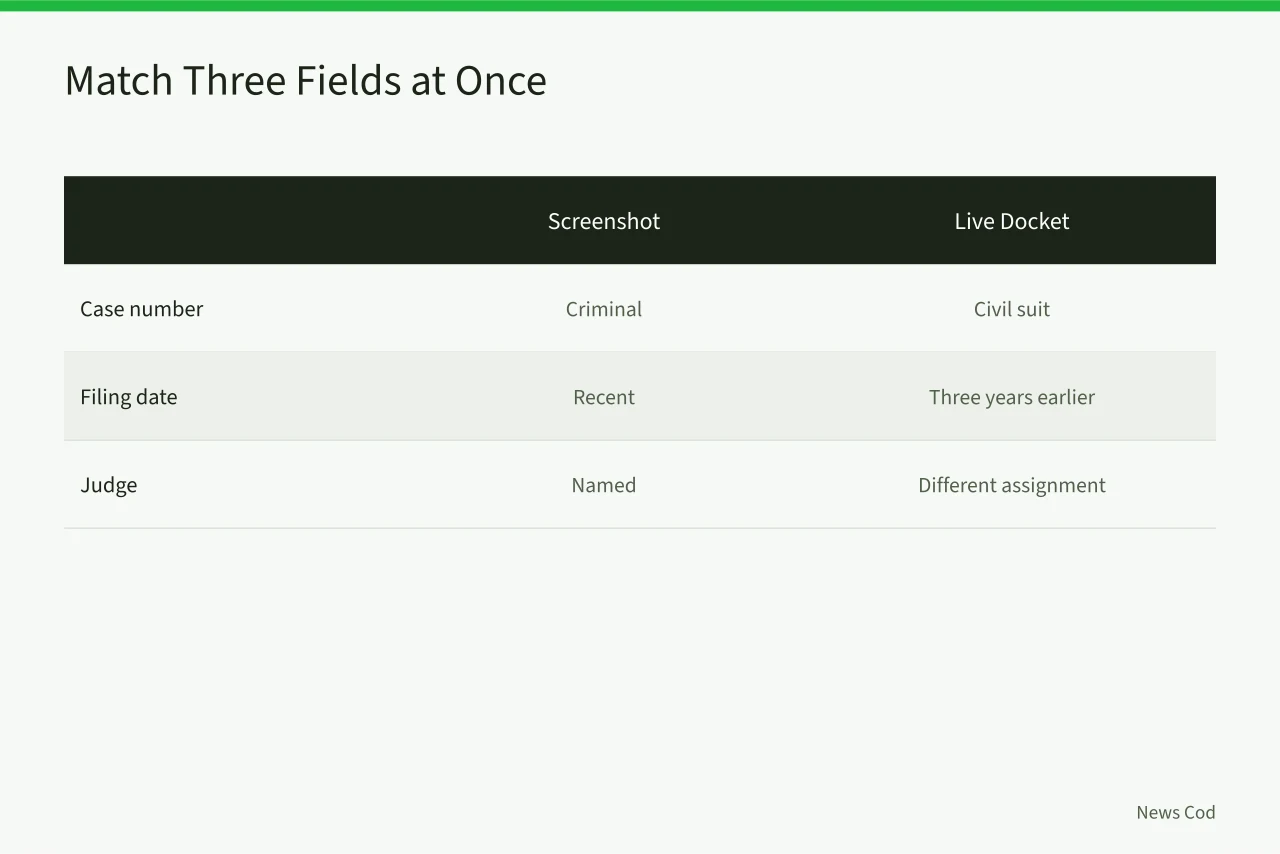
Consequence. The case number belongs to a civil suit filed three years earlier. The header was copied from a different document. Readers who searched the number found a real case and stopped there.
Prevention. Match three fields at once: case number, filing date, and presiding judge. A mismatch in any one of them breaks the screenshot. The federal courts publish structure and case type guidance at the court role and structure page, which helps you tell a criminal matter from a civil one before you search.
Situation. A post claims a New York state court filing proves a settlement. The screenshot shows a NYSCEF stamp.
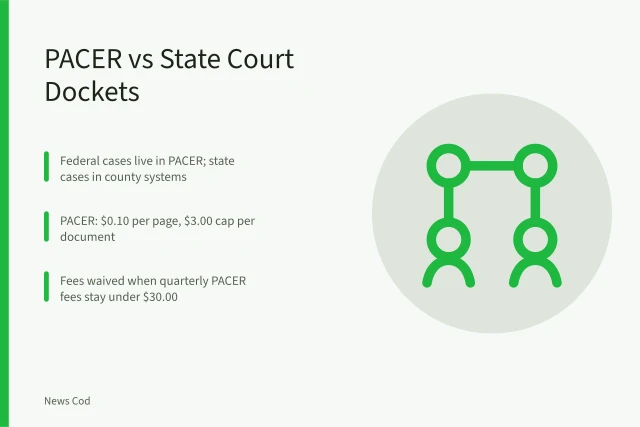
Consequence. No such entry exists in the state system. The poster assumed state courts work like PACER, where most federal filings are free to view once you pay the per page fee.
Prevention. Search the state system directly. New York, California, and Texas each run their own portals with their own access rules, and a federal search will never surface them. Our comparison of state public records request rules explains how those three states differ on access, fees, and turnaround.
The ones that only show up later
Situation. A screenshot of a bankruptcy filing circulates during a company story. The docket entry is genuine.
Consequence. Months later, a reader notices the document was filed under seal and later withdrawn. The screenshot captured a moment that no longer reflects the record, and the post never said so.
Prevention. Check the entry's current status, not just its existence. Dockets carry withdrawal, amendment, and sealing notations that change what a filing means.
Situation. A post cites a filing to support a claim about federal case volume.
Consequence. The number is wrong, but the screenshot is real. The poster misread the docket for a statistic.
Prevention. Separate the document from the claim built on it. Caseload figures come from published tables, not from one filing, and the federal caseload statistics tables are where those numbers live.
| Check | What you compare | What a mismatch means |
|---|---|---|
| Case number | Screenshot against live docket | Wrong case or fabricated entry |
| Filing date | Entry date against post date | Backdated or recycled image |
| Judge | Caption against docket assignment | Header copied from another case |
| Attachment | Page number against filed PDF | Forged or swapped exhibit |
| Status | Entry against current docket | Withdrawn, sealed, or amended filing |
A five step check before you share
- Read the case number and court off the screenshot, then search that court's system directly. The PACER FAQ covers account setup, fees, and what the system does and does not include.
- Confirm the filing date and judge match the docket entry. If either is missing from the screenshot, treat the image as unverified.
- Download the document and open the cited page. Compare it to the screenshot line by line.
- Check the entry status for withdrawal, sealing, or amendment.
- If the case is sealed or the docket is unavailable, say so. Do not fill the gap with a guess.
- Case number searched in the correct court system
- Filing date and judge matched to the docket
- Cited page compared against the downloaded PDF
- Entry status checked for changes
- Unavailable records labeled as unconfirmed
What they have in common
Every one of these failures starts with a partial check. The case number verifies, so the reader stops. The docket entry exists, so the document must be real. Each shortcut skips the step where the forgery or the error actually lives.
The pattern repeats across record types. A genuine government dataset can sit under a false headline, the same way a genuine docket entry can sit under a swapped exhibit. Our guide to public document types and statuses maps how drafts, filings, and final records differ, which is the distinction most viral screenshots blur. When a claim leans on a record you cannot pull, the answer is not a verdict. It is a note that the record is unconfirmed, followed by a link to the source so the next reader can try.
Common questions
Can I verify a PACER filing without paying? Sometimes. PACER charges per page after a quarterly threshold, and some courts offer free access at public terminals. A docket search may show the entry without the full document, which is enough to check the case number but not the attachment.
What if the case is sealed? Then you cannot confirm it from outside. Sealed dockets hide the entry itself, so any screenshot claiming a sealed filing is unverifiable by design. Say that plainly instead of treating the image as proof.
Do state court dockets work the same way? No. Each state runs its own portal with its own fees and access limits. California, New York, and Texas differ on what the public can see and download, so a federal search habit will miss state filings entirely.
Is a screenshot ever good enough on its own? Only as a lead. It tells you where to look. The confirmation comes from the court system, and the document behind the entry is what you are actually checking.