Features
Part of Synthetic media verification: a working guide for reporters
Fictional case: correcting a cloned-voice emergency report
Cloned-voice correction case showing how a newsroom retracts an unsupported emergency report, verifies the call, limits harm, and documents process changes.
What to take away
- This is a fictional training case, not a report about a real person, station, or emergency.
- A familiar voice and urgent detail were mistaken for independent confirmation.
- The correction replaces every public version and explains the failed verification step.
- The newsroom preserves the audio and evidence while limiting further circulation.
- New controls require callback verification and two-person approval for emergency claims from disputed audio.
The fictional scenario
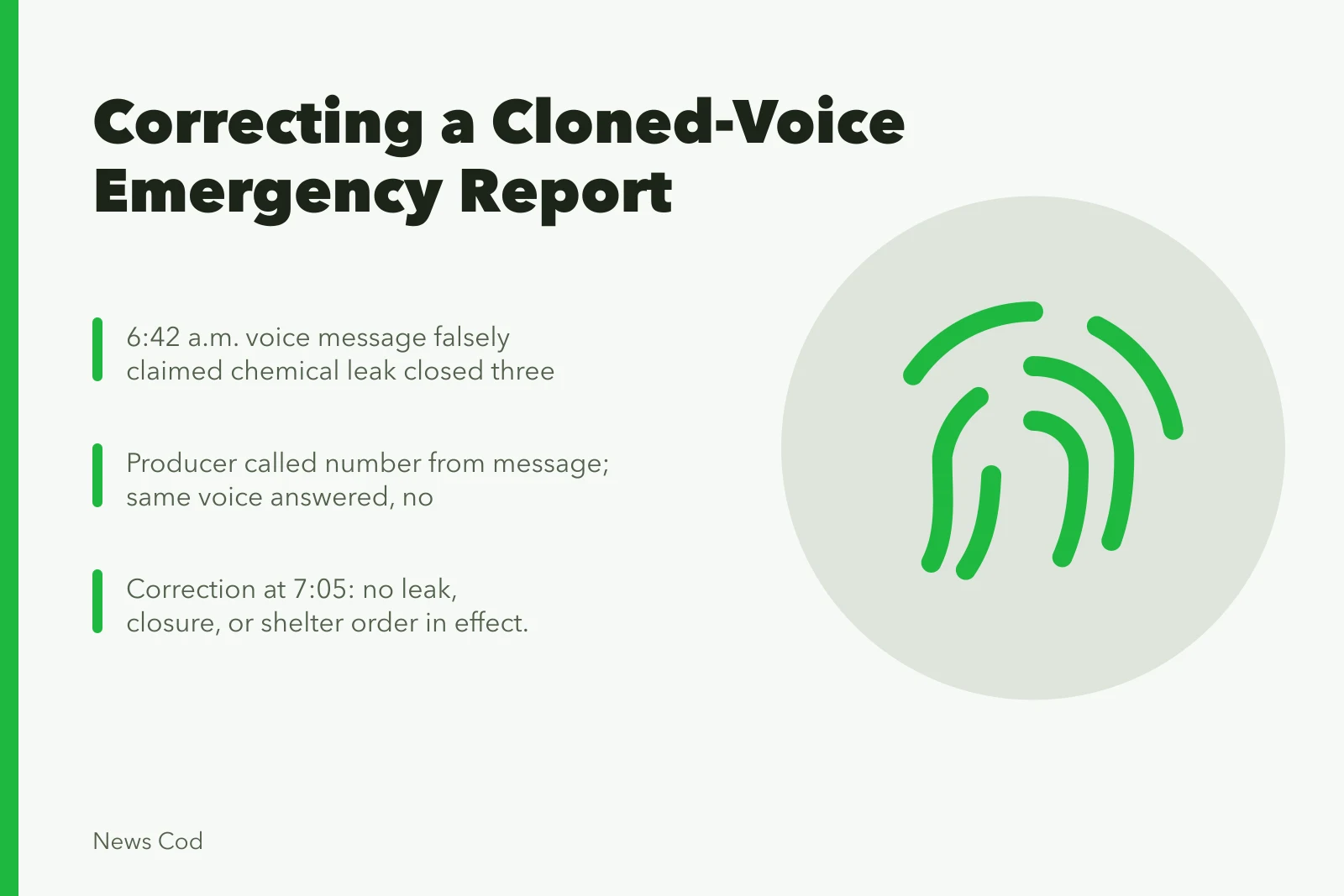
At 6:42 a.m., a local newsroom receives a 19-second voice message from an account labeled as the county emergency director. The voice says a chemical leak has closed three schools and orders residents in two neighborhoods to remain indoors. The message uses local street names and sounds like the director.
False alert timeline
- 642 a.m. Voice message received
- 651 a.m. Mobile alert published
- 654 a.m. Web post published
- 702 a.m. County denies incident
- 705 a.m. First correction issued
An overnight producer calls the number displayed in the message. The same voice answers, repeats the warning, and says an official alert will follow. The newsroom publishes a mobile alert at 6:51 and a short web post at 6:54. Radio hosts repeat it.
At 7:02, the county's verified public-information officer calls the assignment desk. There is no leak, no school closure, and no shelter order. The emergency director's messaging account was copied, not compromised. The callback number was controlled by the sender. The station removes the alert but initially changes the web headline to "Possible emergency report under review."
What the newsroom can say at 7:05
The first correction should be direct:
Correction: News Cod's earlier alert stating that a chemical leak had closed three schools was false. County emergency officials confirm that no leak, closure, or shelter order is in effect. The alert relied on an impersonating voice message and a callback to a number supplied by the same sender. Do not follow or share the earlier warning.
The newsroom should place this text at the top of the story, push it to every alert recipient, post it on the same social channels, tell on-air staff, and notify syndication partners. It should not wait for a final technical determination about how the voice was produced.
Why the first verification failed
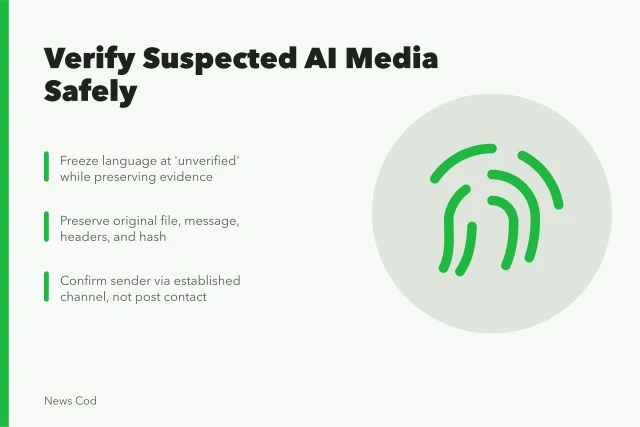
The producer performed two contacts, but both belonged to one untrusted chain. The incoming voice message supplied the callback number. Hearing the same voice again added repetition, not independence.
The newsroom also let accurate local details stand in for identity. Street names, school names, and job titles can be copied from public material. Urgency discouraged the producer from opening the county directory and calling the established duty number.
The Federal Trade Commission's advice on fake emergency scams recommends calling the person through a number already known to belong to them rather than trusting the voice. The same channel-separation rule belongs in newsroom emergency verification.
Preserve without amplifying
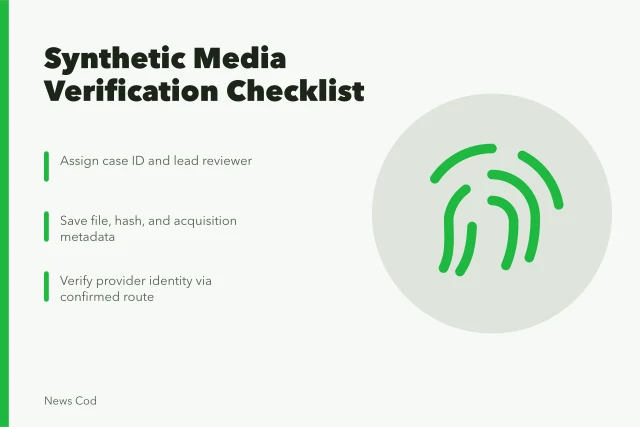
The standards editor creates an incident folder containing:
Incident folder contents
- Original message file and hash
- Sender identifier and metadata
- Callback recording and log
- Screenshots of false alert
- Verified county response and call log
- Publication and correction timeline
- Staff notes written while fresh
The public correction does not embed the full clean audio. A short, clearly labeled excerpt may be retained for a later explanatory report if publication serves a defined public interest and does not make reuse easier. Personal phone numbers and operational details remain redacted.
Investigate the production method carefully
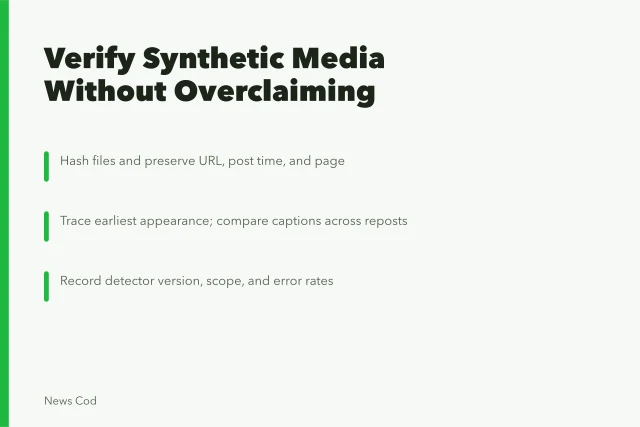
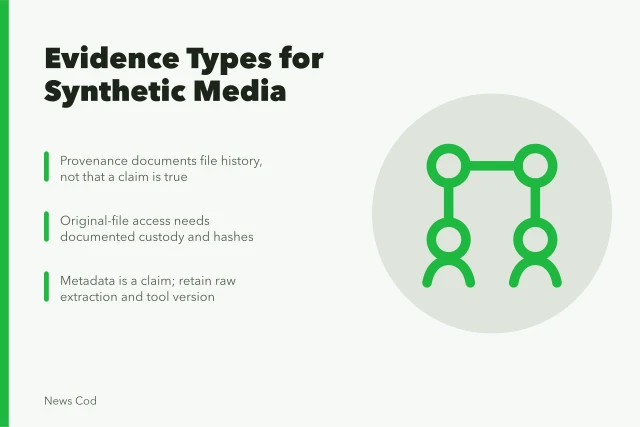
The newsroom asks the emergency director for recent verified recordings, with consent, and sends the preserved file to a qualified audio-forensics specialist. The reviewer compares speech rhythm, room tone, edit boundaries, codec history, and voice characteristics. A commercial detector flags likely synthesis, but the newsroom records its version and refuses to treat the score as the sole finding.
The later evidence may support "voice clone," "edited recording," or only "impersonating audio." The original public-safety claim is already false because the responsible authorities and operational records contradict it. Technical uncertainty about the voice does not delay that correction.
The expanded correction at noon
After confirming distribution and consulting the specialist, the article carries a fuller editor's note:
Editor's note: At 6:51 a.m., we sent a false alert about a chemical leak and school closures. There was no such incident. We relied on an audio message that impersonated the county emergency director and verified it by calling a number supplied in that same message. That callback was not independent. We should have used the county's established duty contact before publication. We corrected our web, mobile, social, and broadcast reports beginning at 7:05 a.m. Audio analysis is continuing, so we are not yet describing the production method as confirmed voice cloning.
This wording owns the newsroom decision, corrects the event, explains the error, and avoids getting ahead of the technical evidence.
Platform and regulatory context
The Federal Communications Commission ruled that AI-generated voices fall under the Telephone Consumer Protection Act's ban on "artificial or prerecorded voice" calls. Its declaratory ruling on AI-generated voice calls covers their legal treatment.
Newsrooms should not say this fictional incident broke a specific law without facts on dialing method, consent, jurisdiction, intent, and enforcement authority.
Process changes after the correction
Within 48 hours, the newsroom adopts these controls:
New verification controls
- Emergency claims require established official directory
- Callback number from claimant never independent
- One editor confirms event; another identity
- High-impact alerts record source and time
- Rehearse voice-cloning scenarios twice yearly
- Distribute corrections through every original channel
The newsroom also reviews whether speed incentives, overnight staffing, directory access, or unclear escalation roles contributed. Training alone cannot repair a workflow that makes safe verification hard.
Correction audit table
| Public item | Original time | Correction action | Completion time |
|---|---|---|---|
| Mobile alert | 6:51 a.m. | Send explicit false-alert correction | 7:05 a.m. |
| Web post | 6:54 a.m. | Replace headline and add top note | 7:06 a.m. |
| Radio bulletin | 6:56 a.m. | Read correction twice and log it | 7:07 a.m. |
| Social posts | 6:57 a.m. | Reply, correct, and retain audit copy | 7:09 a.m. |
| Syndication feed | 6:58 a.m. | Transmit correction and confirm receipt | 7:14 a.m. |
Common questions
Why not wait for the audio analysis before correcting?
Because officials and operational records already establish that the reported emergency did not occur. The public needs that correction at once.
Should the false alert be deleted?
Remove active dangerous instructions, but preserve an internal audit copy and leave a clear public correction where readers encountered the claim.
Was calling back a second source?
No. The number came from the disputed message, so the callback remained inside the same untrusted chain.
When may the newsroom say "voice clone"?
When the evidence supports that production method. Until then, "impersonating audio" is the safer description.