Rules
Part of Synthetic media verification: a working guide for reporters
Common synthetic media reporting problems
Synthetic media reporting problems include detector overclaiming, artifact guessing, provenance confusion, false context, unsafe sharing, and vague corrections.
What to take away
- "AI-generated" is a technical conclusion that needs evidence, not a synonym for suspicious.
- Missing credentials, odd pixels, or one detector score cannot bear a confident verdict alone.
- A false caption and a fabricated file are separate problems.
- Reporting can harm people by amplifying a deceptive file even while debunking it.
- Corrections must replace the wrong finding and explain how the verification failed.
Synthetic-media stories invite certainty because readers want a simple answer. The strongest reporting often uses narrower language. It distinguishes a verified event from a verified file history, and it leaves the production method unresolved when the evidence does not settle it.
Problem 1: Letting a detector write the headline
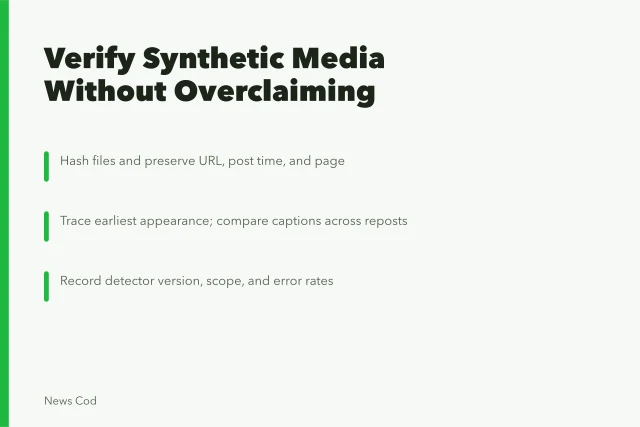
A detector result is shaped by its training data, supported media, file quality, version, and threshold. "Tool says 91 percent fake" is not enough. The newsroom must understand what the number represents, preserve the tested file, and see whether the result survives ordinary transformations.
Better practice: describe the model output as one signal, identify the tool and version, seek an authentic control, and pair it with independent source and context work.
Problem 2: Calling every visual defect an AI artifact
Compression blocks, motion blur, stabilization, rolling shutter, portrait effects, low light, frame interpolation, and platform transcoding can create strange faces, hands, shadows, or edges. Once a reporter expects generation, ordinary defects begin to look diagnostic.
Better practice: inspect the highest-quality file, review adjacent frames, compare with media from the same device or platform, and ask a qualified reviewer to reproduce consequential findings.
Problem 3: Treating absent provenance as guilt
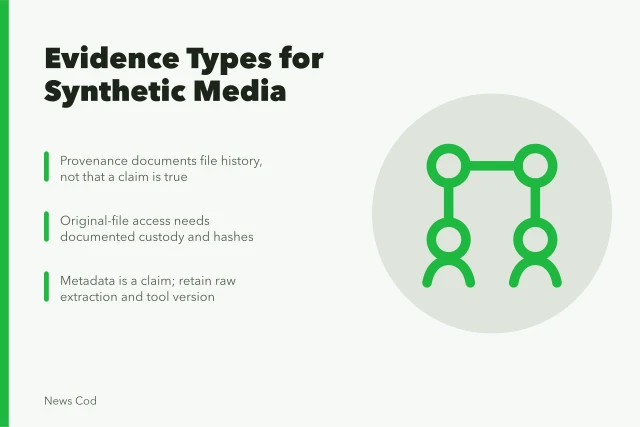
A file can lose metadata or credentials during export, screenshotting, messaging, or social-platform processing. Lack of a signed record does not mean the content is false. It means that evidence lane is unavailable.
The research framing keeps the categories apart. DARPA's Semantic Forensics program has run challenges asking models to tell fully synthetic images from authentic ones, including authentic images that were manipulated or edited by conventional means. Edited, synthetic, and unverified are three findings, not one.
Better practice: validate credentials when present, explain exactly what they cover, and keep factual verification separate.
Problem 4: Confusing false context with synthetic production
An old authentic video can be relabeled as a new attack. Real audio can be cut and placed over unrelated images. A generated illustration can be attached to an accurate story but falsely presented as a news photograph.
Better practice: write separate findings for origin, date, place, identity, words, editing, and generation. If the event claim is disproved but the file method is unknown, say so.
Problem 5: Trusting the apparent sender
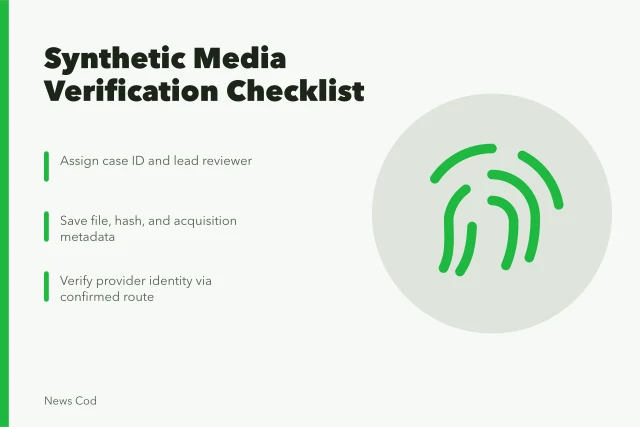
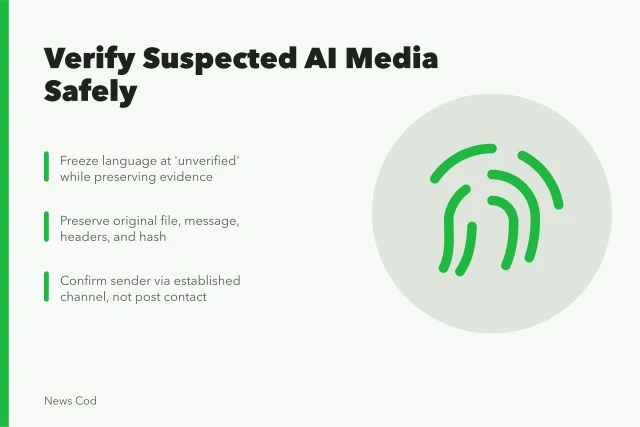
Account compromise, look-alike domains, spoofed caller ID, and cloned voices can make a message appear to come from a familiar source. Contacting the number supplied inside the disputed message only returns to the same evidence chain.
Better practice: verify through an established number, earlier thread, official directory, known assistant, or in-person contact. Require separate approval for urgent payment or credential requests.
Problem 6: Asking the audience to diagnose the file
Publishing a high-quality deceptive clip with "Is this fake?" can supply the fraud with reach and expose private or abusive content. Crowd replies also mix unsupported confidence with tool screenshots that cannot be audited.
Better practice: share only what readers need to understand the finding. Use stills, short excerpts, transcripts, or descriptions when the full media would cause avoidable harm. Keep the original in a controlled evidence file.
Problem 7: Assuming watermarks solve voice cloning
Watermarks, authentication, real-time detection, and post-use analysis address different stages. A watermark may be absent, removed, altered, or unsupported by the receiving platform. A real-time detector may fail on a new method.
The Federal Trade Commission's review of approaches to AI-enabled voice cloning discusses upstream authentication, watermark limitations, real-time detection, and post-use evaluation, and says there is no single solution. Newsroom language should reflect that layered defense.
Better practice: verify the transaction or request through a separate channel even if technical screening reports no problem.
Problem 8: Using old comparison material carelessly
A person's voice, appearance, accent, health, microphone, and speaking style can change. Comparing a compressed current call with a studio interview from years earlier can exaggerate differences.
Better practice: collect several verified references near the same date, in similar conditions, and with known provenance. Explain any mismatch in recording quality.
Problem 9: Hiding uncertainty behind passive language
"Questions have been raised" does not tell readers who found what. "Experts say it may be fake" conceals methods and disagreement.
Better practice: attribute each observation, name the material tested, state the method in plain language, and distinguish direct evidence from inference.
Problem 10: Correcting the label but not the damage
Deleting "confirmed deepfake" and replacing it with "unverified" can leave social posts, push alerts, syndication copies, and reputational harm untouched.
Better practice: publish a visible correction, change the headline and summary, update derivative posts, notify partners, preserve the old wording, and say which verification step failed.
A safer language table
| Weak wording | Better wording |
|---|---|
| "Obviously AI" | "The file contains anomalies that require further testing" |
| "The detector confirmed a fake" | "Tool X flagged the tested copy; the original is unavailable" |
| "No metadata means generated" | "The available copy contains no usable creation metadata" |
| "The video is fake" | "The video predates the event named in the caption" |
| "A verified credential proves it happened" | "The credential validates this recorded file history" |
Common questions
Is "deepfake" always the best term?
No. Use generated, face-swapped, voice-cloned, edited, spliced, or falsely contextualized when the evidence supports a more precise description.
Should a newsroom name the detector it used?
Yes, along with version, tested file, output meaning, and relevant limits.
Can authentic media still mislead?
Yes. False dates, places, captions, crops, and edits can change the apparent meaning of authentic material.
When should a story say "inconclusive"?
When credible evidence conflicts or the available file and source record cannot support a firmer finding.