
Guides
Actor awards search: how to assess a claim
Actor awards search: check a claim against the body's published list, matching body, year, category, and result; say clearly when you cannot verify it.
An actor awards search is a check of a specific claim against the record of the organization said to have given the award. Start by finding the body, then find its published list for the stated year and match four things. The hard part is often starting from the claim instead of the body.
This is a method for evaluating a claimed award, not a directory of winners or a database of award results. Begin with the organization named in the claim, then look for its own published record.
For an Oscar claim, start with the Academy of Motion Picture Arts and Sciences' official Academy Awards results. BAFTA and the SAG Awards, presented by SAG-AFTRA, are other examples of awarding bodies whose own records should be checked. IMDb and Wikipedia can help you find a claim or a lead, but their entries may omit context or blur a nomination, a win, and the relevant award year; verify those details against the body's record.
What to take away
- The body's published list for the year is the strongest source for its own decision. If it is unavailable, cite the source you actually used and say what it can establish.
- Match four fieldsbody, year, category, result. A mismatch on any one of them means the claim is not the record.
- If you cannot locate a reliable record, report that the claim could not be verified; do not treat absence as proof it is false.
The check, in order
- Identify the body precisely.Full name as it names itself, not an abbreviation and not a description. Similar names are the most common source of a false match.
- Find the body's own site and its results section.A body that gives awards publishes what it gave and to whom.
- Go to the year stated in the claim, then to the year either side.Bodies label their years differently from the calendar, so a near miss is often a labeling difference rather than a false claim.
- Match the category exactly.Categories are split, merged and renamed, so a plausible category name is not a match.
- Match the result.Nominated and won are different facts, and a nomination presented as a win is the single most frequent error in transcribed awards data.
- Record where you looked and when.A verification nobody can repeat is not a verification.
For example, check the claim, “Cillian Murphy won the 2024 Academy Award for Actor in a Leading Role.” The Academy of Motion Picture Arts and Sciences' official results for the 96th Oscars, the 2024 ceremony, list Murphy as the winner in that category. The Academy labels the ceremony by its ordinal and ceremony year; it honored films released in 2023, so do not mistake a film's release year for the award year.
Award years are defined by the body, so a result in the year before or after the claimed calendar year may reflect the body's labeling rather than a mismatch.
What each source can actually establish
| Source | Establishes | Does not establish |
|---|---|---|
| The body's published list for the year | The decision, as the body recorded it | Anything about how the field was assembled |
| The body's rulebook for that year | What the rules were then | What they are now |
| A press release from a production | That a claim was made, and by whom | That the body agrees |
| An aggregator or database entry | That someone transcribed something | The original, since transcriptions carry errors |
| A resume or profile | A claim by the person making it | Anything at all, until matched to the body |
Use the original record whenever possible. Secondary sources can help locate it, but they do not replace it.
When the body cannot be found
Sometimes the search fails, and the failure is informative. Work through the possibilities in this order.
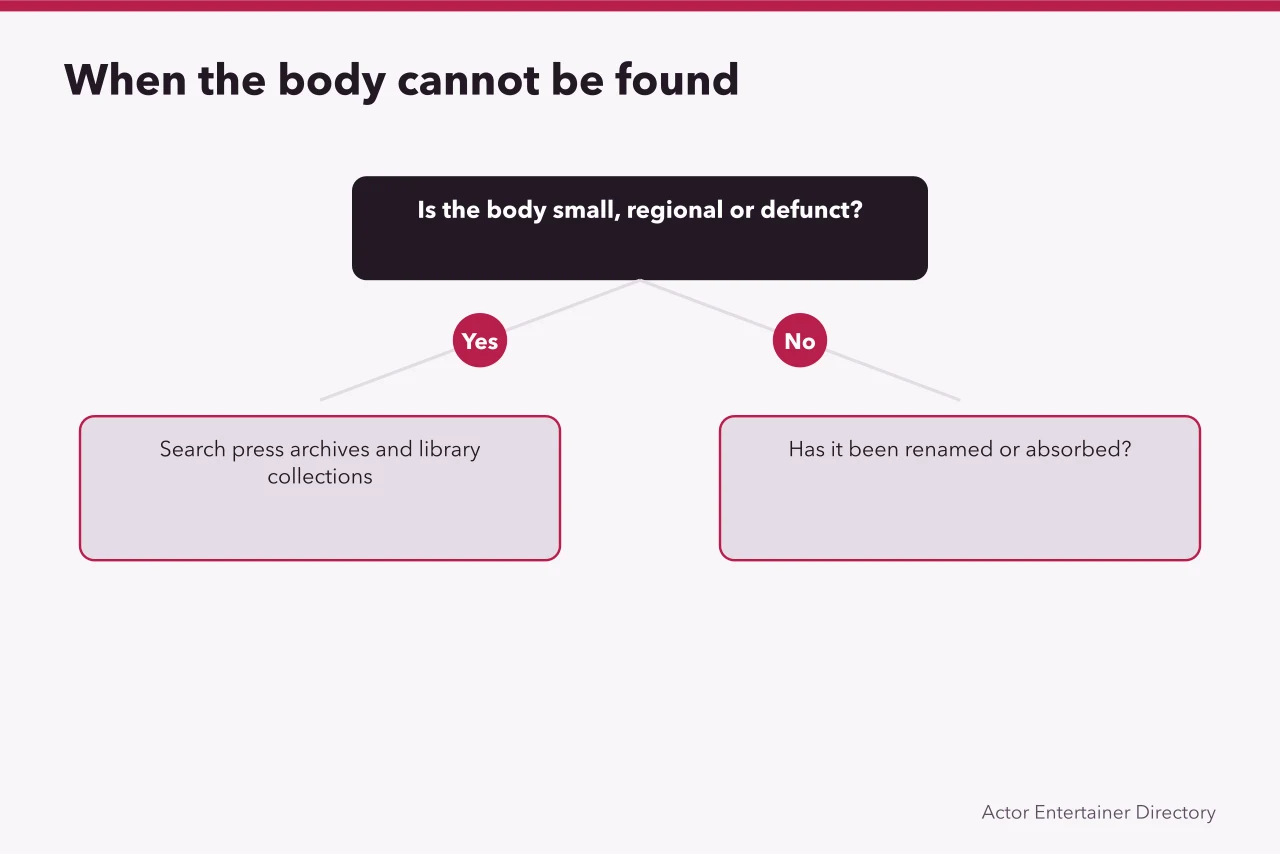
The body may be small, regional or defunct, in which case its lists may survive in press archives or in a library collection rather than online. It may have been renamed or absorbed, so search the older name. Or it may not exist in the sense the claim implies.
An organization that mainly gives awards, charges recipients a fee, keeps its voting body unnamed, and whose website lists no history before a recent year is selling a product, not making a judgment.
Before treating an honor as independent recognition, look at whether recipients pay a fee, whether the voting body is named, and whether the organization has a history beyond recent years.
Verifying a claim someone made about themselves
This comes up in casting, in journalism and in ordinary curiosity, and it deserves a plain rule: an unverified award is not a false one.
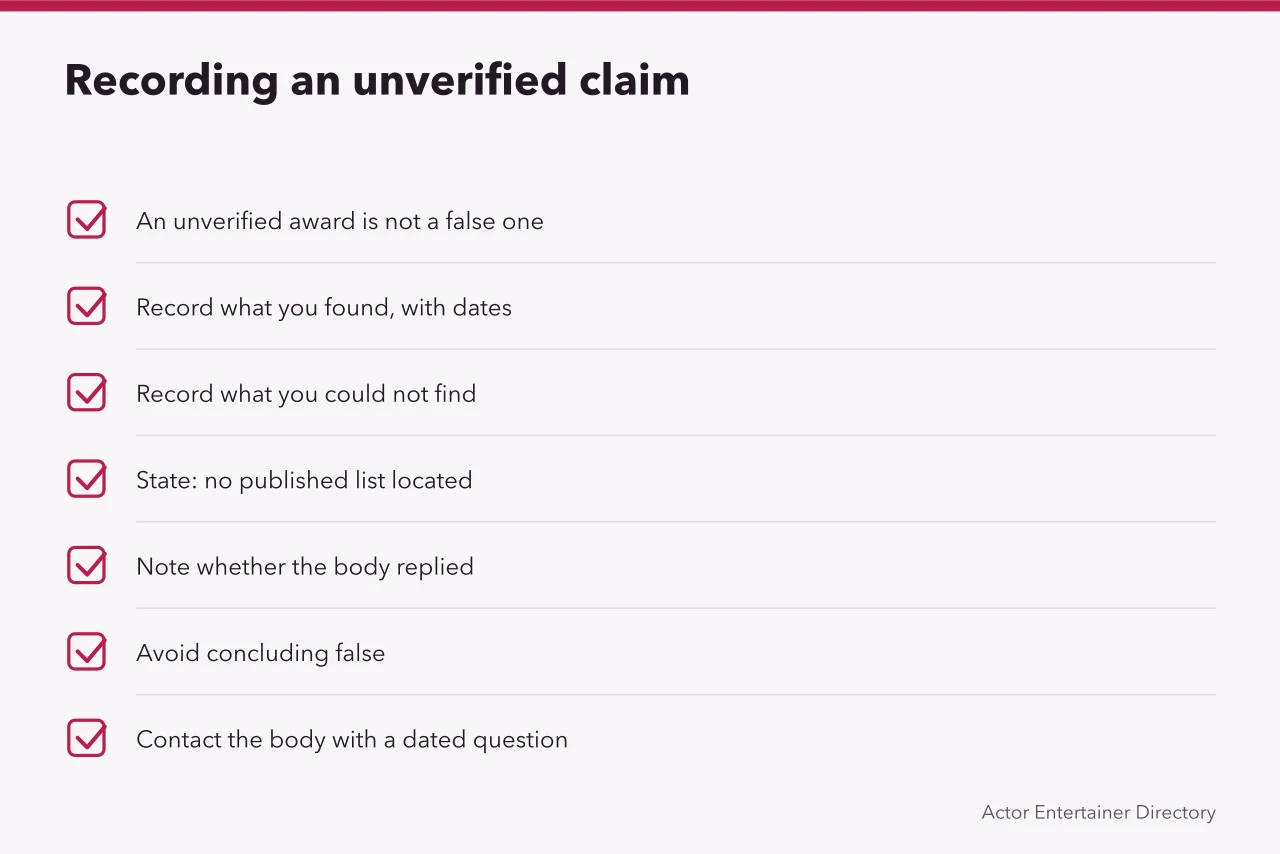
Record what you found and what you could not find, with dates.
"No published list located for the stated year, body contacted, no reply" is useful and honest.
"False" is a conclusion the search did not reach. Record the result and the date you checked, and distinguish that from an unverified claim.
Where the claim matters enough, contact the body. Bodies answer questions about their own published records, and a specific, dated question gets a far better response than a general one.
Where the lists actually live
Start with the body. The Library of Congress's performing arts collections guide can help researchers locate ceremony programs, trade press and organizational papers.
For film-related records, the Academy of Motion Picture Arts and Sciences' Margaret Herrick Library and the Library of Congress's motion-picture collections are concrete places to investigate. Their materials may corroborate a claim, but they do not replace the awarding body's own results.
Digitized trade press is the most useful secondary source for older results, because it reported the lists at the time. It is still a transcription, so cite the body's list where it survives and cite the press where it does not, saying which you did.
Common questions
The body's site has no archive. Now what?
Try the Wayback Machine to look for archived captures of the body's own pages, then check trade press for the year, then a library collection. A capture may not exist; cite what you actually used, not the body's current page.
A nomination is listed but the claim says win. Which is right?
The body's list. Nominations misrecorded as wins are common enough that this should be the first thing you check rather than the last.
Is a festival prize an award?
It is a decision by a jury at that festival, which is a real record. Store it with the body and the kind, and do not pool it with peer-academy results in any total.
Does an award prove anything about the performance?
An award records a decision by one group within its own process and time frame. It does not, by itself, establish a definitive measure of a performance.