Maintenance
Part of Synthetic media verification: a working guide for reporters
Synthetic media verification checklist for suspicious footage
Synthetic media verification checklist for claim framing, evidence preservation, source contact, provenance, context, forensic review, and publication controls.
What to take away
- Use this checklist as an evidence record, not a shortcut to a binary verdict.
- Assign one owner to the preserved files and another reviewer to the conclusion.
- Confirm identities and urgent requests through channels established before the incident.
- Record detector versions and raw outputs, including results that do not support your theory.
- Publish a bounded finding with an evidence cutoff and a correction route.
This checklist supports newsroom review of suspected generated or manipulated images, video, and audio. Mark an item complete only when the reporting file contains the supporting record. Use "not applicable" with a reason rather than silently skipping a step.
Intake and safety
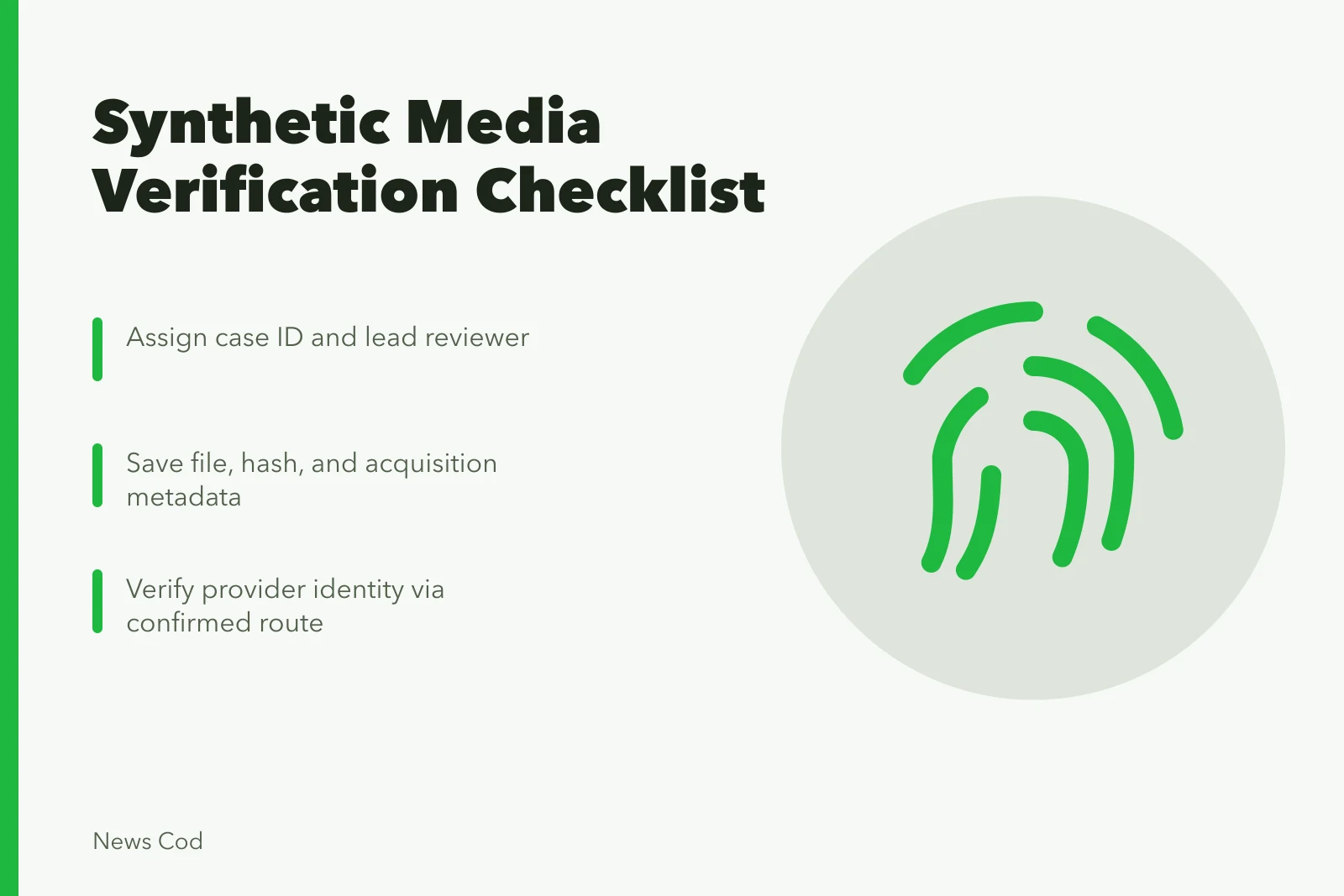
- Assign a case identifier and lead reviewer.
- Record the exact claim without paraphrasing it into stronger language.
- Note the claimed speaker, subject, action, place, date, time, and event.
- Record who supplied the media and how it arrived.
- Identify immediate risks involving money, credentials, privacy, physical safety, or reputational harm.
- Pause requested transactions or disclosures until independent confirmation.
- Restrict access to sensitive material and document who handles it.
Preservation
- Save the highest-quality available file without editing it.
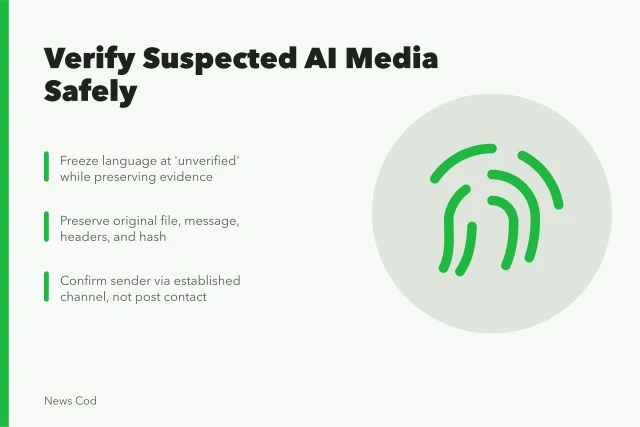
- Save the full web page, message, caption, URL, account identifier, and visible timestamp.
- Record the acquisition date, time, and time zone.
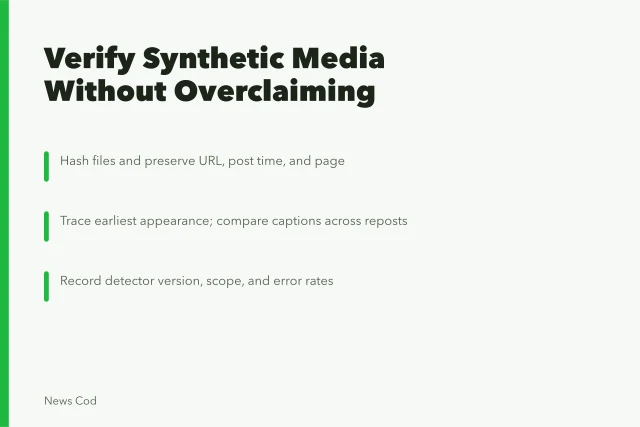
- Calculate and record a cryptographic hash.
- Store an untouched preservation copy and a separate working copy.
- Record whether the file is camera-native, an export, a screen recording, a download, or unknown.
- Keep later versions under different names and hashes.
Source and identity
- Verify the provider's identity independently.
- Determine whether the provider had direct access to the claimed event.
- Ask for the original file and an account of capture or acquisition.
- Contact the depicted or impersonated person through a previously confirmed route.
- Ask open questions before presenting disputed details.
- Record refusals, conflicts, and unavailable sources fairly.
The FBI's public guidance on defending against synthetic content notes that visual and audio inconsistencies can be indicators, while its own investigative use of AI-generated leads remains subject to human verification and validation. Your checklist should preserve that distinction between a lead and proof.
Source and identity checks
- Verify provider identity independently
- Determine direct access to event
- Ask for original file and capture account
- Contact depicted person via confirmed route
- Ask open questions before disputed details
- Record refusals and conflicts fairly
Distribution history
- Locate the earliest known public appearance.
- Normalize upload times to one time zone.
- Search transcript phrases, captions, watermarks, and several video frames.
- Compare longer, clearer, or differently cropped copies.
- Record caption changes across reposts.
- Determine whether apparently separate posts share one origin.
Event and context
- Check the subject's independently documented schedule or whereabouts.
- Compare location features, signs, terrain, interiors, language, and acoustics.
- Check weather, daylight, shadows, clocks, and event timing.
- Locate parallel recordings, live streams, witness material, or official records.
- Test whether an older authentic file was relabeled as current.
- Separate proof of false context from proof of synthetic production.
File and provenance
- Record type, size, dimensions, duration, frame rate, codecs, and audio channels.
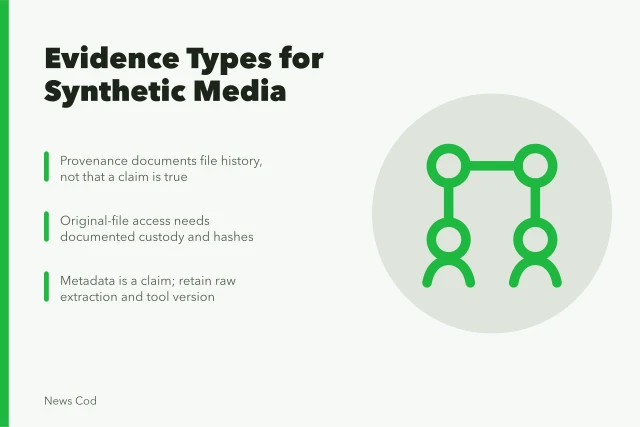
- Extract metadata with tool name and version.
- Compare creation, modification, and export fields with the source account.
- Check for embedded previews, thumbnails, or ingredient files.
- Detect and validate any signed provenance record.
- Record signer, trust state, actions, ingredients, and validation errors.
- Avoid treating missing metadata or credentials as proof of generation.
Visual review
- Inspect the native-resolution file, not only a platform preview.
- Review facial boundaries, hair, teeth, hands, text, patterns, and object geometry.
- Compare shadows, reflections, perspective, depth of field, and light direction.
- Review adjacent frames around suspicious areas.
- Check motion, occlusion, blinking, lip alignment, and abrupt cuts.
- Consider ordinary explanations such as stabilization, beauty filters, rolling shutter, and compression.
Audio review
- Listen on suitable headphones and speakers.
- Compare cadence, pronunciation, breath, inflection, and room tone with verified samples.
- Check for abrupt noise-floor or reverberation changes.
- Compare sound with visible actions and room characteristics.
- Determine whether authentic phrases may have been spliced or moved.
- Preserve both channels of stereo material before downmixing.
Tools and expert review
- Review privacy, retention, and upload terms before using an external service.
- Record the exact input hash, tool, version, settings, date, and full output.
- Confirm that the tool supports this medium and file condition.
- Test an authentic control with a similar device or distribution path when available.
- Repeat any consequential result.
- Seek a qualified specialist when the finding depends on advanced signal analysis.
- Give a second reviewer the evidence package before sharing the proposed verdict.
The NSA, FBI, and CISA guidance on organizational deepfake threats recommends combining detection and provenance methods with planning, training, protected communications, and rehearsed response. This supports treating verification as part of a response system rather than a stand-alone software check.
Decision and publication
- Identify the narrow claim each evidence item supports or conflicts with.
- Label the outcome as verified, falsely contextualized, edited, synthetic, unverified, or inconclusive.
- Name the decisive evidence and material limits.
- Avoid publishing private data or an unnecessary high-quality copy of harmful media.
- Describe detector output precisely without converting it into certainty.
- Include source responses and the status of the original file.
- State the evidence cutoff date and time.
- Add a visible update and correction route.
- Preserve the published version and later changes.
Sign-off record
| Role | Name | Date | Decision |
|---|---|---|---|
| Lead verifier | |||
| Independent reviewer | |||
| Standards or legal review, if needed | |||
| Publishing editor |
Common questions
Must every box be checked?
No. Mark irrelevant or unavailable steps clearly and explain why. The remaining evidence must still support the conclusion.
Who should keep the original file?
Assign a named custodian and use access controls suited to the material's sensitivity.
Can the checklist replace an expert?
No. It organizes evidence and escalation. It does not supply expertise in every forensic method.
What if an urgent warning is needed before verification ends?
Publish narrowly framed protective guidance and label the media unverified. Update when the evidence supports a stronger conclusion.