Guides
PACER vs State Court Dockets: Which Should You Check First?
PACER vs state court dockets decides where a case record lives and what it costs. Federal filings are centralized and paid; state lookups vary by county.
What to take away
- Start with the court that has jurisdiction over the dispute, not with the search engine you find easiest. A federal case lives in PACER; a state case lives in the county or state system where it was filed.
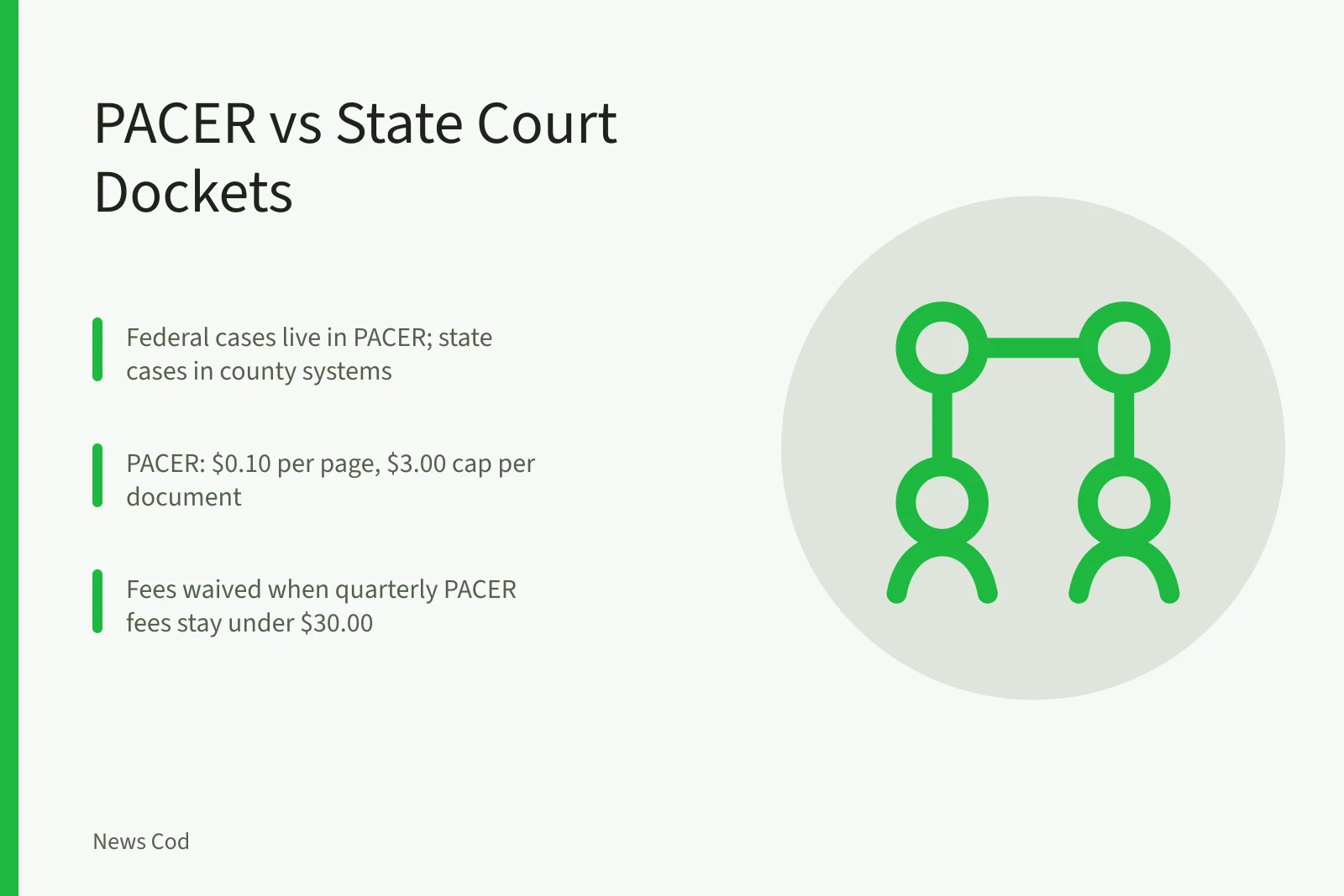
- PACER charges $0.10 per page with a $3.00 cap per document and fees waived under $30.00 per quarter, per the PACER FAQ.
- State portals range from free to per-page charges, and many counties still require a counter visit or a phone call.
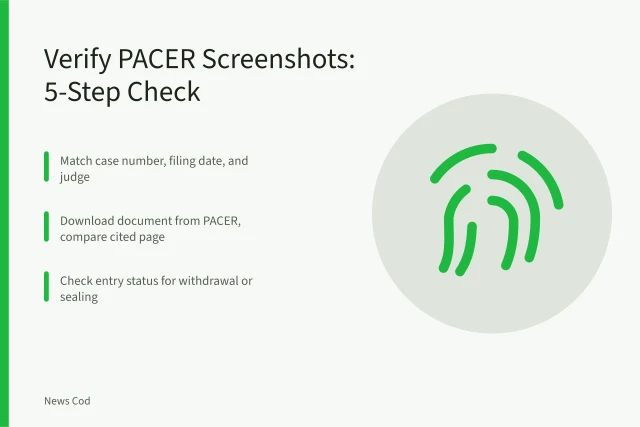
- Neither system proves a document is authentic on its own. You still match the case number, judge, and filing date against the docket entry.
- Budget time for the gap: state trial courts often lag days or weeks behind the paper filing.
What is being compared
Two record systems answer the same question in different ways. PACER, the Public Access to Court Electronic Records service, covers the federal district, bankruptcy, and appellate courts. State systems cover everything else: criminal charges, most family matters, evictions, small claims, and the bulk of civil suits.
A reporter chasing a fraud claim needs to know which courthouse heard it. The federal court structure explainer is the fastest way to settle that question before you pay for anything.
The criteria that matter
| Criterion | PACER (federal) | State court systems |
|---|---|---|
| Coverage | All 94 district courts, bankruptcy, appellate | County, district, and state courts, varies by state |
| Cost | $0.10 per page, $3.00 cap per document | Free to $10+ per search or per document in some states |
| Fee waiver | Waived when quarterly fees stay under $30.00 | Rare; some states waive for indigent filers only |
| Search | One national index by party name or case number | Often county by county, sometimes no name search |
| Document access | Most filings as PDF | Mixed; some courts show a register of actions only |
| Authentication | Docket entry plus case number and stamp | Varies; some portals lack a verification page |
Option by option
PACER. Create an account, run a party name search, and pull the docket. Charges accrue per page viewed, not per search, and the quarterly waiver means light users often pay nothing. The docket shows every filing with a date and a number, which is what you cite.
State portals. California, Texas, and New York each run their own mix of statewide and county systems. Some charge for a name search before you see a single result. Others publish a free register of actions but withhold the documents themselves.
Court clerk counters. The oldest method still works. Call the clerk, give the case number, and ask for copies. Fees are set locally and often run $0.50 to $1.00 per page.
Third party aggregators. Commercial sites resell docket data. They are useful for finding a case number fast, then you verify against the court. Treat the aggregator as a lead, never as the record.
Where each one wins
PACER wins when the case is federal, when you need one national name search, or when the document must be a filing rather than a news clip. Bankruptcy and patent disputes sit here almost every time.
The state system wins for anything local: an arraignment, a divorce, a landlord tenant case, a zoning appeal. If the story is about a person's conduct in their own city, the county courthouse is the first stop.
If you are still deciding which records request to file, the walkthrough on how to find and request public records covers the request letter itself, which is a separate skill from docket reading.
Example: a claim about a lawsuit that may not exist
A tip says a local contractor was sued for fraud last month. You search PACER by name and find nothing. That is not proof. The suit would be a state civil filing, so you check the county portal and find a case number with a complaint filed eleven days ago.
The docket shows the complaint and a summons, nothing else. No answer, no judgment. Anyone claiming a verdict is ahead of the record. For the broader vocabulary of filings and their statuses, see public document types and statuses compared.
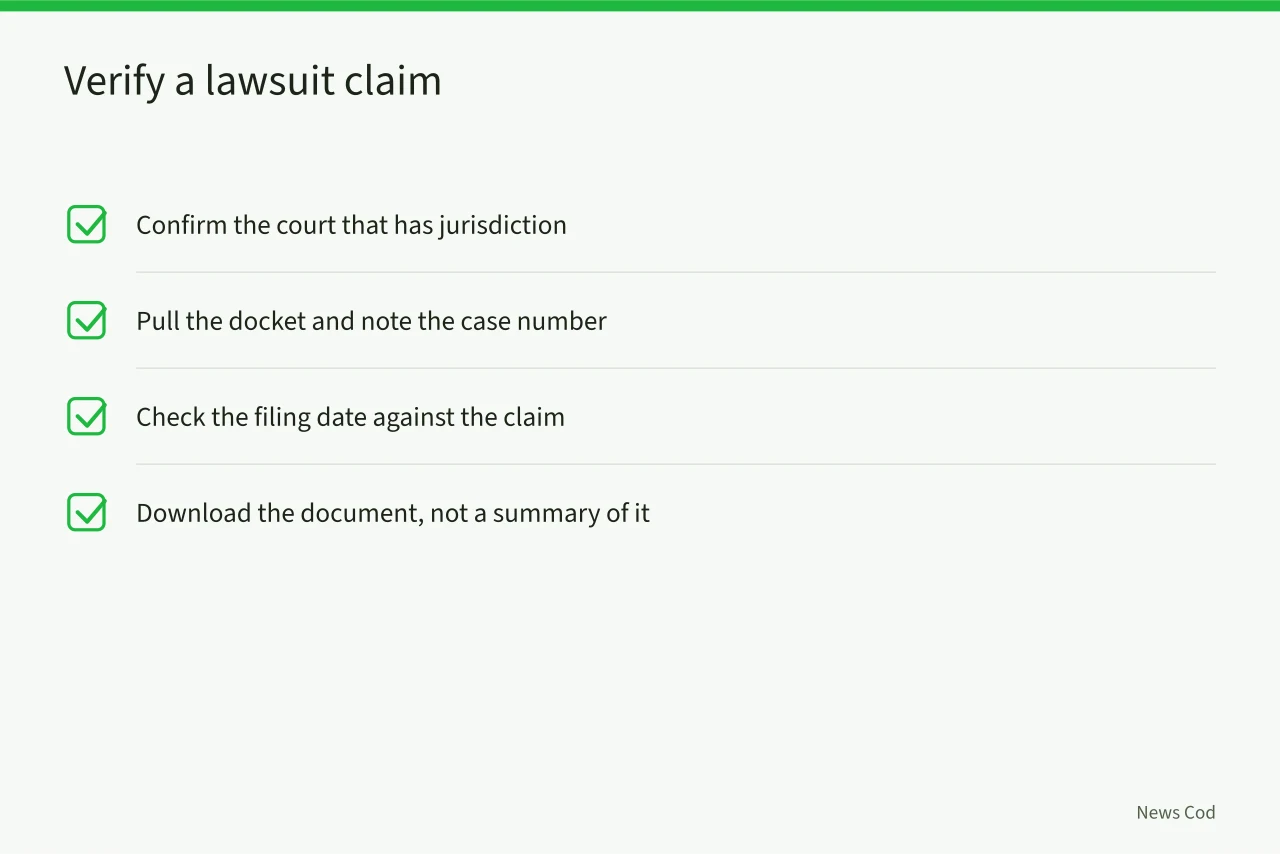
- Confirm the court that has jurisdiction
- Pull the docket and note the case number
- Check the filing date against the claim
- Download the document, not a summary of it
What none of them solve
No docket tells you whether the allegations are true. A complaint is one side's account, filed by a lawyer, and it stays on the docket even after dismissal. Reading it as a finding is the most common error in court based reporting.
Sealed documents, juvenile records, and grand jury material stay off both systems by design. When a record is sealed, the honest answer is that you cannot see it, and a source who claims otherwise owes you a document.
A docket proves a filing happened. It never proves the filing is correct.
Cost is also not the deciding factor. Ten dollars of PACER pages can settle a question that a week of free searching cannot. For a parallel case study in matching a claim to the right dataset, the piece on government records and public documents verification guide is worth the time.
Common questions
Is PACER free? No, but light use often costs nothing. The PACER FAQ states fees are waived when total quarterly charges stay at or under $30.00, and pages run $0.10 with a $3.00 cap per document.
Can I search all state courts in one place? Rarely. A few states run a unified portal, but most require a county by county search, and some counties publish no online index at all.
Which should I check first for a criminal charge? State court, almost always. Federal criminal cases are a small share of prosecutions, and the caseload tables at the federal statistics reports page show how the totals break down.
How do I know a downloaded PDF is genuine? Match the case number, filing date, and judge against the docket entry, and prefer the court's own copy over a forwarded file. If you are comparing record systems more broadly, state public records compared: California, Texas, and New York request rules sets out how the three states differ on access.