Guides
School Board Meeting Claims: Check the Agenda and Minutes Before Sharing
School Board Meeting Claims: verify the agenda and minutes before you share. Texas and California open meetings deadlines, draft minute risks, and what to wait for.
What to take away
- Check the agenda before you share a board meeting claim. The agenda is the official notice of what the board may act on.
- Minutes are not transcripts. They summarize actions and often appear weeks after the meeting.
- Texas and California both require posted agendas, but emergency meetings have shorter notice rules.
- If no agenda or approved minutes exist yet, the honest answer is that the claim is unverified.
A school board meeting claim usually starts with a screenshot or a clip, not with the district record. The verification order is fixed: agenda first, then minutes, then recordings or a records request. If any earlier record is missing, later records cannot fix the gap. In Texas, the Open Meetings Act generally requires 72 hours of posted notice for a regular meeting. In California, the Brown Act imposes the same 72-hour posting window for regular meetings. Those deadlines are the first thing to check when a claim says a board approved something last night.
The short version
This rollout has four stages. You verify a meeting claim by moving from notice to action to final record. If a stage is missing, stop there and say the claim is not yet confirmed. Do not skip ahead to a video clip if the agenda is absent. If the district portal is missing records, a step-by-step guide to request public records can help.
Stage by stage
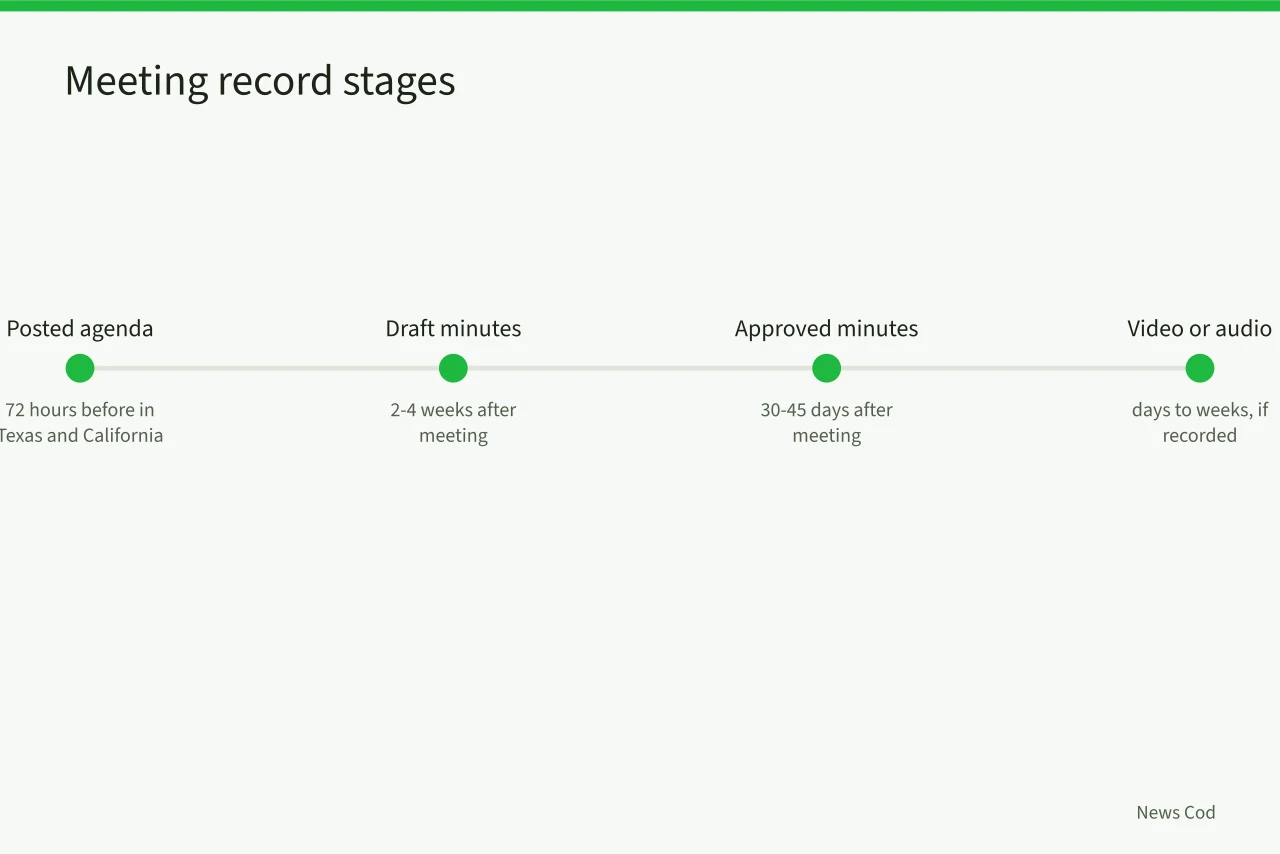
| Stage | What to check | Typical duration |
|---|---|---|
| Posted agenda | District board portal or bulletin board | Regular meeting: 72 hours before meeting in Texas and California; emergency: 2 hours in Texas |
| Draft minutes | Board secretary or district clerk | Posted within 2-4 weeks after the meeting, often before approval |
| Approved minutes | Final board-approved record | Available after the next board meeting, often 30-45 days after the original meeting |
| Video or audio | District website or archive | Posted within days to weeks, if the district records at all |
After the agenda stage, you can compare what was listed for action with what people say happened. A public comment is not board action. If the agenda lists an item as discussion only, a vote cannot be confirmed from that record. If you are comparing districts in different states, the state public records compared guide explains deadlines.
What has to exist before what
Three records must line up before you can confirm a board vote. First, a posted agenda must exist before the meeting. Without it, you cannot know whether the item was properly noticed under open meetings laws. Second, draft minutes must exist after the meeting, but they are not final. Third, approved minutes must exist after the board votes to accept them at a later meeting.
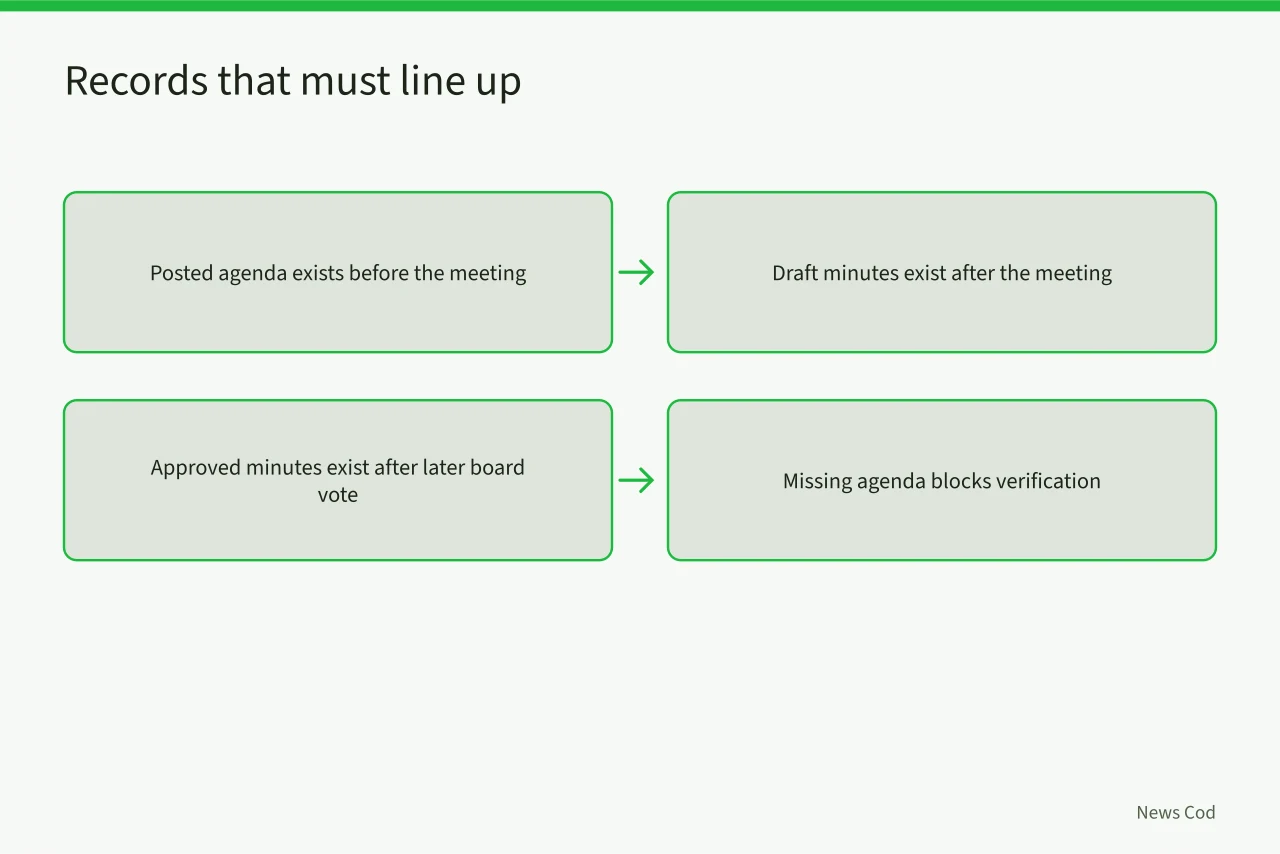
The missing link is often the agenda. If a district never posted an agenda for the date claimed, that missing record is a blocker. You cannot verify the vote from minutes or video because the official notice is absent. The same rule applies to a closed session item. The difference between an agenda, draft minutes, and approved minutes is explained in public document types and statuses.
Where it stalls
The most common failure mode is the agenda item that looks like a decision. A reader sees an item titled Budget update and shares that the board approved a budget change. The cause is a one-word label: the agenda said discussion or information, not action. Because the board did not vote, the minutes will never show an approval.
A second stall is draft minutes treated as final. Districts often post draft minutes before the next board meeting. A person shares them as the official record. Then the board edits or rejects the draft. The cause is early publication, not a hidden plot. Wait for the board to vote on the minutes before citing them as final.
What to do while waiting
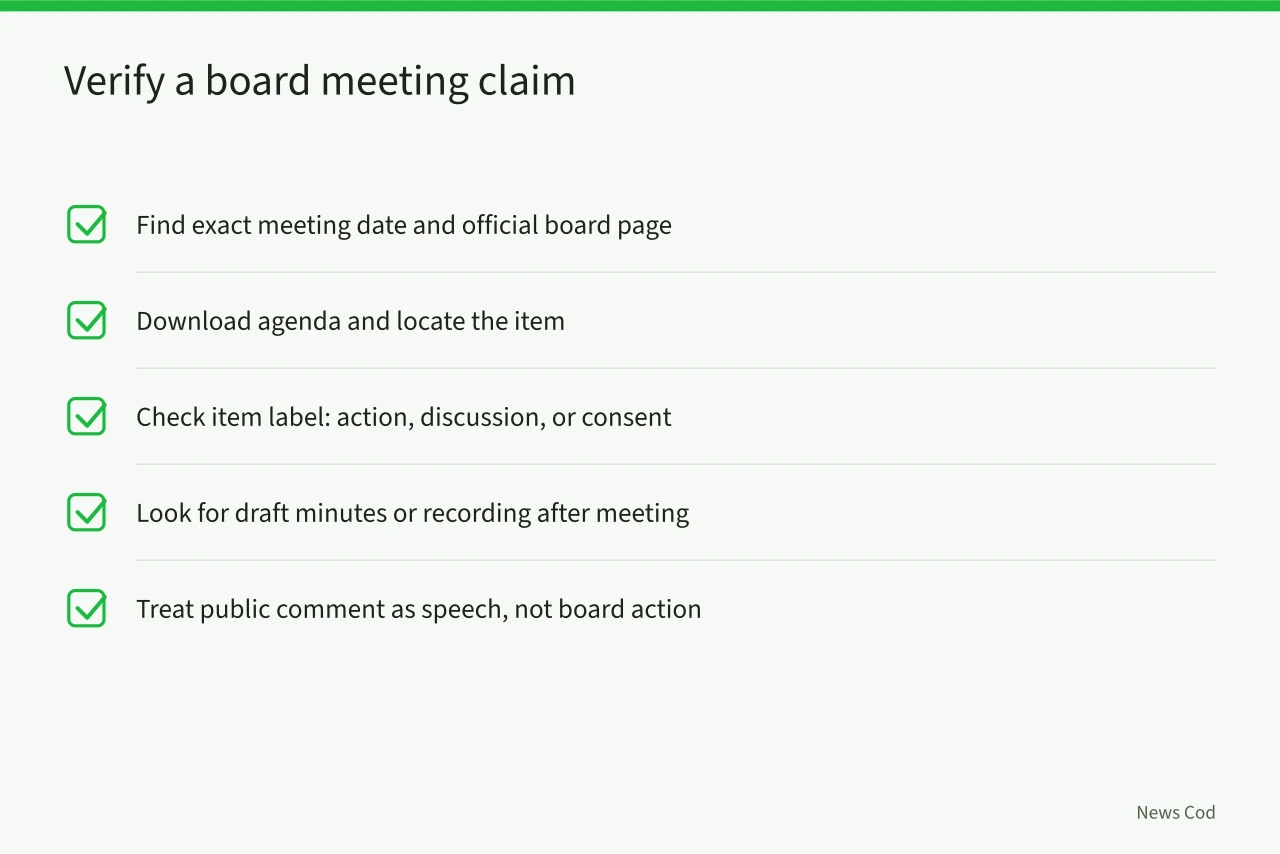
- Find the exact meeting date and the board's official page.
- Download the agenda from the district portal and locate the item.
- Check the item label for action, discussion, or consent.
- Look for draft minutes or a recording after the meeting.
- If only a public comment exists, treat it as speech, not board action.
While waiting for approved minutes, use a records request only if the district has a portal gap. A broader government records and public documents verification guide may help if you need other local records.
Example: Texas and California portals
Texas school boards often use a board management portal with separate tabs for agendas, minutes, and recordings. A Houston ISD agenda PDF, for example, lists items with labels like Information or Action. You can download that PDF and match the item number to the claim. California districts follow the Brown Act and post agendas on their public board pages. A Los Angeles Unified School District agenda lists each item and allows public comment before or during the meeting on agenda items.
In both states, the posted agenda must be specific enough to inform the public of what may be decided. If a claim says the board approved an item that appears only as discussion, the official record will not support it. Check the next meeting's minutes to see if a vote was later added. If not, you have no confirmed board action.
Common questions
Do I need to check both the agenda and the minutes? Yes. The agenda shows what the board was allowed to decide. The minutes show what the board actually did. One without the other leaves the claim half-verified.
How much notice does a Texas school board have to give? A regular meeting generally requires 72 hours of posted notice. An emergency meeting can be posted with as little as two hours of notice. Check the district's local posting rules.
Are draft minutes enough to confirm a vote? No. Draft minutes are a staff record, not the board's final action. The board usually approves minutes at its next regular meeting.
What if the meeting was closed for a student matter? Closed session records may be limited by FERPA, which protects student education records. If a board decision is challenged in federal court, the PACER FAQ explains how to retrieve the filings.