Guides
5 Checks for a State Bill Signing Claim Before You Report It
Verify bill signing claim with five checks against state legislature bill status pages, governor veto records, and official enacted laws databases online.
What to take away
- A bill signing claim is only as good as the chamber's own status page on the day you check it, not a press release or a screenshot.
- Measure one thing: days between the legislature's final passage entry and the governor's action entry. Under 10 days, the record is usually complete. Over 30 days, treat the claim as unverified.
- Governor action logs are the second source, and they disagree with bill pages more often than people expect.
- No single metric tells you whether a bill became law. Enacted laws databases lag, and some states never post veto messages at all.
- Stop measuring when two independent official sources agree on the same status and date.
What to measure
The metric is the governor action gap: the number of calendar days between the date the legislature records final passage and the date the governor's office records a signature, veto, or no action.
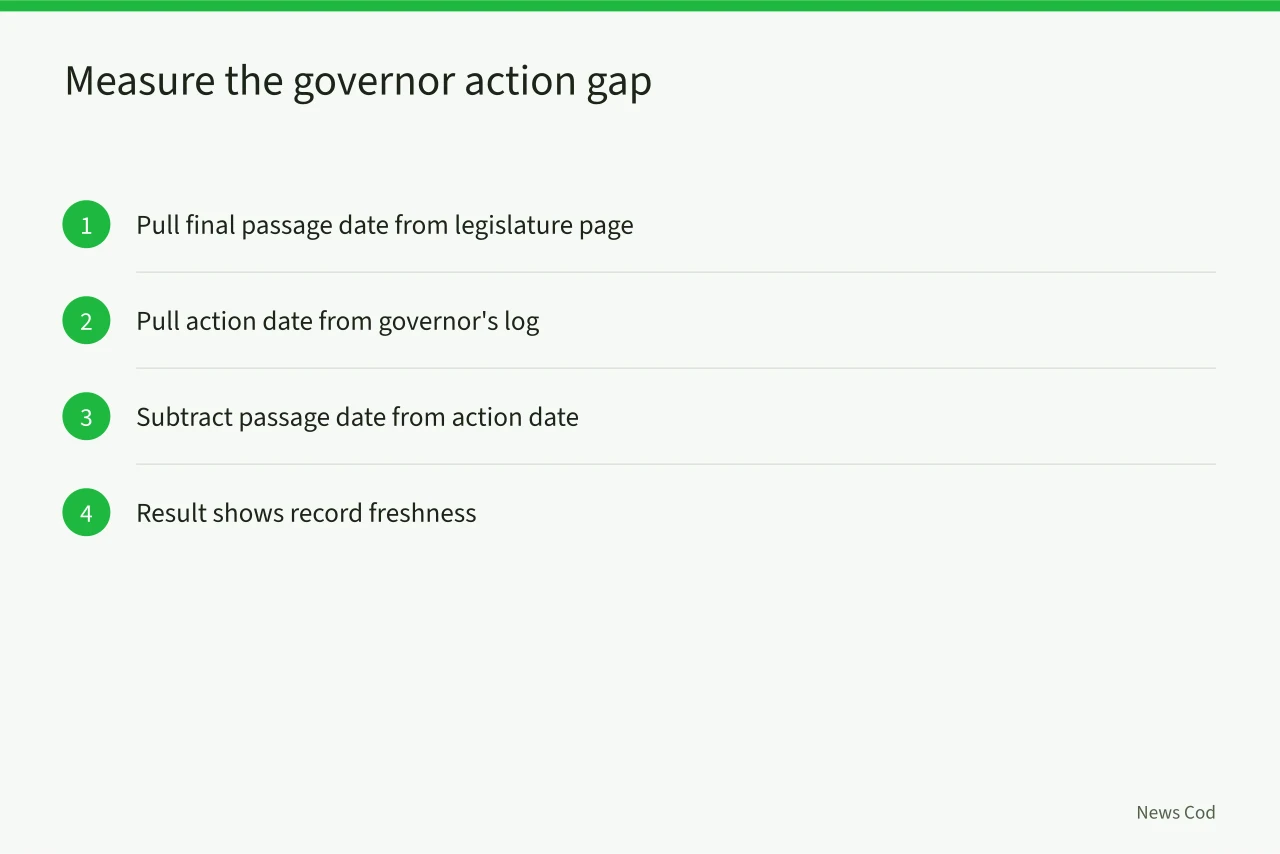
Pull both dates from official pages. The legislature posts them under a bill number, and the governor's office posts them in an action log or press release archive. Subtract one from the other. That single number tells you how current the record is and whether anyone has actually confirmed the outcome.
Use a government records and public documents guide to keep your sourcing consistent across states, because the fields are not named the same way twice.
How to read the gap
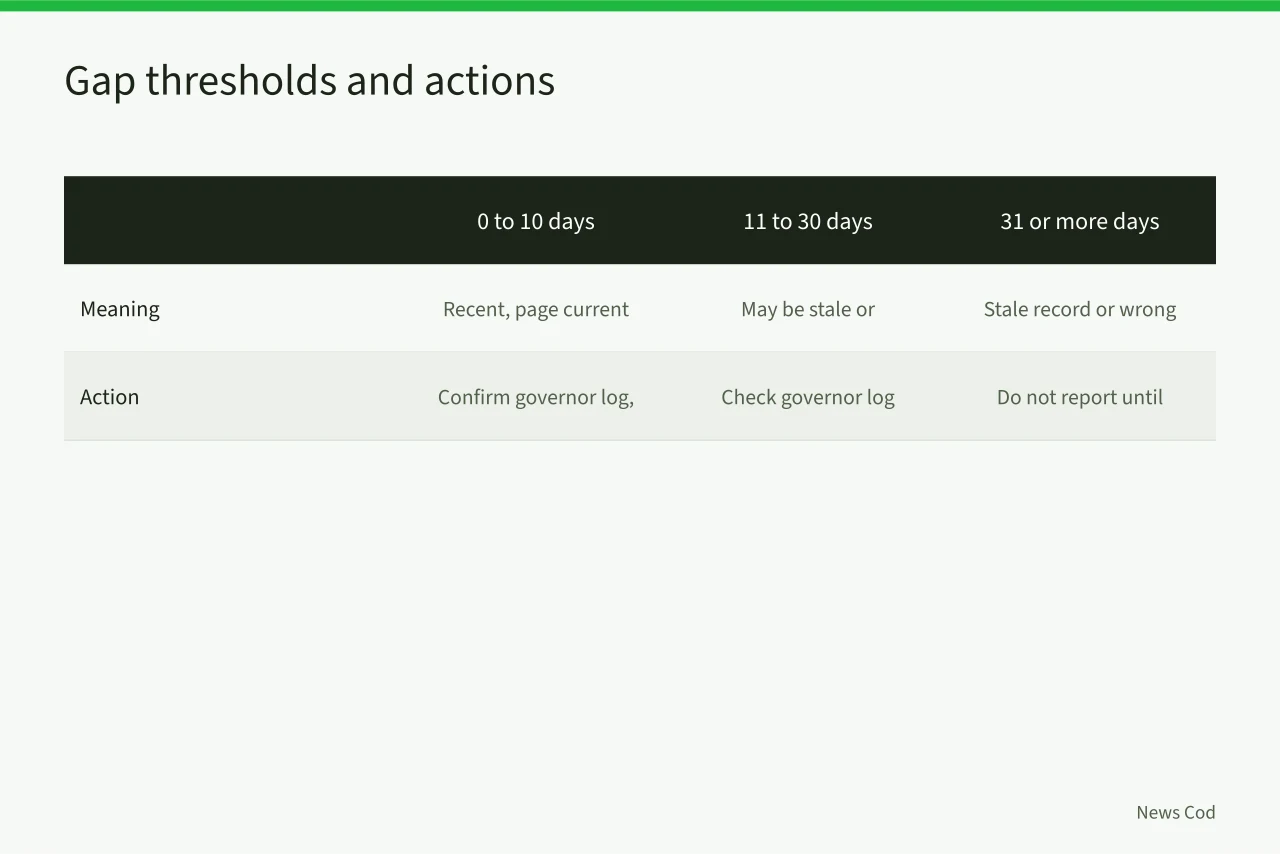
| Gap in days | What it usually means | What to do |
|---|---|---|
| 0 to 10 | Action is recent and the page is probably current | Confirm against the governor's log, then report |
| 11 to 30 | Page may not have refreshed, or the bill is still with the governor | Check the governor's log directly before writing |
| 31 or more | One of the two records is stale or the claim is wrong | Do not report the status until both agree |
The threshold for acting is simple. If the gap is 10 days or less and both sources agree, you can write the status. If the gap exceeds 30 days, you cannot, even if a spokesperson confirms it verbally.
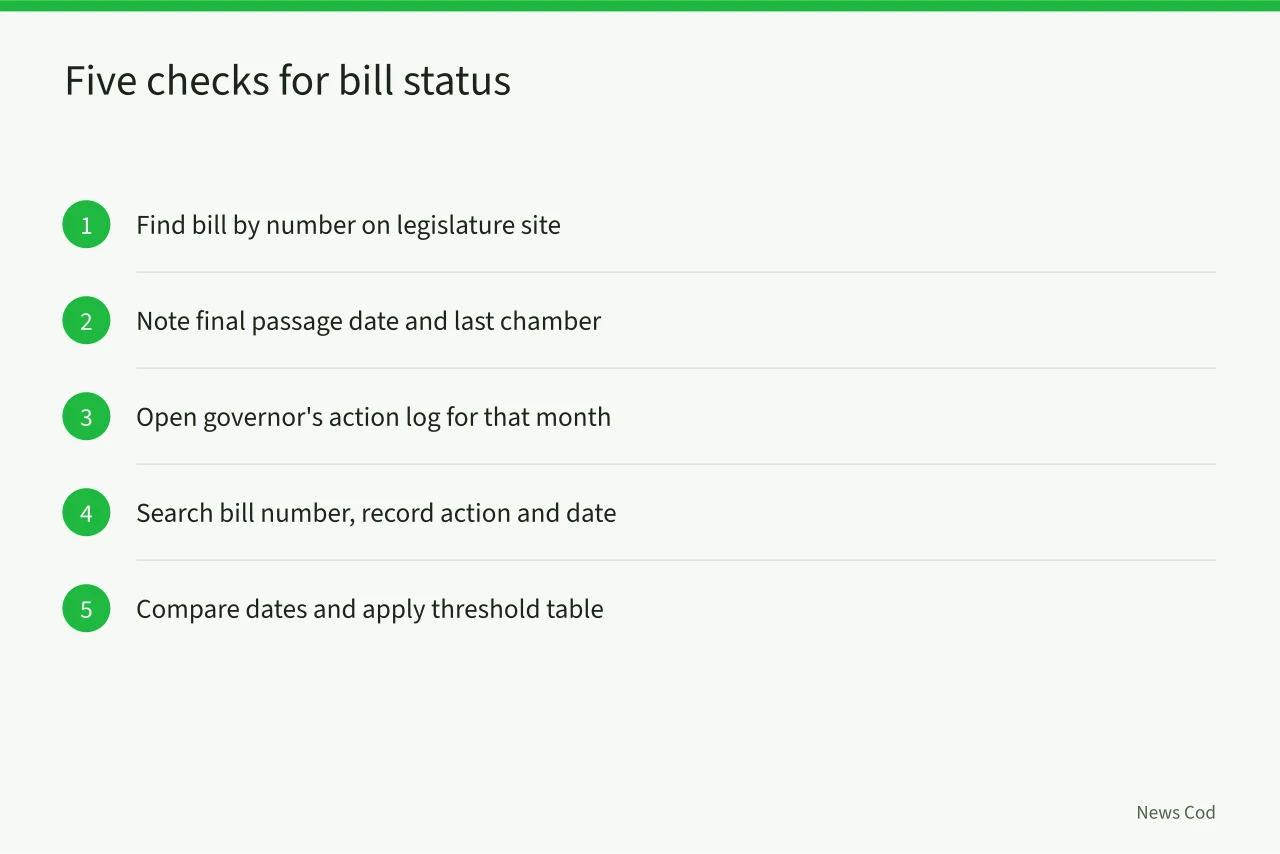
- Find the bill by number on the state legislature site.
- Note the final passage date and the chamber that passed it last.
- Open the governor's action log for that month.
- Search the bill number in the log and record the action and date.
- Compare the two dates and apply the table above.
Example of a gap that misleads
A tip says a state senate bill was signed last week. The legislature page shows final passage 46 days ago and still reads "enacted" with no signature date. The governor's log for that period lists no action on the bill number at all.
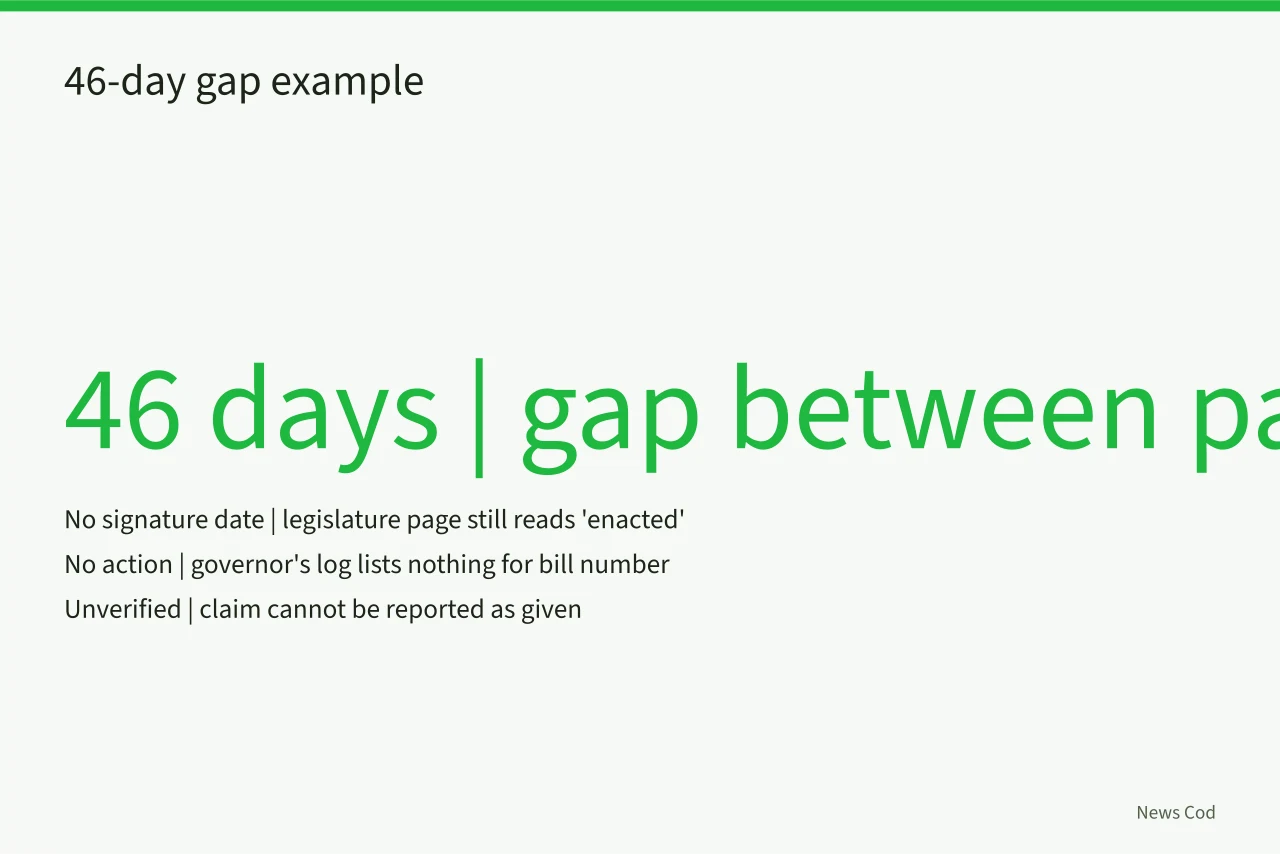
The gap is 46 days, well past the threshold. Two possibilities remain: the governor signed it and the log is incomplete, or the bill died without action. Either way, the claim as given is unverified, and the honest line in the story is that the outcome is not yet documented. A state public records comparison helps when you need to file for the missing record.
A status page is not a legal record. It is a database entry, and database entries get edited, backfilled, and occasionally reversed.
What it cannot tell you
This metric measures record freshness, not legal effect. A bill can be signed and still not take effect for months, and a veto can be overridden after the gap closes.
It also cannot detect a bill that was amended into a different bill, or a chaptered version that replaced the original text. Those cases need the enrolled version, not the status line. And it says nothing about appropriations, which live in separate budget bills.
The biggest blind spot is states with weak posting habits. A long gap there reflects an understaffed clerk, not a dead bill.
Attribution and its limits
Attribute the status to the specific page and the date you checked it. "According to the legislature's bill status page, checked March 4" is defensible. "The bill was signed" is not, unless the governor's log says so.
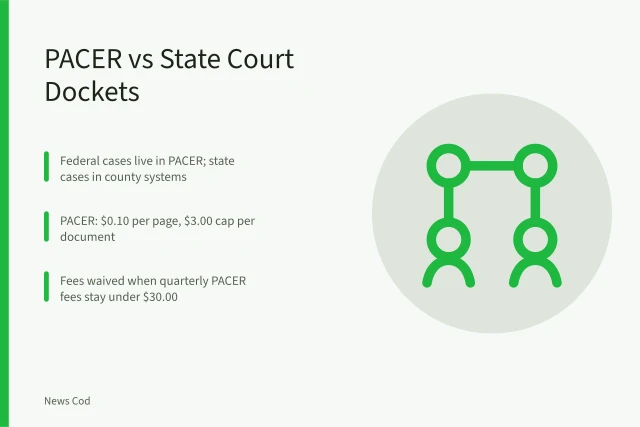
Keep the two sources separate in your notes. If a reader asks, you should be able to say which page carried which date. For federal comparisons, the same discipline applies to court records, and the PACER FAQ explains how those documents are accessed and verified.
When to stop measuring and decide
Stop when two official sources agree. At that point more checking adds nothing, and the story needs to run.
Stop early, before the threshold, only if the governor's office confirms in writing and you have the document. A verbal confirmation is not a second source.
If the gap stays past 30 days and no record appears, write the uncertainty into the story. Saying the outcome is undocumented is accurate, and it is better than repeating a claim the state's own pages contradict. The federal court system's caseload statistics show the same principle at work: the published table is the record, and the record is what you cite.
Common questions
How many sources do I need before reporting a bill signing? Two independent official sources with matching dates. A legislature page plus a governor action log is the standard pair.
What if the governor's office has no public log? Some states do not post one. In that case, file a records request and report the gap as unresolved until the document arrives.
Does a press release count as a source? It counts as a claim, not a record. Use it to find the bill number, then verify against the legislature and the governor's office.
Can I rely on an enacted laws database alone? No. Those databases lag by weeks or months, and they often omit vetoes entirely. Treat them as a third check, never the first.