Maintenance
Part of Election and political claim checking guide
Election and political claim verification checklist
Election claim checklist for jurisdiction, sources, result status, ballot math, canvass, audits, recounts, campaign finance, lawsuits, media, and updates.
What to take away
- Fix the jurisdiction, contest, election date, process step, and evidence cutoff.
- Distinguish reported returns, projections, canvass, certification, audit, recount, and contest.
- Reproduce vote, turnout, and finance calculations from properly scoped records.
- Attribute political, campaign, witness, and legal statements to their speakers.
- Plan updates for changing results, filings, and litigation.
Use this checklist for election results, viral voting claims, candidate records, campaign finance, political statistics, and election litigation. Add a reviewer, result, retrieval time, and evidence path for every material check.
Claim and jurisdiction
- Exact claim and original speaker captured
- Compound statement split into testable parts
- State, locality, district, precinct, and contest identified
- Election date and type confirmed
- Responsible state and local officials identified
- Governing law, rule, procedure, or order current for the claim date
- Evidence cutoff and time zone recorded
Source identity
- Official website and account reached independently
- Result portal, document, dataset, or filing identifier saved
- Screenshots traced to full pages and original files
- Candidate or campaign source separated from election administrator
- Media report traced to its stated evidence
- Multiple reports checked for independent origin
Result status
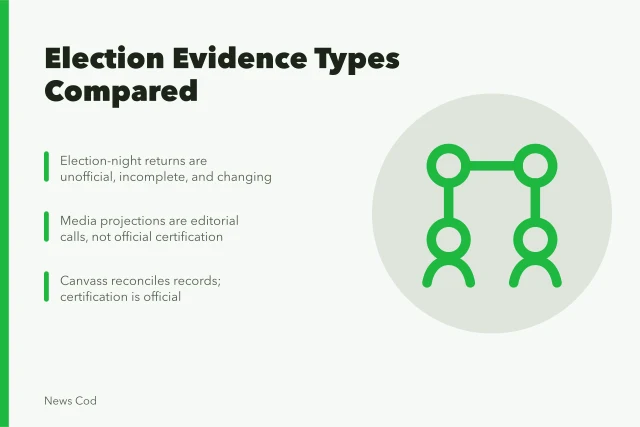
- Election-night return labeled unofficial
- Media projection attributed to outlet
- Reporting units and outstanding ballot categories checked
- Canvass stage and expected completion recorded
- Certification body, instrument, and date identified
- Later correction, recount, contest, or court action checked
- "Winner" language matched to current status
Canvass and reconciliation
- Ballots issued, cast, returned, accepted, rejected, and counted reconciled where relevant
- Early, mail, Election Day, provisional, challenged, military, and overseas categories considered
- Chain-of-custody and incident documentation reviewed for the specific allegation
- Discrepancies described with cause, resolution, and possible outcome effect
- Observer claims compared with procedure and records
The Election Assistance Commission's Guide to the Canvass emphasizes reconciliation, chain of custody, documented issues, valid ballot inclusion, and public communication on the route from unofficial returns to certification. State and local law still controls the particular canvass.
Canvass reconciliation steps
- Reconcile ballots issued, cast, returned, accepted
- Consider early, mail, provisional, military categories
- Review chain-of-custody for specific allegation
- Describe discrepancies with cause and resolution
- Compare observer claims with procedure and records
Numbers and denominators
- Candidate, contest, county, and statewide totals use matching snapshots
- Ballots distinguished from votes in a contest
- Undervotes, overvotes, write-ins, and blank contests considered
- Registration denominator matches place and date
- Turnout formula stated
- Rounding and percentage basis checked
- Changes between result files tied to batches, corrections, or jurisdictions
Audit, recount, and contest
- Audit type, sample, selection, threshold, and escalation rule named
- Audit result separated from initial count and recount
- Automatic, requested, or court-ordered recount basis identified
- Recount scope, timing, requester, and cost rule checked
- Election contest separated from recount request
- Final totals and winner change, if any, reported precisely
Security claim
- System at issue identifiedregistration, pollbook, voting, tabulation, reporting, or office IT
- Outage, attempted intrusion, access, compromise, data change, and outcome effect distinguished
- Technical claim supported by logs, assessment, or responsible expert
- Absence-of-evidence statement bounded to source scope and time
- Election process safeguards checked without treating them as proof about a specific incident
CISA's statement on the security of the 2024 elections said the agency had no evidence of malicious activity with a material impact on election-infrastructure security or integrity, then pointed to state and local certification work. Cite the scope and date of such statements rather than turning them into timeless claims about every allegation.
Security claim verification
- Identify systemregistration, pollbook, voting, tabulation
- Distinguish outage, intrusion, access, compromise, data change
- Support technical claim with logs or expert
- Bound absence-of-evidence statement to scope and time
- Check safeguards without treating as proof
Campaign finance
- Candidate and committee identifiers confirmed
- Committee type and relationship to candidate stated
- Filing coverage period and amendment status checked
- Receipt, expenditure, transfer, refund, loan, debt, and memo entry distinguished
- Aggregation rule and date range documented
- Committee disclosure not called an FEC finding
- Newsroom total reproduced from raw transactions where material
Political and legal records
- Speech or ad reviewed in full context
- Policy proposal distinguished from enacted measure
- Complaint allegation separated from court holding
- Docket entry and later status checked
- Poll population, wording, field dates, method, and uncertainty recorded
- Candidate biography claim checked through primary records
Visual evidence
- Earliest post and highest-quality file preserved
- Location and date verified independently
- Visible process identified before intent assigned
- Ballots, envelopes, blank stock, test decks, and other papers distinguished
- Edit, crop, speed, sequence, and audio context examined
- Personal voter information protected
Publication and updates
- Headline, chart, caption, alert, and social copy use same status
- Uncertainty and missing evidence placed near finding
- Responsible office and affected party given a fair chance to respond
- Next official step and date included
- Monitoring owner assigned
- Correction reaches every distributed format
Common questions
Must a story wait for certification?
No. It can report unofficial results with clear status, source, cutoff time, outstanding work, and planned updates.
Is a result-site outage evidence of changed votes?
No. Establish which system failed, whether it connects to tabulation, what records changed, and what officials verified.
Does an audit erase every concern?
No. Report what the audit tested, its scope, findings, limits, and escalation rules.
Can official statements conflict?
Yes. Identify each office's authority, records, scope, time, and specific wording, then resolve the factual difference where possible.