Rules
Part of Election and political claim checking guide
Common election and political reporting problems
Election reporting problems explained, including premature winner claims, turnout math, audit and recount confusion, finance errors, and unsupported fraud labels.
What to take away
- State the contest, jurisdiction, result status, source, and retrieval time with every changing total.
- A process irregularity, technical incident, or counting correction is not automatically fraud or outcome-changing error.
- Turnout, vote-share, and finance claims fail when denominators, periods, or entities do not match.
- Candidate statements and legal filings need attribution; they do not verify themselves.
- Repair alerts, charts, result widgets, and social cards when a correction changes the conclusion.
Election coverage compresses changing processes into short labels. The resulting errors are predictable. Each problem below includes a direct repair.
1. Unofficial returns become final results
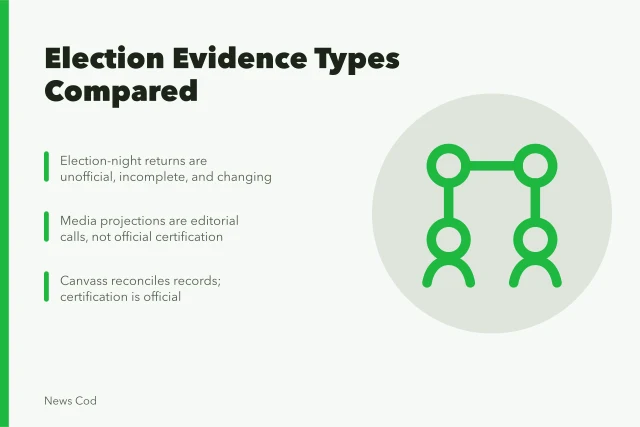
Election-night totals are published as if all eligible ballots have been processed and the responsible official has certified the contest.
Unofficial vs Final Results
Unofficial returns
- Status
- Reported
- Ballots
- Outstanding categories
- Timing
- Cutoff time
- Language
- Use reported
Final certified results
- Status
- Certified
- Ballots
- All eligible processed
- Timing
- Certification schedule
- Language
- Use final
Repair: Use "reported," "unofficial," and a cutoff time. Name outstanding ballot categories and the certification schedule.
2. A projection becomes an official declaration
A news outlet calls a race, and another story says election officials declared the winner. The projection's methods and institutional source disappear.
Repair: Attribute the projection to the outlet. Report the official status separately.
3. "100% reporting" becomes "all votes counted"
A dashboard shows all precincts reporting, but mail, provisional, cure, military, or overseas ballots can still be processed under local law.
Repair: Check the portal's definition and remaining categories. Do not infer completeness from one label.
4. A changing total becomes evidence of fabricated ballots
Successive uploads add batches or correct a display. A post subtracts two snapshots and calls the difference fraudulent.
Repair: Match contest, reporting units, timestamps, and ballot categories. Ask the office to reconcile the change and inspect supporting records.
5. A counting delay becomes a voting deadline violation
A ballot counted after election night is called a vote cast late. Casting, postmark, receipt, cure, processing, and tabulation deadlines are conflated.
Repair: Identify the governing event and rule. State when the ballot had to qualify, not merely when it appeared in results.
6. Turnout exceeds 100 percent through denominator mismatch
Writers compare ballots from a district or updated registration file with a smaller, older, inactive-only, or precinct-limited denominator.
Turnout Denominator Mismatch
Mismatched comparison
- Geography
- District vs precinct
- Election
- Different elections
- Status
- Inactive-only
- Snapshot
- Older file
Correct comparison
- Geography
- Same geography
- Election
- Same election
- Status
- Same status definition
- Snapshot
- Same snapshot date
Repair: Match geography, election, status definition, and snapshot date. Publish the formula and source files.
7. Ballots and contest votes are treated as equal
A voter can leave a contest blank or mark too many selections. The number of ballots cast can therefore exceed valid votes in one race without showing missing ballots.
Repair: Reconcile ballots, contest votes, undervotes, overvotes, and write-ins.
8. An audit becomes a full recount
A sampled audit is reported as if every ballot was counted again. Or a recount is called a forensic audit without describing its actual method.
Repair: Name the process, sample, records, selection, threshold, expansion rule, and conclusion.
9. A recount request proves an error
A candidate requests a recount, and coverage implies officials discovered a faulty count. The request may be allowed by a close margin without prior proof of error.
Repair: State who requested it, the legal trigger, scope, payment rule, and eventual changes.
10. An administrative mistake becomes fraud
Fraud implies intentional deception. A transposition, delayed upload, misplaced form, procedural violation, or equipment fault can be serious without establishing intent.
Repair: Describe the observed act and evidence. Reserve fraud for supported intent under the relevant standard.
11. A website outage becomes a voting-system breach
Registration, pollbook, election-night reporting, office network, voting equipment, and tabulation systems are treated as one system. An outage in a public display is said to have changed votes.
Repair: Identify the affected system, connection, access, data change, operational effect, and assessment.
12. A candidate name search becomes campaign finance research
Names can vary, donors can share names, and a candidate can have multiple committees. Outside groups can spend independently. A simple search produces duplicate or incomplete totals.
The Federal Election Commission's guide to researching candidates points researchers to candidate and authorized-committee filings, cross-references from other committees, receipts, disbursements, cash, and debts. Start with stable IDs and the correct committee relationships.
Campaign Finance Research Checklist
- Record stable IDs
- Identify committee type
- Note filing period
- Check amendment status
- Classify transaction type
- Apply aggregation rule
13. An amended filing is counted twice
Original and amended reports are added together as separate activity. Memo entries, transfers, refunds, and attributed contributions can create more duplication.
Repair: Determine which amendment supersedes which report and follow the FEC data model for the total being calculated.
14. Independent spending becomes a candidate purchase
An outside committee reports spending that supports or opposes a candidate. Coverage says the candidate's campaign spent the money or directed the message without evidence of coordination.
Repair: Name the spender and transaction category. Treat coordination as a separate factual and legal claim.
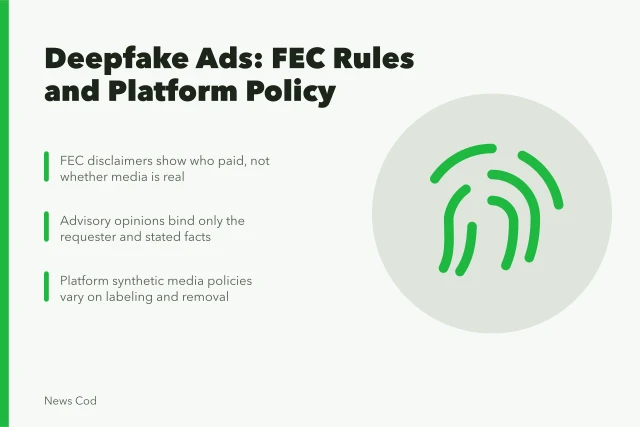
15. A campaign filing becomes an agency finding
A committee reports a transaction, and the article says "FEC records confirm" the underlying purpose or legality.
Repair: Attribute the disclosure to the filer. Search for regulator correspondence, enforcement, or adjudication separately.
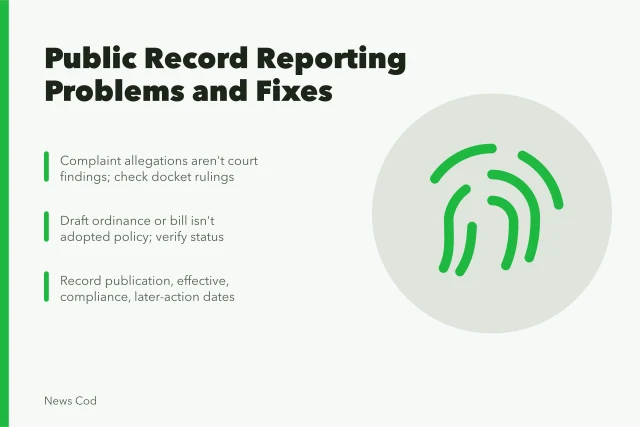
16. A lawsuit becomes proof
A complaint or declaration is summarized as a court finding. Dismissal of a claim is then misreported as proof that every underlying event did or did not occur.
Repair: Identify the speaker, document type, entry, ruling, scope, and current appeal status.
17. A rule from one jurisdiction becomes national
A viral post applies one state's ballot receipt, identification, observation, or recount rule to another state.
Repair: Verify with the current authority and responsible office for the exact jurisdiction.
The Election Assistance Commission's election-official toolkit on rumor versus reality advises checking process claims with the local election official before sharing them. That check should produce a cited procedure or record, not merely an appeal to authority.
18. A correction fixes text but leaves the result card
The body is updated while the push alert, social image, live blog, newsletter, and embedded table retain the false result.
Repair: Use a distribution inventory and make the correction as visible as the original error.
Quick repair table
| Problem phrase | Better form |
|---|---|
| "Candidate wins" during count | "Candidate leads in unofficial returns" |
| "12,000 ballots appeared" | Name result snapshots and batch explanation |
| "Audit recounted all ballots" | State audit method and sample |
| "FEC says donor paid" | "Committee reported in an amended filing" |
| "Court confirms" from complaint | "Campaign alleges in its complaint" |
Common questions
Does precise language weaken an election story?
No. It tells readers what happened at the current process stage and prevents later updates from looking like contradictions.
Can a procedural error affect an outcome without being fraud?
Yes. Investigate error, scope, remedy, and effect separately from intent.
Is a local election official always the final legal authority?
Not on every question. State law, boards, courts, or other officials may control. Identify the authority for the issue.
Should a false claim be repeated in full?
Only when needed for understanding. Lead with verified facts and avoid giving a sensational allegation extra distribution.