Reviews
Part of Election and political claim checking guide
Election and political evidence types compared
Election evidence types compared across returns, projections, canvass, certification, audits, recounts, filings, lawsuits, polls, and campaign speech.
What to take away
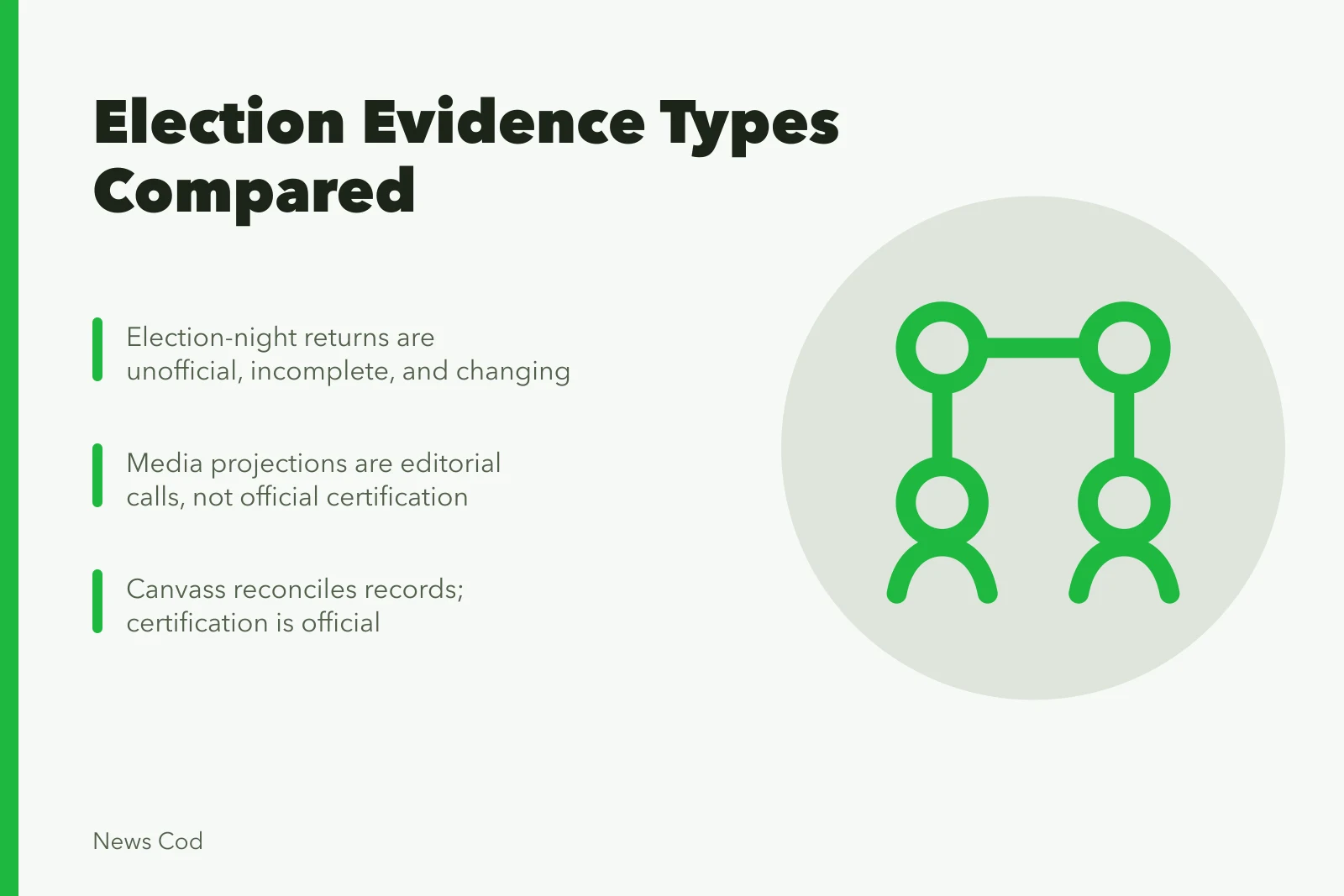
- Election-night returns, media projections, and certified results answer different questions.
- Canvasses, audits, and recounts use different scopes and procedures.
- Campaign finance filings show what filers reported, not automatic regulator findings.
- Lawsuits separate party allegations from court decisions.
- Political speech is primary evidence of what a speaker said, not proof of the underlying claim.
The word "official" can describe a source without describing the status of its information. An official election page may display unofficial returns. An official campaign filing may contain a committee's disclosure. An official court docket may preserve unproven allegations. Use this comparison to state what each source owes.
Core comparison
Evidence types at a glance
Evidence
- Election-night return
- Unofficial count
- Media projection
- Likely winner
- Canvass record
- Reconciliation
- Certification
- Official attestation
- Post-election audit
- Defined check
- Recount
- New count
Best use
- Election-night return
- Incomplete, changing
- Media projection
- Not certification
- Canvass record
- Varies by jurisdiction
- Certification
- Recount may follow
- Post-election audit
- Often samples
- Recount
- Scope, trigger vary
Main limit
- Election-night return
- Media projection
- Canvass record
- Certification
- Post-election audit
- Recount
Best use
- Election-night return
- Current unofficial count
- Media projection
- Outlet's assessed likely winner
- Canvass record
- Reconciliation and aggregation
- Certification
- Official attestation of result
- Post-election audit
- Defined check on tabulation or records
- Recount
- New count under state procedure
- Campaign filing
- Filer's disclosed finance activity
- Complaint or petition
- Party's legal allegations
- Order or judgment
- Court action and reasoning
- Poll
- Estimate of a defined population
- Candidate speech
- What the candidate claimed
Main limit
- Election-night return
- Incomplete and changing
- Media projection
- Not official certification
- Canvass record
- Process varies by jurisdiction
- Certification
- Can be followed by recount or contest
- Post-election audit
- Often samples rather than all ballots
- Recount
- Scope and trigger vary
- Campaign filing
- Amendments and filer errors possible
- Complaint or petition
- Not a judicial finding
- Order or judgment
- Scope and appeal status matter
- Poll
- Not a vote count or forecast by itself
- Candidate speech
- Claim needs independent evidence
Unofficial returns
These are changing totals released before the required post-election process is complete. They can support a time-stamped statement about votes then reported. They do not support "final" unless the jurisdiction has certified the contest.
Check which ballot categories, counties, and reporting units are included. Preserve source files and time zone.
Media projections
News organizations use returns, models, turnout estimates, and reporting to project likely winners. A projection can be accurate and still remain an editorial call. It does not cause or replace certification.
Attribute the call to the organization and state the official count status separately.
Canvass and certification
The canvass reconciles election records, aggregates valid ballots, and resolves discrepancies under local law. Certification is the designated authority's official attestation of results. The exact actors, deadlines, and order differ.
California's account of the official canvass shows the shape of the work in one state. A semifinal official canvass opens at 8 p.m. on election night and runs until the last precinct reports.
Mail ballots are signature-checked and processed on a separate clock that begins days before the election. They may not be tabulated until the polls close; use the relevant state's statute and official calendar for a particular claim.
Audits
An audit checks a defined set of records, equipment outputs, or ballots under a specified method. Some examine samples; some can expand. The question may be whether tabulation was accurate enough to support the outcome, not the exact total produced by a full recount.
Report audit type, sample, selection, tolerance, discrepancies, escalation rule, and final finding.
Recounts
A recount counts ballots again for a contest. It may be automatic, requested, or court ordered. Eligibility, payment, timing, scope, and voter-intent rules vary by jurisdiction. A recount can adjust totals without changing the winner.
Do not call an audit a recount or treat a request as evidence that a recount found an error.
Campaign finance filings
Committees file reports, statements, and notices. Transaction records may be amended, memoed, attributed, refunded, or linked to other schedules. Candidate committees, party committees, political action committees, and independent spenders are not interchangeable.
The Federal Election Commission's guide to researching the public record lists what is available and when: filings must be public within 48 hours of receipt, or 24 hours for electronic ones, and paper filings are scanned and posted.
The online archive reaches back to 1993 for party and presidential committees but only to 2000 for the Senate. Save candidate or committee ID, filing, and coverage period. Save amendment, transaction type, retrieval time.
Lawsuits and adjudicated records
A complaint, petition, brief, declaration, and exhibit come from parties or witnesses. Orders, opinions, and judgments come from the court. A dismissal can turn on procedure or legal sufficiency without resolving every factual dispute.
Report the case, entry, filing party, document type, operative language, outcome, and appeal status.
Administrative and security statements
An election office can explain its procedures and records. A cybersecurity agency may assess a system or threat. A law-enforcement agency may confirm an investigation. Bound each statement to the speaker's responsibility, time, system, and stated evidence.
An absence of evidence in one assessment is not proof about every alleged event. A claim about a public result website does not automatically describe voting systems.
Polls and models
A poll estimates opinion among a target population through a sampling and weighting method. A forecast combines polls and other assumptions. Neither is a count of ballots cast. Exit polls estimate voter behavior and can be revised.
Report field dates, population, sample, mode, sponsor, question, weighting, uncertainty, and model date.
Speeches, ads, and platforms
These are strong primary sources for a speaker's statement, promise, or argument. A platform can state a party's adopted position. Neither proves a claimed statistic or another person's conduct.
Quote enough context to preserve meaning, identify the date and audience, and verify factual components separately.
Matching claims to evidence
Match claims to evidence
Claim
- Candidate won officially
- Certification record
- Count changed by 4,000
- Time-stamped result files
- Audit confirmed tabulation
- Final audit report
- Donor gave committee amount
- Amended filing, transactions
- Candidate promised policy
- Full speech or platform
- Court rejected claim
- Order or judgment
Most direct evidence
- Candidate won officially
- Count changed by 4,000
- Audit confirmed tabulation
- Donor gave committee amount
- Candidate promised policy
- Court rejected claim
| Claim | Most direct evidence |
|---|---|
| Candidate won officially | Certification record and current status |
| Count changed by 4,000 | Time-stamped official result files and explanation |
| Audit confirmed tabulation | Final audit report and method |
| Donor gave committee amount | Relevant amended filing and transaction records |
| Candidate promised policy | Full speech, platform, or recorded statement |
| Court rejected claim | Order or judgment, not opponent's brief |
Common questions
Can certified results change?
Some state procedures allow recounts, contests, or corrections after certification. Describe the current legal status and later action.
Is an audit stronger than a recount?
They answer different questions. Strength depends on design, scope, execution, records, and the claim being tested.
Does an FEC filing prove a donation was lawful?
No. It reports the transaction. Compliance may require separate legal and enforcement analysis.
Is a concession legally decisive?
Generally, a concession is a political statement. Official results follow the governing election process.