Guides
Part of Election and political claim checking guide
How to check a viral election claim in under an hour
Viral election claim workflow for preserving posts, locating jurisdictions, identifying processes, checking official records, verifying media, and publishing status.
What to take away
- Preserve the original post, media, account, engagement, and timestamp before contacting sources.
- Identify the exact jurisdiction and election process shown or described.
- Ask the responsible local or state election office a narrow, reproducible question.
- Verify numbers, documents, images, and videos through independent methods.
- State what remains unknown and when official status may change.
This workflow is designed for a claim spreading while election administration is still underway. Speed matters, but the first accurate answer may be a bounded status update rather than a verdict.
Step 1: preserve the claim
Save the post URL, account handle and numeric identifier where available, profile details, text, attached media, visible timestamp, engagement counts, and replies that supply context. Capture the page and download the highest-quality media without altering the original.
Preserve the viral post
- Save post URL and account handle
- Record numeric identifier and profile details
- Capture text, media, timestamp, engagement
- Download highest-quality media unaltered
- Note when newsroom first saw it
Write down when the newsroom first saw it. Deleted or edited posts can become part of the story, but only if their earlier state was preserved.
Step 2: quote the smallest checkable statement
Remove reactions and split compound claims. A post saying "This video proves election workers secretly added 12,000 ballots after the deadline" requires separate checks of:
Split compound claims
- Check whether the video is authentic
- Find where and when it was recorded
- Identify who the people are
- Determine what material is shown
- Test whether 12,000 is supported
- Clarify which deadline is meant
- Check whether activity was authorized
Create a row for each claim. Do not issue one true-or-false label for a bundle with mixed evidence.
Step 3: locate the jurisdiction
Look for signs, ballot styles, machine labels, staff badges, room layouts, forms, broadcast graphics, file names, accents, weather, and uploader history. Search exact text and distinctive frames.
Confirm the state, county or city, contest, election date, and facility. A rule from another place is not a rebuttal.
Step 4: identify the process shown
Determine whether the activity is registration, ballot issuance, envelope verification, curing, duplication of damaged ballots, tabulation, adjudication, canvass, audit, recount, or storage. Obtain the jurisdiction's written procedure and observation rules.
Identify the process shown
What activity is visible?
Match to written procedure
Describe actions, avoid intent
Describe visible actions before assigning intent. "A worker places a paper stack beside a scanner" is an observation. "A worker adds fraudulent votes" is a conclusion requiring evidence about the papers, system, authorization, and records.
Step 5: find the responsible official source
The Election Assistance Commission's state-by-state directory rests on the premise this step depends on: each state and territory administers elections differently. The directory links to each state election office and local office instead of answering for them, and it tells readers to verify its own summaries against those linked sources.
Identify which office controls this specific process. Then independently find its verified site, public notices, result portal, and contact information.
An official response is evidence about the office's position and records. It does not eliminate the need to inspect the underlying procedure, logs, and media.
Step 6: ask a narrow question
Send the original media and state the claim without amplifying its rhetoric. Ask:
Ask a narrow question
- Is this your facility and election?
- What date and process does it show?
- What are the papers or devices?
- Who is authorized to perform the action?
- Which logs or observers can confirm it?
- Did an incident occur and was it resolved?
- Where is the governing procedure published?
Record who answered, their role, time, and evidence cited.
Step 7: verify the media independently
Find the earliest available upload. Reverse-search key frames. Compare architecture, furniture, equipment, signs, and clothing with official images. Check shadows, clocks, weather, and event schedules for time. Inspect metadata while recognizing that platforms often remove it.
Look for cuts, repeated sequences, changed speed, missing audio, or captions added later. A genuine clip can still carry a false date or explanation.
Step 8: test the number
Trace "12,000" to its first appearance. It may be an estimate, difference between result snapshots, total ballots in a batch, registered-voter figure, or number copied from another jurisdiction.
Save official result files with timestamps. Compare like contests and reporting units. Ask which ballot categories or jurisdictions changed. Reproduce the arithmetic and retain the denominator.
Step 9: check the deadline and legal claim
Identify whether the claimed deadline concerns voting, postmark, receipt, curing, canvass, certification, recount request, or another step. Locate the current state or local authority and any court order. Quote the operative language and date.
Do not call a ballot illegal merely because it was counted after election night. The relevant question is whether it qualified under the governing rules.
Step 10: look for independent records
Seek observer reports, chain-of-custody logs, incident tickets, canvass documents, meeting video, court filings, audit reports, and result snapshots. Independence comes from origin, not the number of websites repeating the same press release.
If an observer makes an allegation, obtain the full statement and what the observer could see. Then compare it with process records and responses.
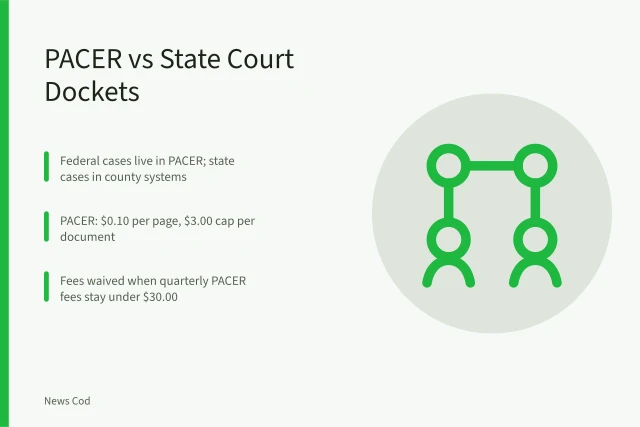
Court filings are the most retrievable of those records. The federal judiciary's case lookup service holds filings from district, bankruptcy, and appellate courts, and where an electronic file is unavailable the same paperwork can be read at the courthouse where the case was filed. Cite the docket entry, not a description of it.
Step 11: publish a bounded finding
Use a structure that exposes the evidence:
Publish a bounded finding
- Claim:exact statement.
- What the media shows:direct observations.
- Where and when:verified or unresolved.
- Process:official description and record evidence.
- Numbers:calculation and source.
- Status:what is known at the cutoff time.
- Next step:canvass, certification, audit, hearing, or update.
Avoid repeating a graphic allegation in the headline when the verified subject can be named directly.
Step 12: monitor and correct
Set alerts for the result page, official account, docket, and relevant meeting. Preserve new versions. If later records change the finding, update the headline and distributed posts, add a dated note, and explain what new evidence arrived.
Common questions
What if the election office does not answer quickly?
Publish only verified observations and explain the unanswered questions. Continue checking official records and other independent evidence.
Is a blue check enough to identify an election office account?
No. Confirm through the jurisdiction's official website, stable contact information, account history, and independent references.
Should the newsroom embed the viral post?
Only when needed and with context. Embedding can reward or spread a false claim, expose personal data, and preserve material the author later deletes.
Can a real video support a false claim?
Yes. Authentic media can be old, from another place, edited, or paired with an unsupported description.