Maintenance
How to Verify a US or Canadian Amber Alert Text Before You Forward It
How to check a US or Canadian Amber Alert text before forwarding: sender, official feeds, provincial coordinators, and the scam signals that fail every test.
What to take away
- A real Amber Alert arrives as a Wireless Emergency Alert from your carrier, or through an official state, provincial, or national feed. A random ten digit text is not an alert.
- Verify before you forward by checking the issuing police agency, the state or provincial coordinator, and the listing at the National Center for Missing and Exploited Children.
- Genuine alerts never ask for money, gift cards, or a payment link, and they are not chain messages begging you to share them.
- When no agency has confirmed the case in public, the honest answer is that nobody knows yet, so wait.
How a real Amber Alert reaches your phone
In the United States, Amber Alerts move through the Wireless Emergency Alerts system. The Federal Emergency Management Agency runs it, the Federal Communications Commission sets the carrier rules, and the National Center for Missing and Exploited Children coordinates the program nationally.
Wireless alerts are short by design. The FCC caps them at 90 characters on older networks and 360 on newer ones.
A message sent this way arrives with a distinct tone and vibration, and it targets cell towers near the abduction. A relative three states away may never receive it. Department of Justice guidelines call for a confirmed abduction, a child at risk of serious injury or death, and enough detail to help the public.
In Canada, alerts travel through Alert Ready while the Amber Alert itself is issued provincially. Ontario's coordinator is the Ontario Provincial Police, Alberta's is the RCMP, and Quebec works through the Surete du Quebec. Criteria differ by province, but they generally require a confirmed abduction and a child in danger.
| Where the message appears | What to check |
|---|---|
| Wireless Emergency Alert on your phone | The issuing agency's feed or the state coordinator page |
| Screenshot pasted into a group chat | The child's name on missingkids.org or the provincial alert page |
| Post from an account claiming to be police | The verified account of that police service |
| Chain message with a donation link | Treat it as a scam until an agency confirms the case |
The fast checks before you forward
- Check the sender. A Wireless Emergency Alert arrives through your carrier's alert channel. A scam text comes from a number you do not recognize.
- Search the case. Put the child's name, the plate, or the vehicle description into the official feed for the state or province named.
- Call the agency's non-emergency line. Ask whether the alert is active and whether the details match what you received.
- Compare time and place. Real alerts expire, often within hours or days, and they name a specific area.
Example: a screenshot that fails three checks
Consider a screenshot forwarded into a family group chat. It names a child, a silver van, and a plate, but no police agency.
The message came from a ten digit number rather than the alert channel, and the timestamp is nine days old.
Three checks fail at once. The sender is wrong, the timing is stale, and no agency is named. A genuine alert identifies the issuing department and stays tied to a live case.
Red flags in an amber alert scam text
- The message asks you to call a premium number or send money.
- A link opens a page that requests card details, gift cards, or crypto.
- The text claims police are overwhelmed and asks the public to run the search.
- The same wording appears in many counties with only the child's name changed.
- No police feed, news outlet, or state coordinator lists the case.
Verifying Canadian alerts through provincial feeds
In Canada, the fastest check is the provincial coordinator's public feed. Ontario posts through the Ontario Provincial Police, Alberta through the RCMP, and other provinces run their own pages. Alert Ready adds the wireless layer on top.
The RCMP is a federal institution, so a records request about its alert decisions goes through the Access to Information and Privacy process.
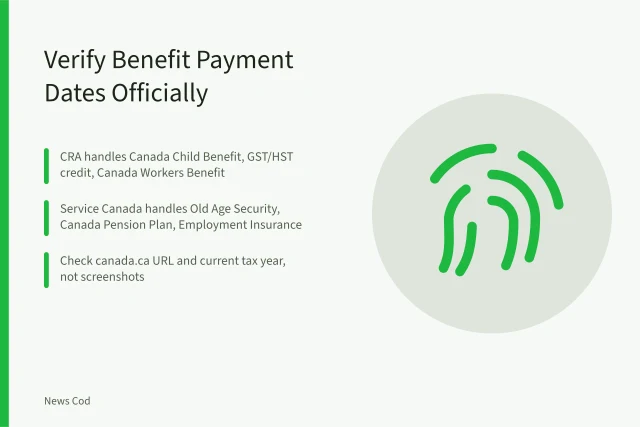
Posts sometimes fold an alert into a wider claim about government money. If a message ties the alert to a benefit deposit, confirm the date at the source and use this method for verifying a benefit payment date claim before sharing it.
When an alert claim rests on scanner traffic or court records
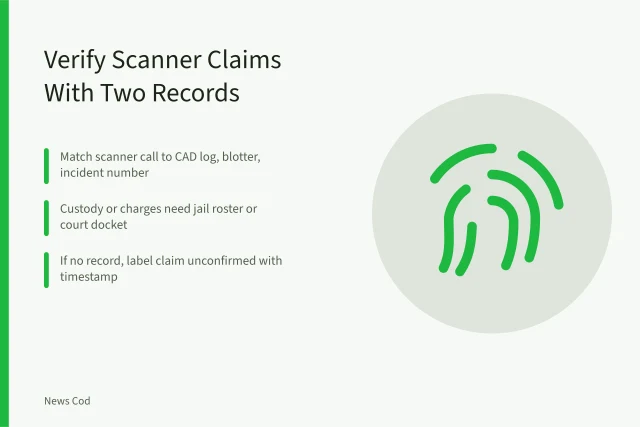
Some posts claim a police radio feed has confirmed the abduction, or that charges were filed within hours. A scanner clip alone proves little, since calls change as officers learn more.
Corroborating what dispatch says takes logs, rosters, and dockets. This guide to confirming scanner traffic before reporting lays out that chain.
If someone is charged, the paperwork sits with the court that has jurisdiction. Abduction charges usually stay at the state level, and the structure of federal courts explains which cases move up.
A screenshot of a filing is easy to fake. The PACER FAQ shows how to pull a docket and confirm a case number yourself.
When the honest answer is that nobody knows yet
Not every claim resolves in five minutes. An agency may issue an alert and cancel it with no public explanation. A post may describe a case that no department will confirm.
In those moments, the correct answer is that the case is unverified. Say that plainly instead of forwarding it.
If the only evidence is a radio clip, work the trail of dispatch logs and court dockets instead of repeating it.
A message that mixes in a benefit payment claim needs a different route, and checking a federal benefit payment calendar at the source settles it fastest.