Maintenance
EPA Water Quality Reports: How to Verify a Local Utility's Boil-Water Notice
How to read a utility's consumer confidence report and SDWIS record to confirm or debunk a local boil-water or contamination claim, step by step.
What to take away
- A consumer confidence report is an annual, legally required summary of what a utility detected. It is not a live status page.
- A boil-water notice usually comes from the utility or the state primacy agency, and it is often precautionary.
- The Safe Drinking Water Information System stores violation and enforcement records you can compare against a claim.
- When the notice, the report, and the database disagree, say so instead of picking a side.
How a consumer confidence report is organized
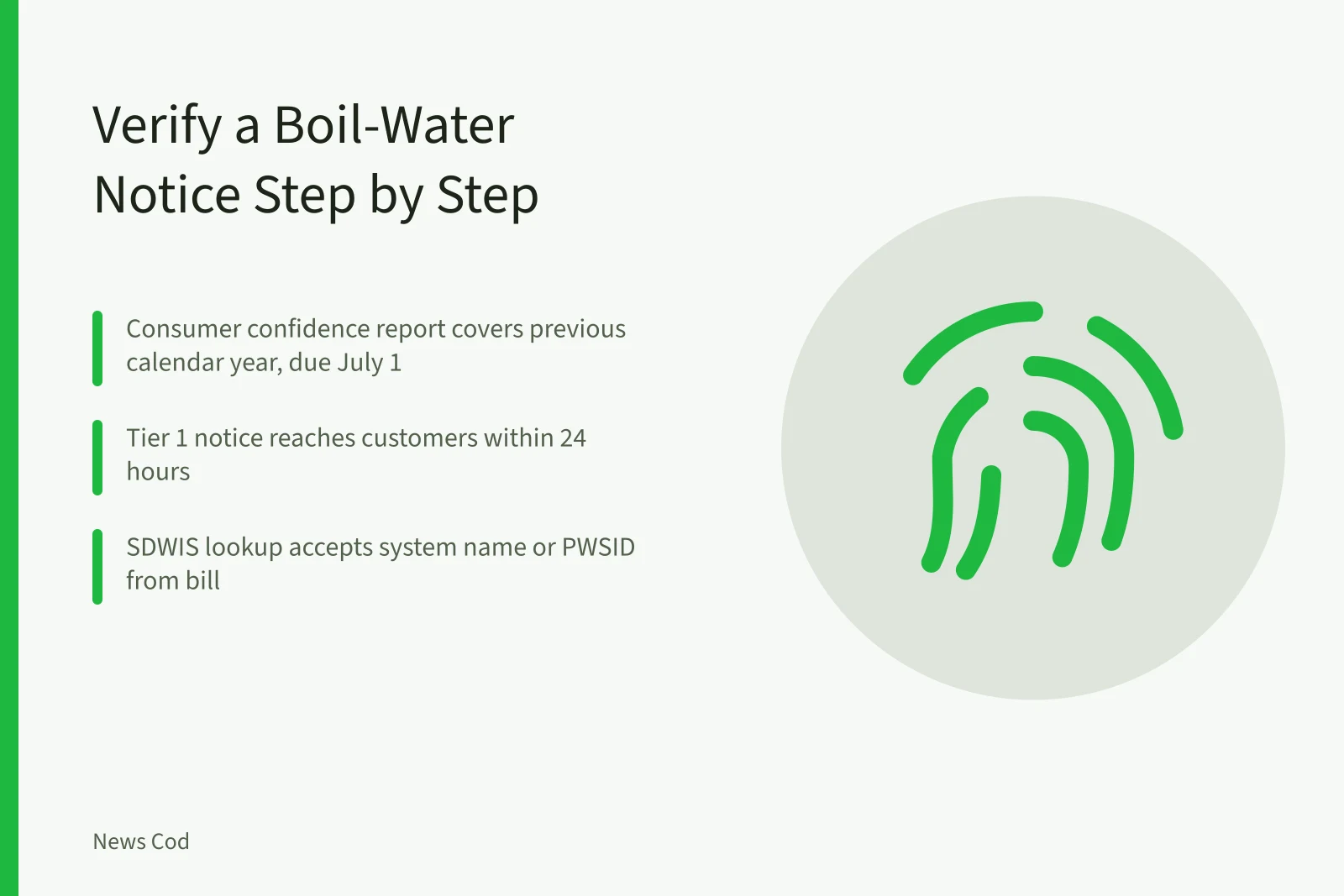
Community water systems must deliver a consumer confidence report by July 1 each year, covering the previous calendar year. The EPA explains what a consumer confidence report must contain and how to request one from your supplier.
A report lists detected contaminants, the level allowed, the highest level found, and the typical sources of each. It also carries health effects language for any violation.
Small systems may publish the report in a newspaper instead of mailing it. Every report must state whether the system met each standard it was tested against.
Reports also name the source water, such as a river, a lake, or a well field. That detail matters when a claim names a specific creek or treatment plant.
Reading the notice itself
Boil-water notices are tiered under the total coliform rules. A Tier 1 notice reaches customers within 24 hours.
Tier 1 covers an E. coli maximum contaminant level violation, a treatment technique failure, or a situation with serious potential harm. Tier 2 allows 30 days. Tier 3, for monitoring problems, can appear in the annual report instead.
A notice describes a risk, not a measurement. Ask which sample, taken when, triggered it.
Checking the SDWIS record
The Safe Drinking Water Information System lookup accepts a system name or the PWSID printed on your bill. It returns violations, enforcement actions, and the primacy agency for the system.
EPA publishes enforcement actions taken against drinking water systems, including formal orders. Compare those dates with the date on the notice you saw.
Check each item against the claim:
- System name and PWSID match the notice.
- The violation date falls near the notice date.
- The named contaminant appears in a recorded violation.
Three documents answer three different questions.
| Document | What it tells you |
|---|---|
| Boil-water notice | The risk and instructions for the day it was issued |
| Consumer confidence report | Detected contaminants and violations for the previous calendar year |
| SDWIS record | Violation and enforcement history for the system |
Example: a claim about a lead result
A neighborhood group posts that the utility "failed its lead test." You open the most recent report and find the 90th percentile lead value.
Lead is measured against an action level of 0.015 mg/L, not a maximum contaminant level. At or below that level, a utility still owes corrosion control and, sometimes, public education. The post may be wrong in either direction.
EPA lists which contaminants are regulated and at what level. Use it to check whether the substance in a post is regulated at all.
Steps to verify a notice
- Record the system name, PWSID, and the date and time printed on the notice.
- Identify the triggera pressure loss, a sample result, or a treatment failure.
- Open the most recent consumer confidence report and locate the named contaminant.
- Search the SDWIS record for violations and enforcement dates.
- Call the utility or the state primacy agency and ask which sample triggered the notice.
- Publish what you confirmed and label everything else as unknown.
What a report cannot tell you
A consumer confidence report covers one utility and one year. It cannot describe a private well, an apartment building's internal plumbing, or a school's own lines. A notice about a building is not automatically a notice about the supply.
Where local claims get lost
Regional planning documents and roadside studio mockups show how local facts get lost when a 2027 forecast is repeated as a settled outcome.
A statewide map can be accurate for its own purpose while saying nothing about your town's pipes. The same gap opens between a notice and a claim built on top of it.
Before repeating a number from a report, work through an EPA report verification checklist that covers ECHO, state portals, and Clean Water Act limits.