Maintenance
FEC deepfake ad rules: how to verify a political video before you share it
How the FEC's fraudulent misrepresentation rule and major platform synthetic media policies apply to a political video, with five checks before you share it.
What to take away
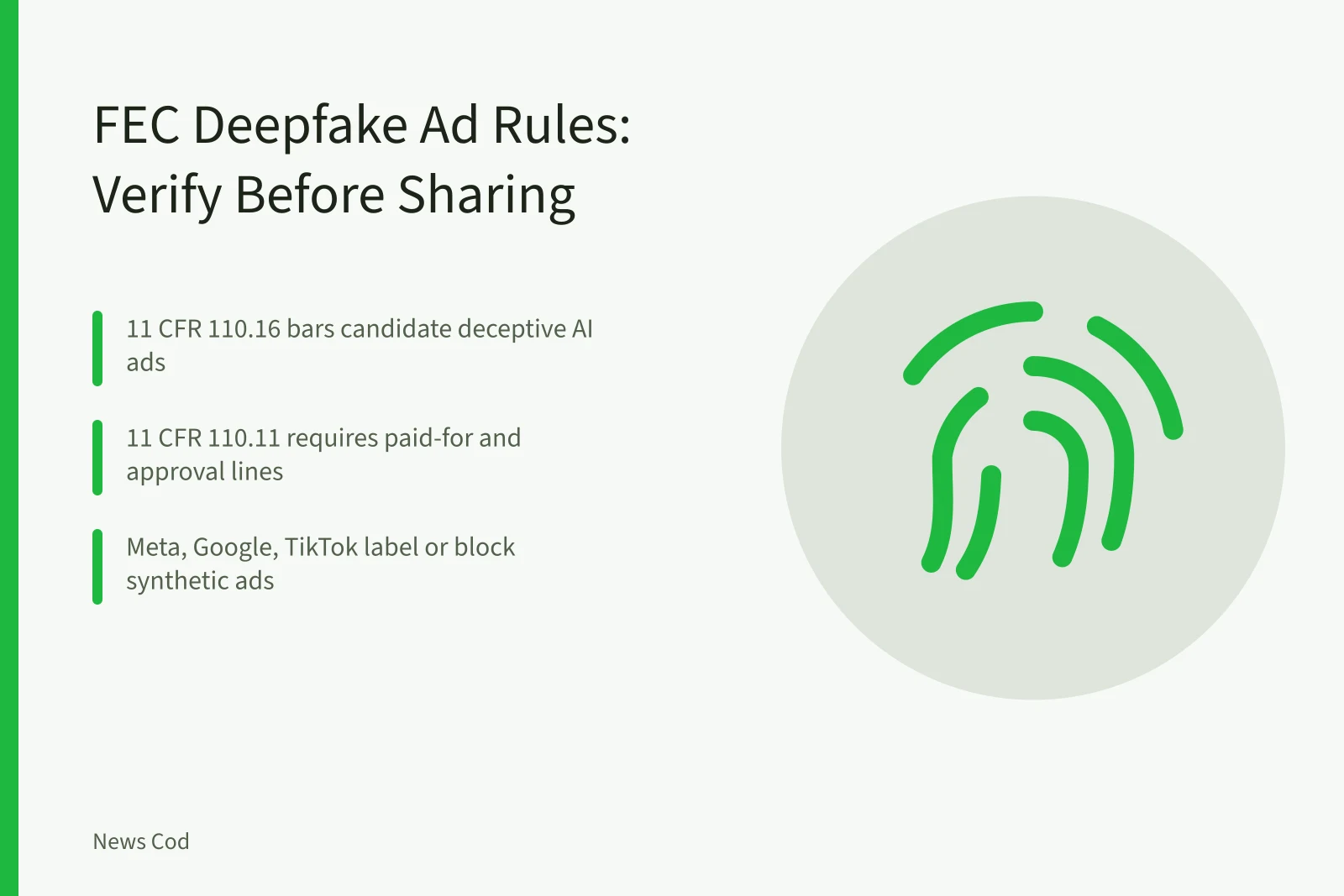
- The FEC's fraudulent misrepresentation rule, 11 CFR 110.16, is the main federal tool against deliberately deceptive AI-generated ads from candidates and their agents.
- Disclaimer rules in 11 CFR 110.11, including the stand by your ad line, tell you who paid for a video.
- Meta, Google, YouTube, TikTok, and Snapchat require disclosure or block realistic synthetic content in paid political ads, and C2PA Content Credentials can carry provenance.
- Four checks settle most casesfind the origin post, read the disclaimer, look at the campaign's own accounts, then inspect the media.
The FEC rule on fraudulent misrepresentation
The Federal Election Commission has no dedicated deepfake statute. Its tool is the fraudulent misrepresentation rule at 11 CFR 110.16, which bars federal candidates and people acting for them from deceiving voters about campaign activity.
In 2023, Public Citizen petitioned the Commission for a rulemaking on AI-generated campaign content. The Commission pointed to the existing rule instead of writing a new ban.
That scope limit matters. An anonymous account or outside group posting a fake sits largely outside the rule, even when the clip looks like a candidate ad.
Enforcement is complaint driven. A filing goes to the Office of General Counsel, then to the six commissioners. Deadlocks are common, and resolutions take months or years.
If you want the everyday version of this habit, this walkthrough of how to verify a claim before sharing covers the basics.
Disclaimers and election ad disclosure requirements
Under 11 CFR 110.11, public communications from federal campaigns need a disclaimer naming who paid. Candidate ads also carry the stand by your ad statement: 'I am [name] and I approve this message.'
That line is your fastest check. A clip with no sponsor line and no approval statement probably did not come from the campaign.
Missing disclaimers are not proof of a deepfake. They show the post is unattributed, which is reason enough to hold off. The practical detail is set out in Student Loan Forgiveness Claims Check State.
What platforms require for synthetic political ads
Platform requirements for synthetic political ads
| Platform | Policy for realistic synthetic content in political ads |
|---|---|
| Meta | Requires disclosure for realistic AI or synthetic content in ads, adds an AI info label, and files the ad in its public Ad Library. |
| Google and YouTube | Requires disclosure for altered or synthetic content in election ads and can remove content that misleads voters about voting. |
| TikTok | Blocks AI-generated depictions of real people in political ads and asks for disclosure plus provenance metadata on other realistic synthetic content. |
| Snapchat | Prohibits misleading synthetic political content and requires disclosure for realistic synthetic content in paid political ads. |
These rules cover paid ads, not every organic post, so a re-uploaded clip can sit in a feed with no label. Search the ad library when a spot looks professional.
Policy wording changes often, and the advisory opinions and C2PA provenance signals deserve their own walkthrough in this guide to FEC rules and platform policy.
Example: checking one video before you share it
Checking one video before you share it
- Find the origin post. Run the clip through Google Lens, TinEye, or Yandex to find the earliest upload. First appearance on a repost is not evidence.
- Read the end card. Pause the last three seconds for the paid for by line and the approval statement. Screenshots usually crop them out.
- Check the campaign's channels. If the video is absent from the candidate's YouTube, X, and Facebook accounts, treat it as unattributed.
- Read the platform label. Meta's AI info tag, YouTube's altered content disclosure, and Content Credentials all point back to a source.
- Inspect the media. Lip sync, teeth, hands, and audio room tone are fast tells, and the deepfake-spotting guide takes the forensic checks further.
For still images, spotting a manipulated image follows the same sequence. Judging the publisher matters too, and reading a source closely is the habit that makes the rest of this work.
Why the FEC will not remove a video this week
An FEC complaint is not a takedown request. The agency cannot order a platform to pull an ad, and investigations run on their own clock.
Court fights move on a different track. A First Amendment challenge to a state deepfake law lands in the federal court system, where trial and appellate courts set the pace.
If a video claims a court already blocked a rule, check the docket. PACER's help pages explain how to find and read federal filings.
Scam ads borrow official language. The Consumer Financial Protection Bureau's student loan pages show how an agency publishes a program's real terms, which is the version to compare against.
Sometimes the honest answer is that nobody knows yet. A clip can be lawful, unlabeled, and not yet reviewed by anyone.