
Guides
Science health news verification: a practical guide
Science health news verification: trace a claim through the paper, trial record, supplement, correction notice and FDA product record before repeating it.
What to take away
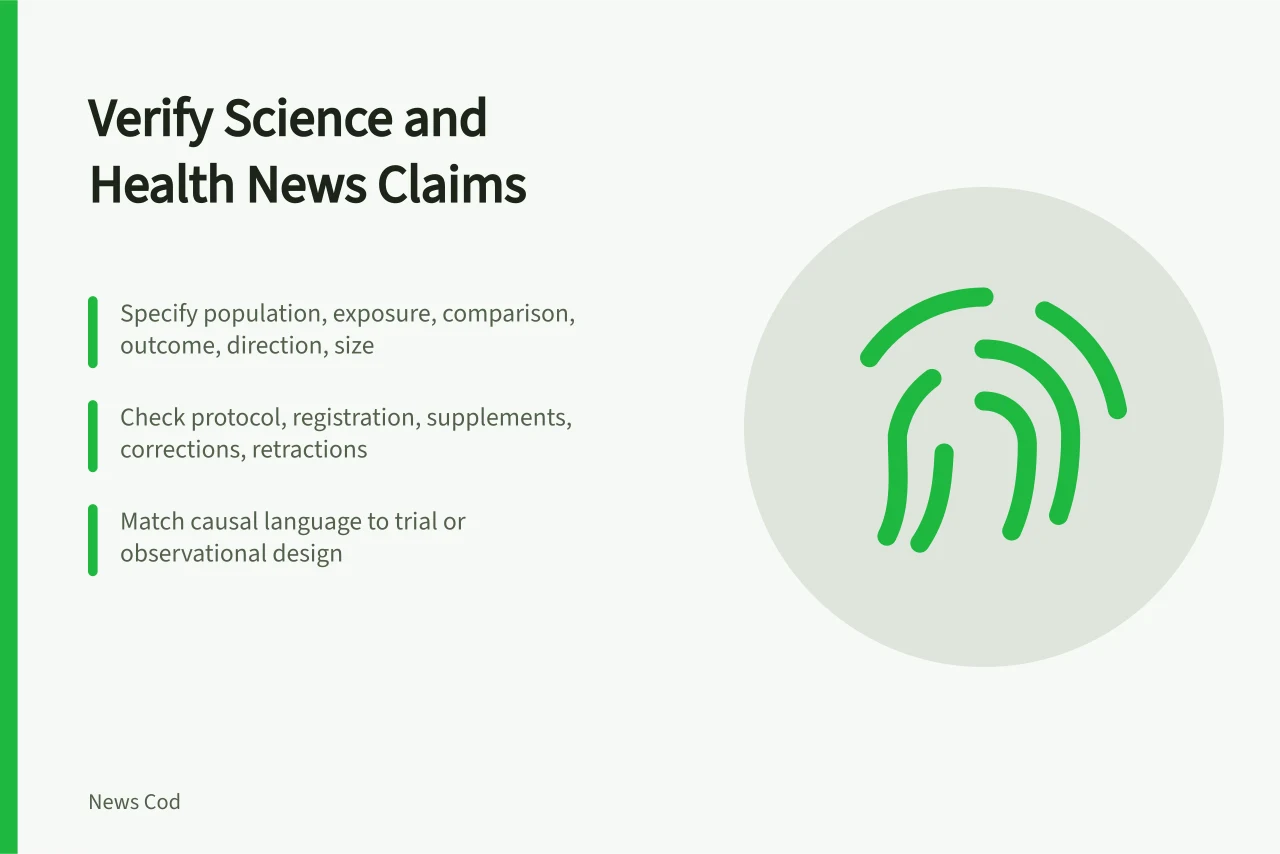
- Write the public claim as five fieldspopulation, exposure, comparison, outcome, and direction and size. A sentence that outruns those fields is not ready.
- Get the paper, the registration, the supplement and the correction record. A release tells you what an institution says, not what the study found.
- Match the verb to the design. "Reduced" needs a credible causal estimate, not an association.
- Give absolute numbers next to relative ones, and carry the confidence interval into the copy.
- Check product status in the regulator's own record, and name which of registered, cleared, authorized or approved applies.
Science coverage is a chain of translations. A researcher turns observations into measurements and a paper. An institution turns the paper into a release.
A reporter turns both into a sentence a reader will repeat at dinner. Each handoff can drop a condition or widen a claim.
Verification walks the chain backward, from the public sentence to the raw evidence.
Write the claim as five fields first
Before you judge whether a claim is true, write down what it actually asserts. Pin down each field:
- Population:Who was studied, including relevant age, health status or other eligibility limits?
- Exposure:What treatment, product, behavior or other factor did participants receive or encounter, and at what dose or level?
- Comparison:What group or condition was it compared with?
- Outcome:What was measured—such as a symptom, diagnosis, laboratory marker or adverse event?
- Direction and size:Which way did the result go, and by how much, using the study's measure and units?
| Field | What to pin down |
|---|
Five claim fields to pin down
- Populationwho was studied
- Exposuredose, behavior, device
- Comparisonagainst what baseline
- Outcomemeasured how, by whom
- Direction and sizehow much
"A supplement protects the heart" usually collapses into something far narrower: adults already at high cardiovascular risk, given a stated dose, showed a lower level of one laboratory marker than a control group after eight weeks. That is a real finding about a marker.
For a claim without a paper attached, map each phrase to one of those fields: identify the population, exposure, comparison and measured outcome, then write the reported direction and size. Mark anything the claim adds that the study did not test—for example, a change in a laboratory marker does not establish protection from a heart attack. The claim mapping guide can serve as a companion to this check.
Assemble the source packet
Pull the fullest research record that exists, in this order:
- The full paper, not only its abstract.
- The study's registry entry and its history; for many US clinical trials, check ClinicalTrials.gov.
- The original protocol and statistical analysis plan, when available.
- The supplement, including detailed methods, outcome tables and adverse-event information.
- Journal correction, expression-of-concern or retraction notices. Check the article's PubMed record for linked notices.
Assemble the source packet
- Paper or preprint, current version
- Protocol, registration, analysis plan
- Supplementary tables and data
- Funding and conflict disclosures
- Journal noticescorrections, retractions
For an approval claim, add the regulator's product record after the research records. Then read the institutional release and independent expert comment against the paper: a release is evidence of what an institution chose to say, not a substitute for the study. An abstract can hide changed outcomes, adverse events, missing data and sensitivity analyses.
Match the design to the question
The National Library of Medicine's chapter on formal trials versus observational studies sets the designs side by side: randomized trials assign an intervention, while observational studies examine exposures as they occur. Randomized placebo-controlled trials remain the standard for judging whether a therapy is safe and effective, but they answer narrow questions.
Trials versus observational studies
Randomized trial
- Question fit
- Narrow questions
- Effect estimates
- Standard for therapy
- Selection
- Randomized allocation
- Blinding
- Investigators and participants
- Missing data
- Attrition handled
Observational study
- Question fit
- Where randomizing impossible
- Effect estimates
- Can overestimate effects
- Selection
- How participants selected
- Blinding
- Often not blinded
- Missing data
- Missing observations handled
Observational work can overestimate treatment effects. It is also the only option where randomizing people is impossible, and a well-built cohort can answer questions no trial will. Judge the design against the question, not against a slogan about evidence rank.
Ask how participants were selected, how comparison groups formed, whether investigators and participants were blinded, and how missing observations were handled. Randomization does not repair a weak outcome measure, heavy attrition or a sample too small for the question.
Compare the plan with the report
Registration records let you see whether the primary outcome, analysis window, eligibility rules or subgroup plan changed between design and publication. Compare the planned and reported versions of each item, along with the analysis method, using the registry history, paper and supplement. A change is not automatically improper. It becomes a reporting problem when a later choice is described as if it had been fixed in advance, or when an unfavorable prespecified result quietly disappears.
| Item | Planned | Reported | Explanation found? |
|---|
Plan versus report audit
- Primary outcomeplanned vs reported
- Measurement timeplanned vs reported
- Sample sizeplanned vs reported
- Exclusionsplanned vs reported
- Main modelplanned vs reported
- Subgroupsplanned vs reported
Ask the authors or sponsor about material differences and report a documented amendment accurately. An unexplained discrepancy is a question, not proof of misconduct.
Read the result in absolute terms
Relative measures flatter small differences. Move an outcome from 2 in 1,000 to 1 in 1,000 and the relative reduction is 50 percent while the absolute reduction is 1 in 1,000. Both numbers are correct. Only the second shows the scale a patient or a policymaker is deciding on.
Relative versus absolute risk
50% relative reduction
2 in 1,000 to 1 in 1,000
Absolute reduction: 1 in 1,000
Only absolute shows the scale
For each main outcome, record the events and totals in each group. Record the absolute risk or mean value. Record the absolute and relative difference. Record the confidence interval. Record the follow-up period. Record losses to follow-up. Record adverse events.
"Not statistically significant" does not mean "no effect." It means the chosen analysis did not separate an effect from noise under its own assumptions. Significance, in the other direction, does not establish clinical importance.
Test the alternative explanations
For observational findings, work through confounding, reverse causation, selection, and recall. Also consider measurement error, missing data, and multiple testing. For trials, inspect allocation, blinding, adherence, and attrition. Also check outcome switching, stopping rules, and whether analysis followed the groups as assigned.
Alternative explanations to test
- Confounding, reverse causation, selection, recall
- Measurement error, missing data, multiple testing
- Allocation, blinding, adherence, attrition
- Outcome switching, stopping rules, assigned groups
- Replication, disagreeing studies, systematic reviews
Then ask whether anyone has replicated it, whether other studies disagree, and whether a systematic review covers the same population and outcome. One new study can shift a body of evidence.
It rarely replaces one by itself.
A case report describes an individual patient's experience; an observational study examines exposures without assigning them; and a randomized trial estimates outcomes after assigning an intervention. A systematic review synthesizes studies that meet defined criteria, while a meta-analysis statistically combines results from multiple studies. These designs answer different questions, so a case report and a meta-analysis should not be presented as if they carry the same weight. The evidence types comparison offers a companion overview.
Check the regulatory status word by word
"FDA registered," "FDA cleared," "FDA authorized" and "FDA approved" are four different things. Each carries its own product record, intended use, population, dose and date. A trial listing on ClinicalTrials.gov does not mean a treatment works, and publication in a journal does not create an approval.
Go to the regulator's decision document rather than the company's press page. For drugs, check Drugs@FDA; for devices, look for the applicable 510(k), De Novo or Premarket Approval (PMA) record, and check the FDA's Emergency Use Authorization records for an EUA. If the study tests an unapproved use of an approved product, say both things in the same sentence. The clinical study story audit covers how to keep the trial, the label and the marketing claim from blending together.
Report funding without treating it as a verdict
Funding, employment, patents, consulting, data access and sponsor control all bear on the risk of bias. None of them proves a result false. Establish who designed the study, who held the data, who ran the analysis, who approved the manuscript, and who paid.
Then evaluate the methods on their own terms, and let readers see the evidence rather than the scoreboard. A Journalist's Resource summary of research on framing scientific errors and trust in science discusses how presenting errors as part of self-correction can support public trust, and notes that American science reporting has leaned toward a broken-or-in-crisis frame.
Write to the strongest supported level
| Evidence supports | Wording that holds |
|---|---|
| Descriptive difference | "was higher" or "was lower" |
| Statistical association | "was associated with" |
| Predictive model | "predicted within this sample" |
| Credible causal estimate | "reduced" or "increased," with scope stated |
| Early or uncertain evidence | "suggests," followed by the limit that matters |
Before publication, read the headline, the deck, the chart caption and the body copy as one document. A qualified body cannot repair an absolute headline, and a chart caption is often the only text a social reader sees. Match the wording to what the evidence supports:
- “Was higher” or “was lower”:Describe an observed difference without implying its cause.
- “Was associated with”:Report a relationship; do not imply that one factor caused the other.
- “Predicted”:Say that a model forecast an outcome, not that the factor caused it.
- “Reduced”:Use causal language only when the design and analysis support a credible causal estimate.
- “Suggests”:Identify the specific finding and keep the uncertainty visible.
Common questions
Does peer review prove a study is correct?
No. It is one round of scrutiny by a few people, done before the data are public. Check the methods, the conflicts, the correction record and whether other studies agree before you treat a finding as settled.
Can an observational study justify causal language?
Sometimes. Some cohort and natural-experiment designs support causal inference when the analysis addresses confounding, selection, timing and measurement, and rules out credible alternatives. Association alone never gets you there.
Should a preprint be ignored?
No, but label it. Say it has not been peer reviewed, check which version you are reading, and look for independent comment. Do not present unsettled findings as established practice.
When does a health story need a safety note?
When a reader could change treatment, delay care or buy a product because of the story. Point individual decisions to a licensed clinician and the current regulator guidance, and keep the reporting on the evidence itself.
In this guide
- How to audit a clinical study story before it runsAudit a clinical study story by pulling the paper, protocol and registry record, then checking every claim, number and quote against the data.
- Health research evidence types compared, from trials to case reportsHealth research evidence types compared across laboratory work, case reports, observational studies, trials, qualitative research, and systematic reviews.
- Science and health story sign-off checklist for editorsA science and health story sign-off checklist for editors: test the draft wording, regulator terms, evidence base and visuals before a health claim runs.
- Common science and health reporting problemsScience and health reporting problems explained, including causal overreach, relative-risk framing, surrogate outcomes, product status, and image claims.
- Fictional case: correcting a retracted health study storyRetracted health study correction case showing how a coding error invalidates a result and how a newsroom repairs its headline, chart, archives, and social claims.